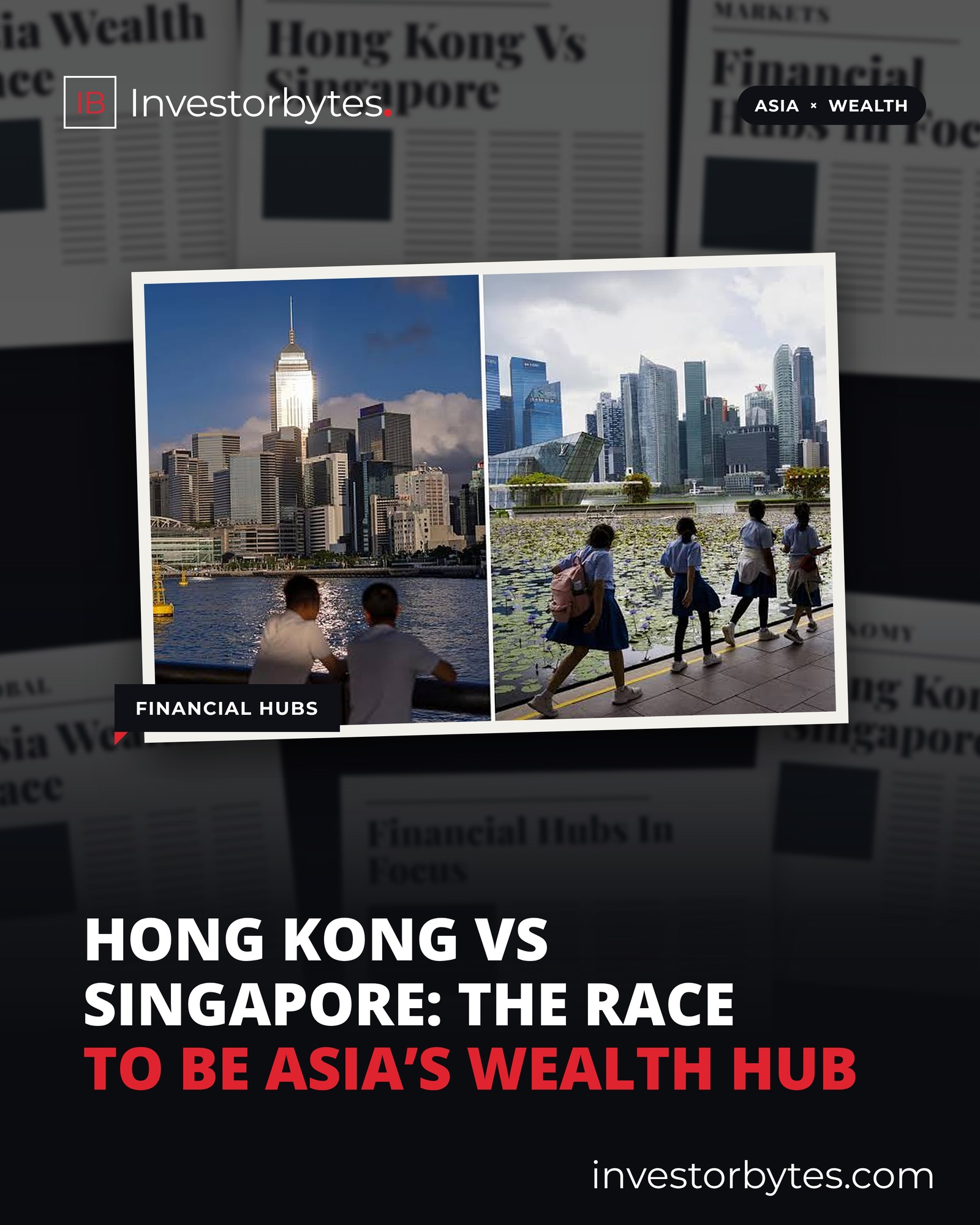
The Hong Kong vs Singapore debate has long been framed as a zero-sum contest for Asia’s financial crown. A closer look suggests something more nuanced. Bloomberg Intelligence projects that both cities will overtake Switzerland as the world’s fastest-growing cross-border wealth hubs, and each is building a distinct identity: one as a high-speed gateway to China, the other as a stable, rules-driven base for Southeast Asia and beyond.
Hong Kong vs Singapore on the fundamentals
Financial superhubs tend to win on three measures: quality of life, career opportunity and proximity to the engines of capital. On the first, Singapore holds an edge. Numbeo’s 2026 Quality of Life Index, published in April, scored Singapore at 159.08 against 130.75 for Hong Kong, with the city-state ahead on purchasing power and pollution while Hong Kong remains competitive on safety and climate.
On overall competitiveness, the two are almost inseparable. The latest Global Financial Centres Index, GFCI 39, places Hong Kong at 765 points and Singapore at 764. Professor Michael Mainelli, chairman of Z/Yen Group and co-creator of the index, characterises the one-point gap as compression at the top rather than convergence. The real differences, he suggests, now emerge in sub-indices covering business environment, human capital and sector specialisation, a picture of differentiated excellence rather than a single winner.
Hong Kong’s comeback as China’s super connector
Hong Kong’s financial history stretches back to the founding of its stock exchange in 1891. Its currency has been pegged to the US dollar since 1983, and the territory returned to China in 1997 under the one country, two systems framework. It became the main offshore renminbi hub in the 2000s and dominated global IPO league tables in the 2010s before a turbulent start to the 2020s.
Momentum has since returned. More than 450 IPO applications are in the pipeline, a figure expected to surpass 2025 activity, and 5,221 start-ups were recorded in 2025, up 11 percent on the previous year. The Top Talent Pass Scheme has helped attract new arrivals, and HSBC’s third Global Investment Summit drew more than 1,500 institutions and 5,200 industry leaders. GFCI 39 ranks Hong Kong first globally for fintech, helped by AI readiness and integration with the Greater Bay Area technology cluster, and nine in 10 local financial institutions are deploying or piloting AI.
The city’s common law system remains an asset for international contracts, and its direct access to mainland capital markets and the world’s largest offshore renminbi pool underpins its role as a super connector. The weaknesses are equally clear: shortages of mid-level talent, capital flows sensitive to geopolitics and mainland policy shifts, and the fact that only 35 percent of firms support AI upskilling, which could weigh on productivity over time.
Singapore’s stability premium
Singapore is often called Asia’s Switzerland, and the label reflects a deliberate strategy of neutrality and predictability. Since the Monetary Authority of Singapore was set up in 1971, the city has built an Asian dollar market, expanded wealth management, weathered the 1997 Asian financial crisis and drawn safe-haven inflows after the 2008 global financial crisis.
Today it is widely seen as winning the family office race, supported by the 13O and 13U tax incentive schemes, strong governance and a growing green finance sector. Ken Ong of recruiter Morgan McKinley notes that compliance has shifted from a support function to a core part of the business as the regulator updates rules frequently, and that the seniority of roles based in Singapore has risen from heads of compliance a decade ago to regional heads today. Google, which opened its first local office in 2007 with 24 staff, now houses nearly 3,000 people at its purpose-built Asia-Pacific headquarters, while Dyson moved its global headquarters there from the UK in 2022.
The costs of that success are rising. Compliance and operating expenses weigh on large funds, Morgan McKinley’s 2026 salary guide points to shortages in AI, data, cybersecurity and sustainability talent, and stringent know-your-customer checks can stretch client onboarding to nine months. Iain Bonner-Fomes of KEY Smart Technologies adds that Singapore’s small geographic footprint is a natural constraint, although its government tends to work more closely with business than Hong Kong’s more individual efforts.
Family offices and the barbell approach
For the wealthy families driving much of this growth, the choice is increasingly not either-or. Jeremy Cheng of the Chinese University of Hong Kong and Lansberg Gersick Advisors says families are adopting a barbell strategy. Satellite offices often give the next generation a genuine operating role, while direct investments are tilting toward AI, biotechnology and transition finance, with ESG viewed as a primary driver of long-term outperformance.
Institutional ties are reinforcing the trend. In April 2026, the Singapore International Chamber of Commerce and the Federation of Hong Kong Industries signed a memorandum of understanding creating reciprocal membership to help members enter each other’s markets and access the Greater Bay Area. SICC chairman Wong Joo Seng frames Singapore as a global and regional base and Hong Kong as the conduit to mainland China, and the agreement is seen as an early building block of an ASEAN to Greater Bay Area corridor. Further detail on the rivalry is set out in World Finance’s analysis of the superhub race.
Conclusion: a partnership, not a race
Viewed through a portfolio lens, the Hong Kong vs Singapore question looks less like a race and more like a division of labour. Singapore offers stability in treasury, governance and wealth preservation, plus growing links to India and the Middle East. Hong Kong offers speed in capital raising, deep liquidity and direct access to China’s growth. Investors who rely on only one hub take on concentrated exposure to its particular risks.
As Asia’s share of global wealth grows, the most successful firms and families are likely to be those that combine both centres into a single diversified, resilient network. In the Hong Kong vs Singapore contest, the ultimate winners may be the investors who refuse to pick a side.