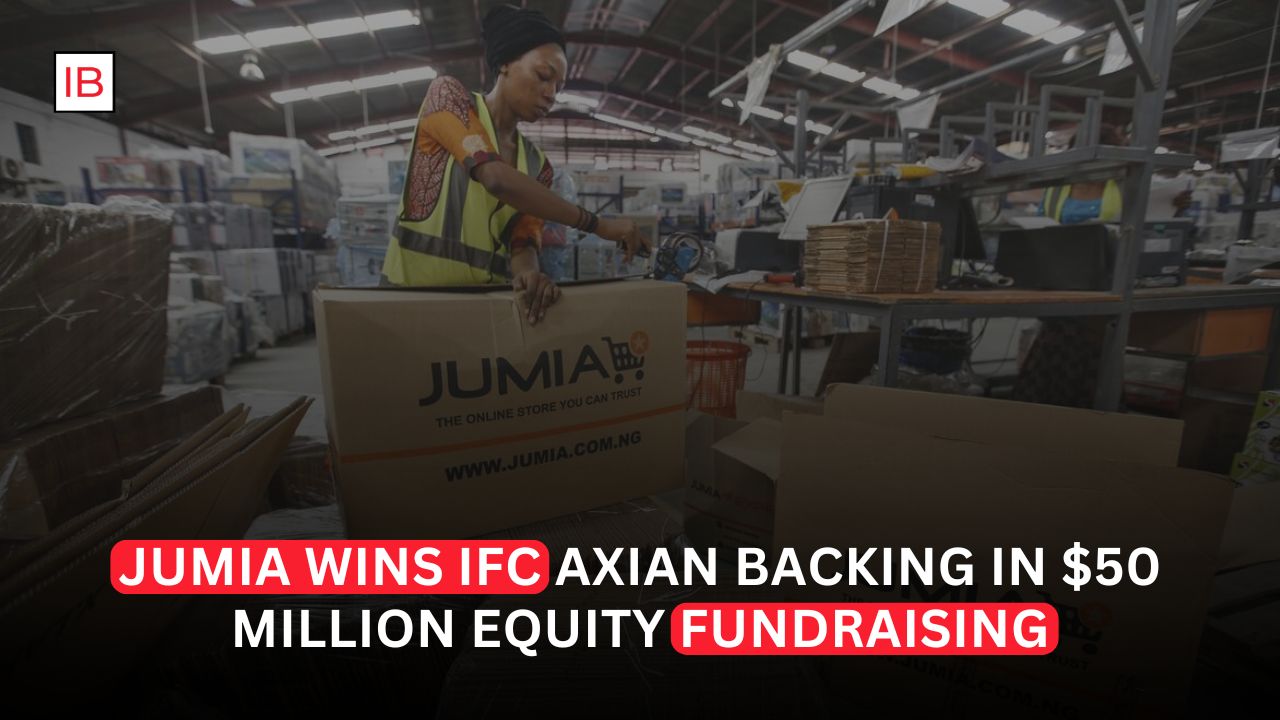
Jumia Technologies is securing a fresh $50 million equity investment from the International Finance Corporation and Axian, giving the African e-commerce company additional capital as it attempts to accelerate growth and move closer to profitability.
The funding comes at a critical stage for Jumia. The company has spent the past several years cutting costs, restructuring its operations and narrowing its geographic focus after years of heavy cash consumption. Jumia has previously targeted full-year profitability in 2027, making access to new capital particularly important as management tries to balance investment with financial discipline.
The deal also deepens Axian’s relationship with Jumia. Axian’s CEO, Hassanein Hiridjee, was formally elected to Jumia’s Supervisory Board earlier this year, signaling that the relationship is becoming more strategic rather than simply financial.
Why the $50 Million Matters
For Jumia, the biggest issue has never simply been demand.
Africa has a huge and increasingly connected consumer population, but e-commerce companies face difficult operating conditions, including fragmented logistics networks, currency volatility, limited payment infrastructure and relatively low online retail penetration.
That makes capital efficiency critical.
Jumia previously pursued an aggressive expansion strategy across the continent, but the company later shifted toward a more disciplined model focused on its strongest markets and improving unit economics.
The new $50 million gives management additional financial flexibility without relying entirely on debt.
That distinction matters because taking on substantial debt while the company is still working toward profitability could increase financial pressure.
Equity financing, by contrast, does dilute existing shareholders, but it does not create the same fixed repayment burden.
IFC’s Participation Is Significant
The participation of the International Finance Corporation, the World Bank Group institution focused on private-sector development in emerging markets, provides more than capital.
IFC investments can also serve as a signal to other institutional investors that a company has passed a certain level of financial and operational scrutiny.
That can be particularly valuable for an African technology company operating across multiple difficult markets.
Jumia’s challenge is not just attracting consumers.
It needs to convince suppliers, merchants, logistics partners and investors that its business model can eventually generate sustainable returns.
Institutional backing can strengthen that credibility.
Axian’s Role Is More Strategic
Axian’s involvement is arguably the more interesting part of the transaction.
The pan-African group operates across telecommunications, digital services and financial technology, giving it businesses that could complement Jumia’s e-commerce platform.
Axian already has a significant presence across African markets and has been expanding its digital infrastructure and financial-services operations. Its own materials describe the group as focused on digital inclusion and access to mobile services in developing markets.
That creates potential strategic connections.
Jumia brings e-commerce, merchants, logistics and consumer relationships.
Axian brings telecom infrastructure, mobile connectivity and financial services.
In theory, combining those ecosystems could help both companies increase customer engagement.
But the Investment Does Not Solve Jumia’s Core Problem
The biggest mistake would be to interpret the $50 million as proof that Jumia has already solved its profitability problem.
It hasn’t.
Fresh capital buys time and creates room for investment, but it does not automatically produce better unit economics.
Jumia still needs to demonstrate that every additional customer, order and delivery can generate attractive economics.
That is particularly important in African markets, where logistics can be expensive and consumer purchasing power varies considerably between countries.
The company’s own previous guidance has emphasized reducing cash burn and reaching breakeven before moving toward full-year profitability.
The real test therefore remains operational execution.
Jumia’s Turnaround Has Already Changed the Business
Jumia is no longer pursuing the same “growth at all costs” strategy that characterized its earlier years.
The company has reduced its footprint and focused resources on markets where it believes it can build stronger economics.
That approach has produced signs of improvement.
Earlier results showed significant growth in orders and gross merchandise value in key markets, while management continued to emphasize cost control and the path toward profitability.
The challenge is maintaining that growth without allowing expenses to rise at the same pace.
That is where the new funding could become useful.
Instead of spending aggressively everywhere, Jumia can direct capital toward the markets, logistics infrastructure and technology initiatives that produce the strongest returns.
Africa’s E-Commerce Opportunity Remains Large
The long-term opportunity behind the investment is difficult to ignore.
Africa’s population is growing rapidly, smartphone adoption is increasing and more consumers are gaining access to digital payments.
Yet online commerce remains relatively underdeveloped compared with markets such as China, the United States and parts of Europe.
That creates a potentially enormous addressable market.
But potential market size should not be confused with guaranteed profitability.
Africa is not one market.
It is a collection of countries with different currencies, regulations, consumer preferences, infrastructure and levels of digital adoption.
Jumia has learned this lesson the hard way.
A strategy that works in Nigeria may not work in Egypt or Kenya.
That makes local execution more important than simply achieving continental scale.
Nigeria Remains Particularly Important
Nigeria is one of the most important markets in Jumia’s portfolio because of its enormous population and growing digital economy.
Strong performance there can have a meaningful effect on the company’s overall results.
But Nigeria also presents major challenges.
Currency fluctuations can complicate financial planning, while inflation can reduce consumers’ purchasing power.
Logistics and payment infrastructure remain critical issues.
Jumia therefore has to build a business that can remain viable even when macroeconomic conditions become difficult.
Axian Could Provide an Important Advantage
This is where Axian’s presence across Africa becomes relevant.
Telecom networks give the group direct relationships with millions of consumers.
Mobile money and digital financial services can potentially complement e-commerce transactions.
And broader digital infrastructure can help expand access to online services.
The connection is not automatically valuable, however.
The companies still need to demonstrate that their businesses can generate measurable synergies.
Simply having overlapping customers does not guarantee that cross-selling will work.
The Earlier Takeover Speculation Matters
Axian’s relationship with Jumia also has an interesting history.
In 2025, reports emerged that Axian was exploring a possible takeover of Jumia. At the time, Jumia’s relatively modest market capitalization made it a potentially attractive strategic target for a large African telecom and digital-services group.
The current equity backing is not the same thing as an acquisition.
Investors should not automatically interpret the transaction as evidence that Axian intends to buy Jumia outright.
However, Axian’s increasing involvement does show that the company sees strategic value in Jumia.
The investment, board representation and operational relationship could potentially evolve over time, but that remains speculation rather than an announced transaction.
Shareholders Face a Trade-Off
For existing Jumia shareholders, the funding presents both a positive and a negative.
The positive is obvious: the company receives capital to fund growth and execute its turnaround.
The negative is dilution.
When a company raises equity, existing shareholders own a smaller percentage of the business unless they participate in the financing.
The key question is therefore whether the capital creates enough additional value to compensate for that dilution.
If Jumia uses the money to expand profitable operations, improve logistics and reach sustainable profitability, the financing could ultimately strengthen shareholder value.
If the company simply uses the cash to delay another restructuring, the benefits will be much smaller.
The 2027 Profitability Target Is Crucial
Jumia’s stated objective of reaching full-year profitability in 2027 gives investors a clear benchmark.
That deadline matters because the company cannot depend indefinitely on external capital.
A successful turnaround should eventually produce enough operating cash flow to fund expansion internally.
The $50 million therefore should be viewed as growth capital during a transition period, not as a substitute for a profitable business model.
Investors will increasingly focus on whether revenue growth is translating into improving margins and lower cash consumption.
What Investors Should Watch
Several indicators will determine whether the investment is producing results.
Orders: Sustainable growth in transaction volumes would indicate stronger consumer engagement.
GMV: Rising gross merchandise value would demonstrate increased activity across the marketplace.
Active customers: Customer growth matters, but repeat purchasing is even more important.
Fulfillment costs: Lower delivery and logistics costs could materially improve unit economics.
Cash burn: This is perhaps the most important metric during the transition to profitability.
2027 guidance: Any delay to the profitability target could undermine investor confidence.
The Bigger Picture
The Jumia deal reflects a broader trend in African technology.
The market is moving away from the era when startups could raise enormous amounts of money simply by promising future growth.
Investors are increasingly demanding evidence of sustainable economics.
That makes Jumia’s current strategy fundamentally different from its earlier expansion phase.
The company now has to prove that African e-commerce can be both large and profitable.
The $50 million investment from IFC and Axian gives Jumia more room to attempt that.
But it also raises expectations.
With institutional investors and a strategically involved African technology group behind it, Jumia has less room for another prolonged period of weak execution.
The next stage of the company’s story will therefore be determined less by how much money it can raise and more by what it can accomplish with that money.
If Jumia can convert the new capital into stronger customer retention, better logistics economics and sustained revenue growth, the financing could mark an important step in its turnaround.
If not, another capital injection will simply postpone the underlying problem.
For now, the $50 million gives Jumia something it has needed for years: financial breathing room while it tries to turn Africa’s enormous e-commerce opportunity into a consistently profitable business.