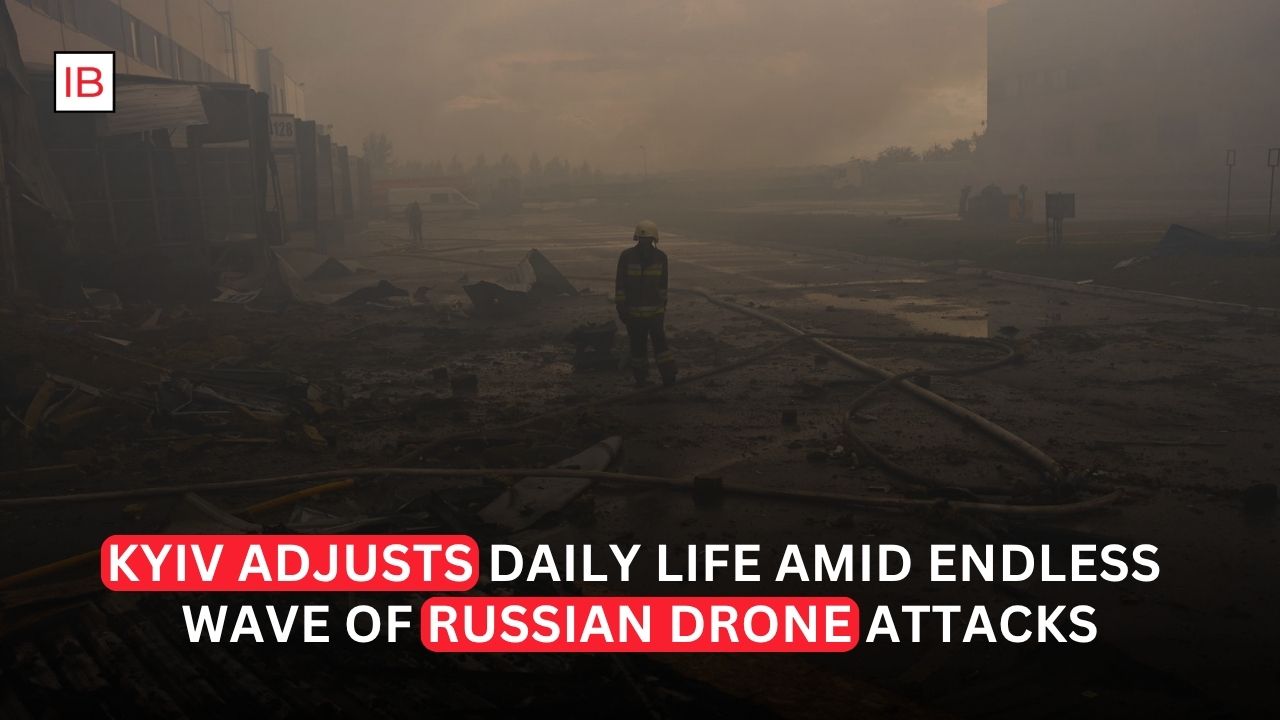
Kyiv is being forced to adapt to a new phase of Russia’s aerial campaign as faster, jet-powered drones increasingly strike the Ukrainian capital during both day and night. The change is disrupting daily life across the city and putting additional pressure on Ukraine’s already stretched air-defense network. Reuters reported on September 5 that the attacks have become increasingly frequent, with commuters, schools, businesses and essential services all affected by the continuing threat.
For residents of Kyiv, the biggest change is the disappearance of a predictable pattern. Earlier in the war, Russian drone and missile attacks were often concentrated during nighttime hours. The growing use of faster drones has made that distinction less meaningful, leaving residents facing the possibility of an air raid at almost any time.
That shift has consequences far beyond the immediate damage caused by individual strikes. Public transportation can be suspended during alerts, schools have to move children into shelters and businesses can be forced to pause operations. Grocery deliveries and other supply chains can also be disrupted when workers and vehicles are unable to operate normally during attacks. Reuters reported that some Kyiv residents are increasingly considering whether they can continue living in the city as the attacks intensify and winter approaches.
The technological change behind the attacks is particularly important. Russia has increasingly deployed Shahed-type drones equipped with jet engines rather than conventional propellers. Reuters previously reported that these jet-powered versions can reach speeds of up to about 500 kilometers per hour, substantially reducing the time available for Ukrainian forces to detect and intercept them.
Speed changes the economics and mechanics of air defense. Ukraine has traditionally relied on a combination of fighter aircraft, surface-to-air missile systems, electronic warfare and lower-cost interceptors to deal with incoming drones. Faster targets can reduce the effectiveness of some of those measures and force defenders to use more expensive systems.
That creates a difficult calculation for Kyiv. Russia can potentially send large numbers of relatively inexpensive drones, while Ukraine cannot afford to respond to every target with its most expensive air-defense missiles. The challenge is therefore not simply destroying drones but developing a layered defense that can deal with different threats at sustainable cost.
Ukraine has already been working on new interceptor drones and other technologies designed specifically to counter the changing threat. The need for those systems has become more urgent as Russian forces have increased the use of jet-powered drones. Reports have indicated that the newer aircraft are harder to intercept because of their speed and reduced reaction time.
The pressure on Ukraine’s defenses has also been intensified by shortages of some Western-supplied air-defense equipment. Patriot systems and other advanced interceptors remain valuable for defending major cities and critical infrastructure, but their limited availability means Ukraine must carefully allocate them against the most dangerous incoming weapons.
That problem was visible during earlier attacks on Kyiv. On September 1, Russian air attacks killed 12 people in Kyiv and the surrounding region, according to Ukrainian authorities cited by Reuters. The attacks demonstrated the human cost of sustained aerial bombardment and the difficulty of maintaining effective protection against large-scale drone and missile attacks.
The September attacks have also shown that Russia is not simply increasing the number of weapons it launches. It is changing how those weapons are used. The shift toward repeated attacks throughout the day appears designed to keep Ukraine’s population under continuous pressure while forcing air-defense units to remain operational for extended periods.
That creates fatigue among both civilians and defenders.
For civilians, constant air-raid alerts can make ordinary activities increasingly difficult. A school day can be interrupted without warning. Public transportation can stop. Workers may have to move underground. Residents may sleep in shelters or remain close to protected spaces because they cannot predict when another attack will begin.
The psychological effect is significant. The objective of an aerial campaign is not limited to physical destruction. Repeated attacks can also undermine confidence in public safety and create pressure on people to leave cities that remain under threat.
Kyiv’s residents, however, have demonstrated considerable resilience. Schools continue operating, often using underground shelters, while businesses and public services attempt to function between alerts. The city has developed routines for responding to attacks, but the increasing frequency means those routines are being tested more severely.
The attacks are also affecting the economic life of the capital. Frequent interruptions can reduce working hours, complicate deliveries and increase the cost of operating businesses. Retailers may face shortages when distribution networks are disrupted, while employees may be unable to reach workplaces during prolonged alerts.
This creates a broader problem for Ukraine. The country’s economy has already been operating under the enormous pressure created by the war. Keeping Kyiv functioning is therefore not only a humanitarian priority but also an economic and political one.
The timing is particularly difficult as winter approaches. Ukraine has repeatedly faced Russian attacks against energy infrastructure during colder months, when damage to electricity, heating and water systems can have especially severe consequences. A sustained campaign involving faster drones could make protecting those systems even more difficult.
Russia’s strategy also places pressure on Ukraine’s Western partners. Kyiv needs additional air-defense missiles, radar systems and other equipment, but Western countries have their own stockpile limitations. The increasing sophistication and speed of Russian drones could therefore increase the demand for cheaper, scalable interception technologies rather than relying exclusively on traditional missile systems.
For Ukraine, developing domestic production could become increasingly important. Local interceptor drones can potentially be produced faster and at lower cost than some conventional air-defense missiles. The country has already become a major testing ground for drone warfare, with both sides rapidly adapting their technologies and tactics.
The aerial conflict is consequently becoming an arms race in which speed, cost and volume matter as much as destructive power.
Russia’s use of jet-powered drones is one part of that evolution. The drones are not necessarily replacing traditional missiles or slower drones. Instead, they add another layer to Russia’s arsenal, forcing Ukrainian defenders to identify and respond to a wider range of threats.
For Kyiv, the immediate goal is to prevent those changes from overwhelming the city’s defenses. That means combining advanced Western air-defense systems with electronic warfare, fighter aircraft, mobile defenses and newly developed interceptor drones.
But the problem cannot be solved entirely through military technology. The longer the attacks continue, the greater the pressure on civilian infrastructure and public morale.
The latest wave of attacks also comes amid renewed diplomatic activity surrounding the war. U.S. envoys are expected to visit Moscow and Kyiv as efforts to restart negotiations continue, even as attacks intensify. The contrast between diplomatic discussions and continuing violence highlights how difficult it remains to translate political engagement into an actual reduction in hostilities.
For Kyiv, the immediate reality remains the same: the city has to function while under attack.
Russia’s shift toward faster, jet-powered drones has removed some of the predictability that previously allowed residents and authorities to prepare for attacks primarily at night. Now, the threat can arrive throughout the day, forcing the capital to operate around air-raid alerts.
Ukraine’s ability to adapt will depend on whether it can expand its air-defense capacity, develop cheaper interception technologies and secure enough Western support to protect its most important cities and infrastructure.
The challenge is enormous. But Kyiv’s response shows that the aerial war is no longer only a contest over which side possesses more weapons. It is increasingly a contest over which side can adapt faster, defend more efficiently and sustain its population under relentless pressure.
As Russia continues refining its drone campaign, Kyiv is once again being forced to change the way it lives, works and defends itself. The coming months will show whether Ukraine can turn that adaptation into an effective answer to a threat that is becoming faster, more frequent and increasingly difficult to predict.