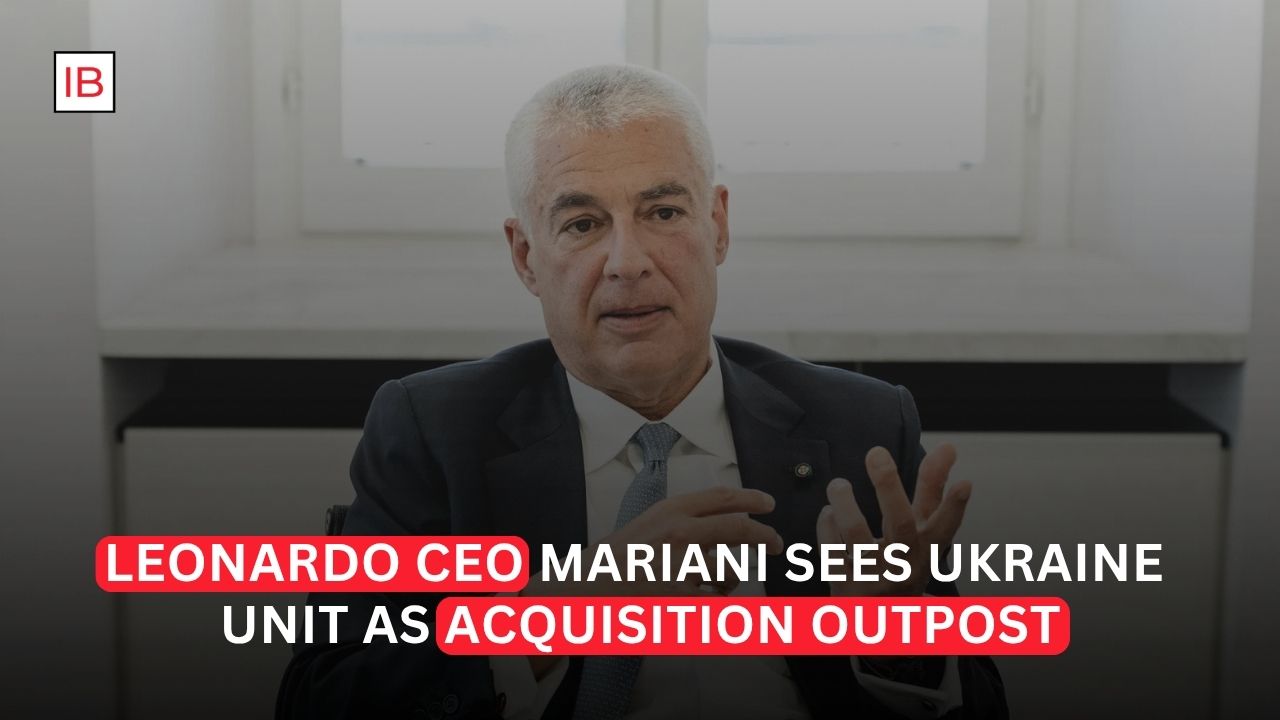
Italian defense giant Leonardo is positioning its new Ukrainian operation as more than a local presence, with Chief Executive Officer Lorenzo Mariani viewing the business as a potential platform for partnerships, technology development and acquisitions as Europe accelerates its military buildup.
The company has established Leonardo Ukraine in Kyiv, a wholly owned subsidiary created as the Italian defense group seeks closer cooperation with Ukraine’s rapidly developing military-technology industry. The move gives Leonardo a direct foothold in a country that has accumulated extensive battlefield experience in drones, electronic warfare, navigation and other technologies during its war with Russia.
For Mariani, that experience represents an increasingly important strategic asset for European defense companies. Ukraine has spent more than four years adapting military systems under real combat conditions, producing technologies that can be developed and modified rapidly in response to battlefield requirements.
Leonardo has been particularly interested in Ukraine’s drone industry. Mariani has argued that European defense companies should develop forms of cooperation with Ukrainian manufacturers to take advantage of expertise built during the conflict. The company’s new Ukrainian subsidiary could provide a local structure through which those partnerships can be developed and potentially expanded.
The strategy reflects a fundamental change in the European defense market. Russia’s invasion of Ukraine has pushed European governments to increase military spending, rebuild weapons inventories and accelerate the development of new technologies. That has created opportunities for established defense companies such as Leonardo, while also increasing the value of smaller technology firms with experience in emerging areas such as autonomous systems and artificial intelligence.
Ukraine has become a particularly important source of that expertise.
The country has developed a large defense-technology ecosystem centered on drones, electronic warfare, battlefield communications and artificial intelligence. Companies are able to test systems under conditions that would be impossible to reproduce in conventional military laboratories, creating a rapid feedback loop between soldiers, engineers and manufacturers.
That environment is attractive to European defense groups seeking to understand how warfare is evolving.
Leonardo’s new company in Kyiv was registered in May 2026 and is focused primarily on research and development in scientific and engineering fields involving optical and navigation systems. Its corporate scope is broader, however, covering areas including telecommunications equipment, measurement and navigation instruments, specialized machinery, software, information technology services and electronic and optical systems.
The structure suggests that Leonardo intends to use the Ukrainian operation as a flexible base for future activities rather than simply as a representative office.
One of the immediate areas of interest is unmanned technology. Drones have become central to the war in Ukraine, with inexpensive systems increasingly capable of surveillance, precision strikes and battlefield coordination. Ukraine has also developed sophisticated approaches to countering drones, making the country relevant not only to offensive unmanned systems but also to air defense and electronic warfare.
Leonardo’s interest extends beyond drones. The company plans to test its Michelangelo Dome integrated air-defense system in Ukraine, potentially allowing the system to be evaluated in an environment where missile, drone and electronic threats are continuously evolving.
The company has described Michelangelo Dome as a multidomain defense architecture capable of complementing existing systems such as the US Patriot and European SAMP/T platforms. Leonardo sees a potentially large international market for the technology over the next decade.
Testing in Ukraine could provide Leonardo with valuable information about how different threats interact in real combat conditions. For defense manufacturers, battlefield data has become an increasingly important component of weapons development, particularly as artificial intelligence and autonomous systems become more prominent.
That makes Ukraine strategically different from a conventional export market. Rather than simply selling equipment to Kyiv, European companies can potentially learn from Ukrainian forces while developing technologies that could later be offered to other European militaries.
Leonardo is already pursuing broader industrial partnerships in this direction. The company has announced cooperation with Turkish drone manufacturer Baykar through a joint venture, reflecting its wider effort to strengthen its position in unmanned systems and next-generation defense technology.
The Ukrainian market could eventually provide another avenue for this strategy, including partnerships with local companies and potentially acquisitions. For Mariani, the country’s growing technology sector offers access to expertise that could complement Leonardo’s existing capabilities.
The potential acquisition angle is particularly significant because Europe’s defense industry is entering a period of consolidation. Governments are demanding faster production, greater technological independence and more integrated European defense capabilities. Established companies therefore have an incentive to acquire smaller specialists with valuable intellectual property, engineering talent or battlefield-tested products.
Ukraine’s defense sector contains many companies that have developed technologies at extraordinary speed. Some have focused on long-range drones, others on autonomous navigation, electronic warfare, battlefield data or counter-drone systems.
For Leonardo, establishing a direct presence in Kyiv could make it easier to identify promising technologies and potential partners.
The strategy also fits with Mariani’s broader effort to increase Leonardo’s production capacity. At the Farnborough International Airshow in July, he said the company was entering a phase in which it needed to accelerate, expand production capacity and sustain growth. He described Leonardo as having a strong order backlog and solid industrial foundations.
Europe’s defense spending boom provides the demand necessary for that expansion. Governments across the continent are reassessing military capabilities after years of relatively low spending and limited weapons production. The war in Ukraine has exposed shortages in ammunition, air-defense systems, drones and other equipment while demonstrating the speed at which battlefield technology can evolve.
Leonardo is therefore attempting to position itself at the intersection of several long-term trends: European rearmament, Ukrainian defense innovation, unmanned warfare and the increasing use of artificial intelligence in military systems.
The Ukrainian operation could also strengthen Italy’s industrial relationship with Kyiv. As European governments seek closer cooperation with Ukraine’s defense sector, having a permanent corporate presence in the country could give Leonardo an advantage in future government programs and industrial partnerships.
There are nevertheless significant risks.
Operating in Ukraine means dealing with an active war zone and the physical and security risks that accompany it. The country’s defense companies are themselves operating under extraordinary conditions, while intellectual property, financing and production arrangements can present additional challenges.
There is also no guarantee that every Ukrainian technology will translate effectively into European defense procurement programs. Battlefield requirements can differ from those of NATO militaries, and systems optimized for the Ukrainian conflict may require substantial adaptation before being deployed elsewhere.
For Leonardo, the challenge will therefore be identifying technologies with broader commercial and military potential rather than simply acquiring capabilities because they have performed well in Ukraine.
The opportunity, however, is difficult for European defense companies to ignore.
Ukraine has effectively become one of the world’s largest real-world laboratories for modern warfare. Its military and private defense sector have developed sophisticated approaches to unmanned systems, electronic warfare and battlefield data at a pace that traditional procurement systems in Europe have struggled to match.
Leonardo’s decision to establish a dedicated company in Kyiv indicates that the group wants direct access to that ecosystem.
If the strategy succeeds, Leonardo Ukraine could evolve from a small research and development operation into a much broader industrial platform, supporting joint ventures, technology development, production agreements and acquisitions.
That would give Leonardo a potentially valuable bridge between Europe’s established defense industry and Ukraine’s rapidly evolving military-technology sector.
For Mariani, the opportunity is ultimately larger than Ukraine itself. The objective is to turn lessons and technologies developed under wartime conditions into capabilities that can strengthen Leonardo’s position in Europe’s emerging defense market.
As European governments prepare for higher military spending and Ukraine continues to refine technologies at the frontline, Leonardo is betting that proximity to Ukrainian innovation will become a competitive advantage.
The new Kyiv operation may therefore be small today, but its strategic significance could grow rapidly. If Leonardo can successfully convert Ukraine’s battlefield expertise into partnerships, acquisitions and commercially viable defense systems, the subsidiary could become an important part of the company’s expansion strategy—and a model for how Europe’s defense industry engages with Ukraine after years of war.