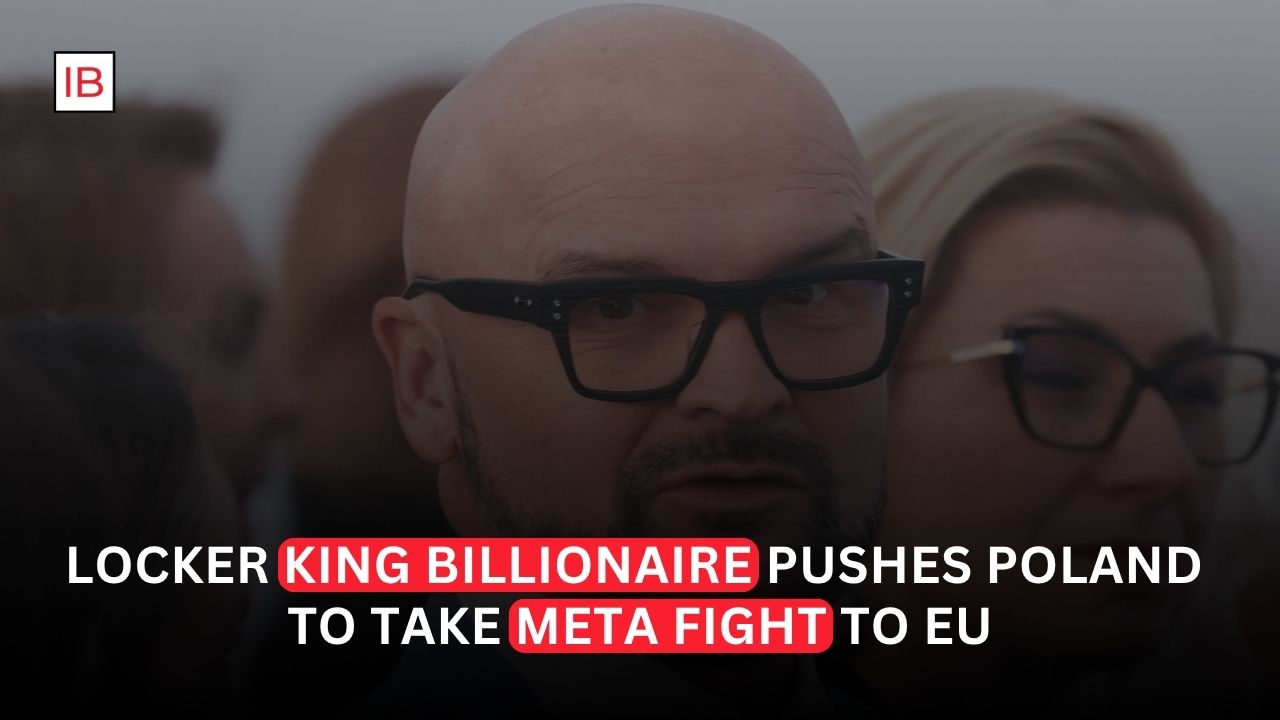
Polish billionaire Rafał Brzoska is escalating his long-running battle with Meta, arguing that Poland should take the fight against fraudulent deepfake advertisements to the European Union. The founder of parcel-locker company InPost has become one of the most prominent European critics of Meta’s handling of scams that use artificial intelligence to imitate famous people.
Brzoska’s dispute began after fake advertisements appeared on Facebook and Instagram using his image and that of his wife, television personality Omena Mensah. The advertisements were linked to fraudulent investment schemes and other false claims. The businessman has argued that Meta should bear greater responsibility when its advertising systems are used to distribute scams.
The ‘Locker King’ Takes on Meta
Brzoska earned the nickname “Locker King” through his success building InPost into one of Europe’s leading parcel-locker networks.
But his current fight has little to do with logistics.
Instead, he is attempting to force one of the world’s largest technology companies to take greater responsibility for advertisements distributed through its platforms.
The dispute has become increasingly important because artificial intelligence has made it much easier for criminals to create convincing fake videos, photographs and audio recordings.
A famous person’s face can now be copied and inserted into an advertisement within minutes, creating an illusion of credibility that can persuade victims to send money or invest in fraudulent schemes.
How the Dispute Started
Brzoska and Mensah complained after discovering numerous fake advertisements using their images.
Some of the fraudulent material reportedly contained false and damaging claims about the couple.
Poland’s Personal Data Protection Office responded by imposing a temporary three-month restriction on Meta’s use of their personal data and images for such advertisements. The decision was notable because it represented an unusually direct intervention against a major technology platform.
However, Brzoska said the problem did not disappear.
New fake advertisements continued to appear, strengthening his argument that removing individual pieces of content is not enough.
The Problem Goes Beyond One Billionaire
Brzoska’s campaign has increasingly focused on the broader problem of celebrity and public-figure deepfakes.
He has said that numerous well-known Polish figures have had their identities exploited by fraudulent advertisements.
The logic behind these scams is simple.
A recognizable person provides instant credibility.
An advertisement featuring a respected entrepreneur, celebrity, politician or financial expert can look more trustworthy than an anonymous investment promotion.
Artificial intelligence makes it possible to manufacture that credibility without the person’s permission.
This has created a new business model for online fraud.
Why Advertising Is Different
One of Brzoska’s strongest arguments concerns the difference between ordinary user-generated content and paid advertising.
Meta can argue that billions of posts are uploaded to its platforms and that it cannot manually inspect every piece of content before publication.
Advertising is different.
Advertisers pay Meta.
The platform’s systems review advertisements, determine where they are shown and use algorithms to target particular audiences.
That creates an argument that Meta has a more active role in commercial advertising than it does in ordinary user posts.
Brzoska wants regulators and courts to take that distinction seriously.
Meta’s Defense
Meta has rejected the suggestion that it knowingly supports fraudulent advertising.
The company has said that scam content violates its rules and that it removes fraudulent material when it identifies it. Meta has also pointed to cooperation with businesses, law enforcement and government authorities to combat online fraud.
The central disagreement is therefore not whether scams should be removed.
Both sides agree on that.
The dispute is about responsibility.
Brzoska’s position is that platforms should face stronger consequences when their systems repeatedly allow fraudulent advertisements to reach users.
Meta’s position is that it already invests heavily in detecting and removing scams and that criminals constantly adapt their methods.
Why the EU Matters
Taking the dispute to the European Union could significantly increase the pressure on Meta.
The EU has developed some of the world’s strongest regulations governing large technology platforms.
The Digital Services Act has created broader obligations for major online platforms, including requirements relating to illegal content, advertising transparency and systemic risks.
European regulators have also demonstrated that they are willing to impose significant restrictions and penalties on technology companies.
For Brzoska, the EU therefore offers a larger regulatory arena than a dispute limited to Poland.
Poland Could Become a Test Case
The case is particularly important for Poland because the country could become an early testing ground for how European law applies to AI-generated advertising scams.
If Polish regulators push the issue at the European level, other governments could follow.
That could eventually produce common standards for how platforms must respond when criminals use AI-generated images and videos of real people.
The implications would extend well beyond Poland.
Deepfakes Are Changing Online Fraud
The technology behind deepfakes is developing rapidly.
A few years ago, convincing synthetic video required considerable technical expertise.
Today, consumer-level AI tools can generate realistic images, voices and videos with relatively little effort.
That changes the economics of fraud.
The cost of producing a scam falls, while the potential audience remains enormous.
Criminals can therefore run multiple campaigns simultaneously and quickly replace advertisements that are removed.
This creates a difficult problem for platforms.
They are not fighting a fixed number of scams.
They are fighting an adaptable system capable of generating new fraudulent content continuously.
Removing Individual Ads May Not Be Enough
This is one of the most important issues raised by Brzoska’s campaign.
If criminals can create hundreds of new advertisements after previous ones are removed, content moderation becomes a game of constant catch-up.
A more effective approach may require platforms to identify the underlying networks behind the scams.
That could include examining advertiser identities, payment methods, landing pages, targeting patterns and repeated use of stolen images.
The goal would be to stop fraudulent campaigns before they scale.
The Financial Incentive Is Important
Brzoska has also questioned the economics of fraudulent advertising.
Meta earns money when advertisements run on its platforms.
That creates an obvious incentive for regulators to examine whether the company’s commercial systems are doing enough to prevent fraudulent advertisers from exploiting them.
The argument is not necessarily that Meta wants fraud to occur.
The issue is whether its incentives are strong enough to ensure that fraud is detected quickly and prevented from returning.
That distinction could become central to future legal battles.
The Case Has International Precedents
Brzoska’s dispute is not happening in isolation.
Meta has faced increasing scrutiny over scams involving fake celebrity endorsements and AI-generated content.
In the United States, Australian billionaire Andrew Forrest has pursued legal action against Meta over the fraudulent use of his image in cryptocurrency promotions. A US judge allowed the case to proceed despite legal protections traditionally available to online platforms.
That suggests the legal environment around deepfake advertising may be changing.
Courts are increasingly being asked to determine whether existing rules were designed for a digital environment that no longer exists.
AI Creates a New Legal Problem
Traditional internet law developed around a relatively simple distinction.
A platform hosted content created by someone else.
AI-generated advertising complicates that model.
The content may be produced by criminals, but the platform controls the advertising infrastructure, targeting system and distribution mechanism.
That creates a gray area between hosting content and actively facilitating commercial distribution.
Brzoska’s campaign is effectively asking regulators to decide where that line should be drawn.
The Stakes for Meta Are Larger Than One Case
Meta operates Facebook and Instagram across the world.
A regulatory precedent in one European country could eventually influence other jurisdictions.
If regulators conclude that platforms have greater responsibility for fraudulent advertisements, Meta and other technology companies could face higher compliance costs.
They might need to introduce stronger advertiser verification systems, more aggressive identity checks and additional monitoring of financial advertisements.
That could make online advertising more expensive and potentially reduce the number of fraudulent campaigns.
But Regulation Has a Trade-Off
There is also a risk in imposing overly broad liability.
Meta processes enormous amounts of content every day.
If platforms become legally responsible for every fraudulent advertisement that slips through, they may respond by aggressively removing legitimate content.
That could create problems for free expression and legitimate commercial activity.
The challenge for regulators is therefore to establish rules that target negligence and systemic failures without making platforms responsible for every individual criminal act.
The Role of Identity Verification
One possible solution is stronger advertiser verification.
Financial advertisements could require additional checks before being distributed.
Advertisers using the image or voice of a public figure could also be required to demonstrate authorization.
Platforms could potentially use AI to detect manipulated images and videos before advertisements go live.
However, criminals are also using AI.
That creates an ongoing technological arms race.
Why Public Figures Are Vulnerable
Public figures are particularly attractive targets because their identities carry commercial value.
A fake advertisement featuring an unknown person may attract little attention.
The same advertisement featuring a billionaire or respected business executive can generate thousands of clicks.
Brzoska’s experience demonstrates how reputational capital has become an asset that criminals can steal digitally.
The victim is not only the person whose image is copied.
Consumers who believe the fake advertisement can lose money as well.
The Issue Could Affect Financial Markets
Deepfake scams are increasingly connected with investment fraud.
Fraudulent advertisements may promote fake trading platforms, cryptocurrency schemes, artificial-intelligence investments or supposedly exclusive financial opportunities.
That makes the issue relevant to financial regulators as well as technology regulators.
If social-media platforms become major distribution channels for investment scams, authorities may increasingly demand cooperation between financial and digital regulators.
Europe Wants Greater Platform Accountability
The European Union has generally taken a more interventionist approach to technology regulation than the United States.
The bloc has introduced rules governing data protection, digital services, artificial intelligence and online advertising.
Brzoska’s campaign fits into this broader European debate.
The central question is whether large technology companies should simply remove illegal content after it is reported or whether they should be expected to design their systems so that certain categories of abuse are much harder to distribute in the first place.
Meta Faces a Difficult Balance
Meta has to balance several competing objectives.
It needs to protect users from scams.
It needs to preserve an advertising system that generates enormous revenue.
It needs to comply with different laws across dozens of countries.
And it must avoid removing legitimate advertisements or political and financial speech unnecessarily.
That makes the problem technically and legally complicated.
What Brzoska Wants
Brzoska’s campaign is ultimately about changing incentives.
He wants platforms to face meaningful consequences when fraudulent advertisements repeatedly appear and generate revenue.
He has also sought to encourage other prominent Polish figures to challenge Meta when their identities are exploited.
The objective is to turn an individual dispute into a broader campaign.
If enough public figures, regulators and victims become involved, Meta could face stronger pressure to change its systems.
What Could Happen Next?
Several outcomes are possible.
EU-Level Regulatory Action
Poland could push the issue toward European institutions, potentially creating broader scrutiny of Meta.
More Legal Challenges
Other public figures could bring similar cases, creating a growing body of European legal precedent.
Stronger Advertiser Verification
Meta could increase checks on advertisers, particularly those promoting financial products.
New Deepfake Rules
European regulators could introduce additional requirements specifically targeting AI-generated fraud.
Higher Compliance Costs
Technology companies could ultimately have to spend significantly more on fraud detection and advertising verification.
The Bigger Technology Debate
The fight between Brzoska and Meta is ultimately part of a much larger debate over artificial intelligence.
AI has made content creation dramatically cheaper.
That is positive when the technology is used for legitimate purposes.
But the same tools can make deception cheaper and more convincing.
Society therefore faces a difficult question: who should absorb the cost of AI-enabled fraud?
Victims cannot realistically identify every deepfake.
Governments cannot inspect every advertisement manually.
That leaves technology platforms with a central role.
Conclusion
Rafał Brzoska’s campaign against Meta has evolved from a personal dispute over fraudulent advertisements into a broader fight over accountability in the age of artificial intelligence.
The Polish billionaire, known as the “Locker King” because of his role in building InPost, has argued that Meta needs to take greater responsibility when its advertising infrastructure is used to distribute deepfake scams. Poland’s data-protection authorities have already taken action concerning the misuse of Brzoska and his wife’s images, but the businessman wants the issue pushed further at the European level.
The stakes are significant.
If European regulators determine that platforms have greater responsibility for fraudulent advertising, Meta and other social-media companies could face stronger obligations to verify advertisers, detect manipulated content and prevent repeat offenders from returning.
But the opposite extreme could also create problems.
Making platforms responsible for every piece of fraudulent content could encourage excessive moderation and impose enormous compliance costs.
The real challenge is finding the middle ground.
Deepfake technology has changed the economics of online fraud. Criminals can now create convincing fake endorsements at low cost and distribute them to enormous audiences through highly sophisticated advertising systems.
That means traditional approaches based simply on removing individual advertisements may no longer be enough.
Brzoska’s push for European action is therefore important because it forces regulators to confront a question that will become increasingly difficult to avoid:
When a technology platform profits from distributing an advertisement created by criminals, where should responsibility begin and where should it end?
The answer could shape not only Meta’s future but the rules governing digital advertising across Europe.