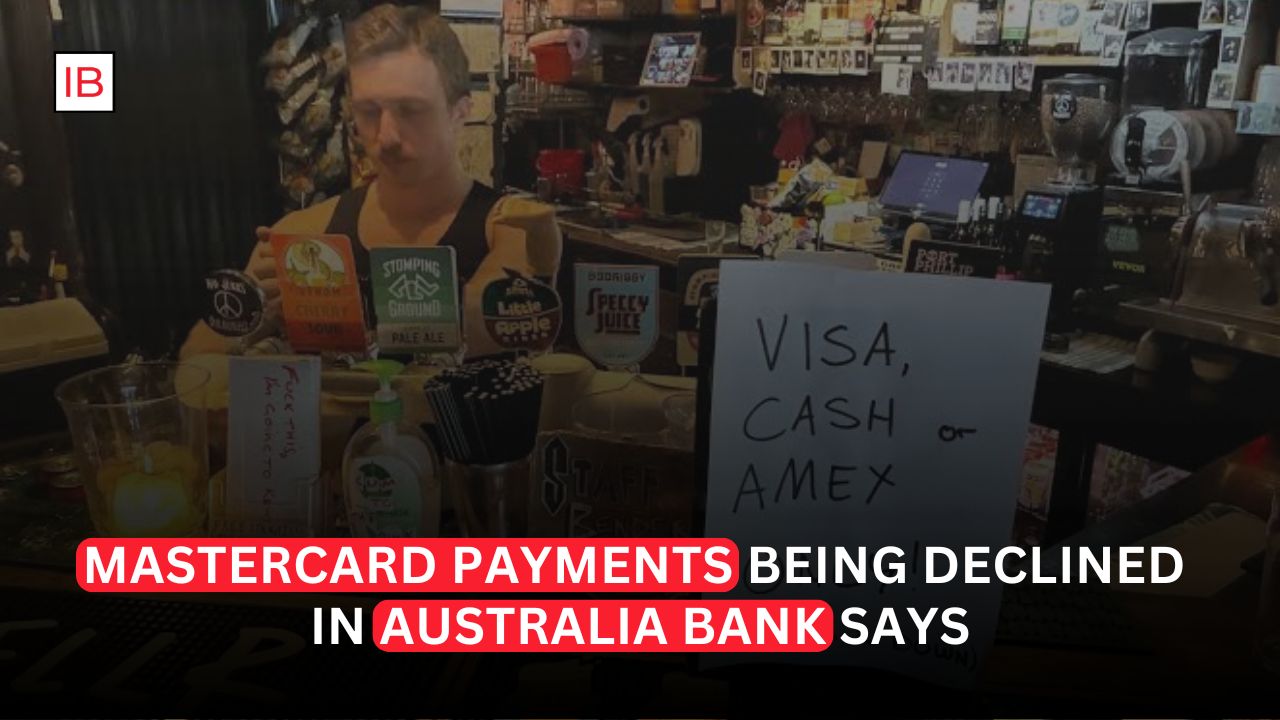
Mastercard experienced a global payment disruption on August 15, causing card transactions to be declined for customers across Australia. Commonwealth Bank told customers the problem was related to a “global Mastercard issue,” while reports also affected mobile wallets, ATMs and Mastercard travel cards.
The important point is that this wasn’t primarily an Australian banking failure. The evidence points to a problem higher up the payment network.
A Global Mastercard Problem
Customers across multiple Australian states reported being unable to make purchases using Mastercard cards.
The disruption affected:
- Mastercard debit cards
- Mastercard credit cards
- Apple Pay
- Google Pay
- Some ATM transactions
- Mastercard travel cards
Visa transactions were generally reported as continuing to work, giving customers an immediate alternative.
That distinction matters because it suggests the issue was concentrated within Mastercard’s payment ecosystem rather than being a broad failure of Australia’s banking system.
Mastercard Says the Issue Was a System Update
The latest reporting says Mastercard attributed the disruption to a scheduled system update and later confirmed that the problem had been resolved, with systems returning to normal.
That explanation is significant.
A scheduled update causing widespread payment failures isn’t necessarily evidence of a cyberattack. In fact, there is currently no solid evidence that this was a cyberattack.
The more immediate lesson is about operational resilience.
A payment network can be highly secure and still experience a serious outage if a change to critical infrastructure behaves unexpectedly.
Why Australia Felt It So Quickly
Australia is unusually dependent on electronic payments.
The Reserve Bank of Australia says cards remain the country’s most widely used consumer payment method, accounting for most in-person payments. Mobile-wallet use has also continued to increase.
That means a major card-network outage quickly becomes a real-world economic disruption.
It’s not just:
“My credit card isn’t working.”
It’s:
restaurants can’t process payments → retailers lose sales → customers can’t buy goods → businesses need backup payment methods.
Some Australian retailers reportedly had to turn customers away during the disruption.
The Mobile-Wallet Problem Is Especially Interesting
Some customers found that their physical Mastercard worked while the same card stored in Apple Pay or Google Pay did not.
Others reported failures with both physical and digital versions.
That inconsistency suggests that different parts of the Mastercard authorization and tokenization ecosystem were affected differently.
It also exposes a broader weakness in the move toward digital wallets:
Your phone can replace your physical wallet, but it doesn’t eliminate dependence on the underlying payment network.
If the network fails, having the card stored digitally doesn’t necessarily help.
Why This Matters for Mastercard
For Mastercard, the immediate financial impact from a short-lived outage may be limited.
The bigger issue is trust.
Payment networks sell reliability.
Merchants and banks don’t simply need Mastercard to process transactions cheaply. They need it to work when customers are standing at checkout.
A brief outage therefore creates a different kind of risk from an ordinary software failure:
Operational failure → merchant disruption → customer frustration → questions about network resilience.
But Don’t Overreact to One Outage
It would be a mistake to conclude from one incident that Mastercard’s infrastructure is fundamentally unreliable.
Payment systems are extremely complex, and even highly resilient networks can experience outages.
The better question is:
How frequently do these failures happen, how quickly are they detected, and how effectively can transactions be rerouted?
A single outage is a warning.
A pattern of outages would be a structural problem.
Australia’s Payment System Is Becoming More Concentrated
There is another reason the incident matters.
Mastercard and Visa aren’t just ordinary commercial networks in Australia.
The Australian Competition and Consumer Commission notes that Mastercard and Visa are among Australia’s prominent payment systems, meaning an outage could create significant economic disruption and damage confidence in the financial system.
That explains why regulators pay close attention to payment-network resilience.
The more society moves toward cashless payments, the more important these networks become.
The Cashless Economy Has a Hidden Risk
Australia’s payment disruption demonstrates a broader trade-off.
Digital payments offer:
- Convenience
- Speed
- Lower cash-handling costs
- Better transaction records
- Easy mobile payments
But they also create systemic dependencies.
If a payment network goes down, millions of transactions can potentially be affected at once.
That’s why maintaining alternatives such as:
Visa + Mastercard + eftpos + account-to-account payments + cash
isn’t necessarily inefficient redundancy.
It can be resilience.
What Businesses Should Take From This
For merchants, the lesson is fairly practical.
Businesses that rely almost entirely on one payment network are vulnerable to outages they cannot control.
Having multiple options can reduce that exposure:
- Visa
- Mastercard
- eftpos
- Bank transfers
- QR payments
- Cash
The cost of maintaining alternatives may be small compared with losing an entire afternoon of sales.
What Investors Should Watch
Outage Frequency
One disruption isn’t alarming. Repeated incidents would be.
Resolution Time
The speed at which Mastercard identifies and fixes failures is crucial.
Network Redundancy
Investors should watch how Mastercard handles traffic when parts of its infrastructure fail.
Digital Wallet Dependence
Greater wallet adoption increases the importance of reliable tokenized payment infrastructure.
Regulatory Scrutiny
Because payment networks are economically important infrastructure, regulators have an incentive to demand high resilience standards.
The Bigger Picture
The Mastercard outage is a useful reminder that the modern payments system is infrastructure, not merely a consumer convenience.
Australia’s heavy reliance on cards and mobile payments means that a technical problem at a global network can quickly become a problem for retailers and consumers on the ground.
The outage appears to have been temporary and has reportedly been resolved.
So the story shouldn’t be exaggerated into a crisis for Mastercard.
But it does expose a fundamental vulnerability of increasingly cashless economies:
When payment networks become invisible, people stop thinking about them—until they stop working.