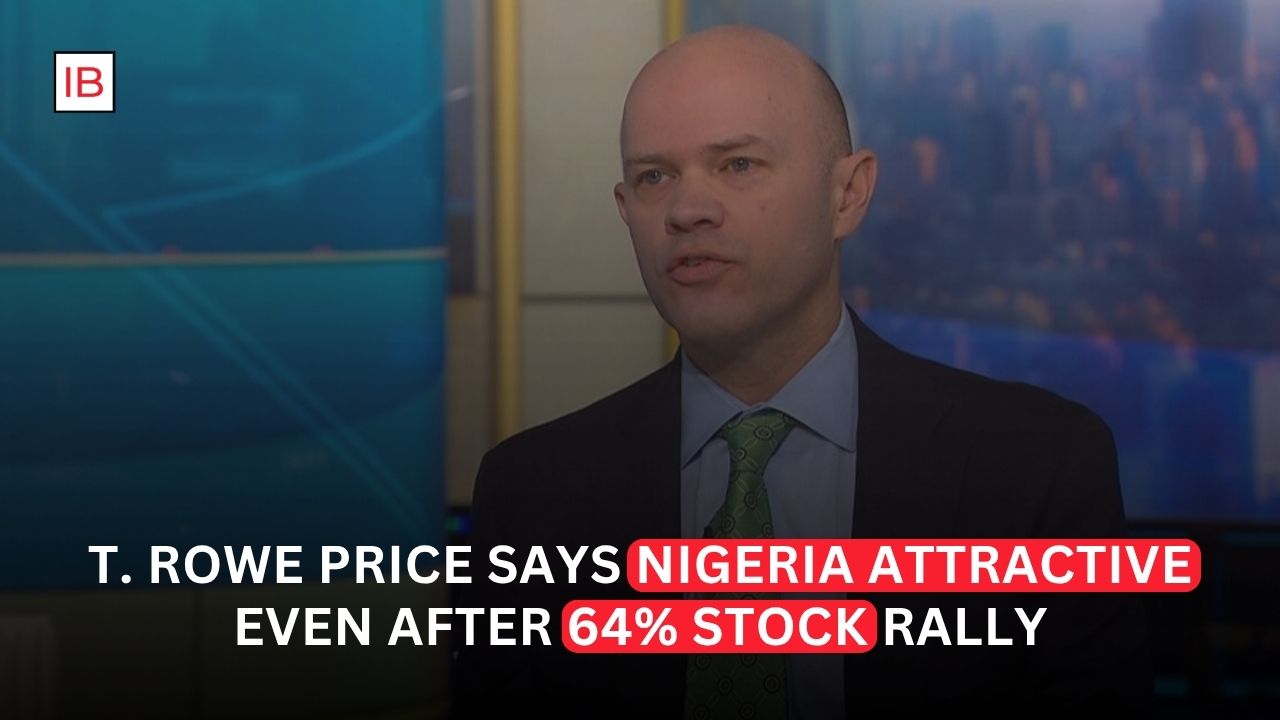
Nigeria’s stock market has delivered one of its strongest rallies in years, but investment firm T. Rowe Price still sees reasons to remain positive on the country. The bullish view is notable because Nigerian equities have already surged around 64%, raising the obvious question of whether much of the good news has already been priced into shares.
The concern is understandable. After such a powerful rally, investors typically become more cautious about valuations and the possibility of profit-taking. Yet T. Rowe Price’s assessment suggests the Nigerian market may still have room to rise because the rally is being supported by broader economic reforms, stronger corporate earnings and growing domestic investor participation.
Nigeria’s benchmark market has indeed delivered an extraordinary performance. The NGX All-Share Index gained nearly 46% during the first half of 2026, while market capitalization increased by about 47 trillion naira. More recent data showed the market capitalization reaching roughly 159.6 trillion naira by late July, representing an 86.7% increase over the previous year.
That performance makes the investment case more complicated — but not necessarily weaker.
Why Nigeria’s Stock Market Has Rallied So Sharply
Nigeria’s rally is not simply the result of speculative buying.
Several major changes in the country’s economic environment have improved investor sentiment.
The government has continued implementing reforms aimed at correcting long-standing distortions in the economy. Changes to fuel subsidies and foreign-exchange policy have been painful, but they have also created conditions in which businesses can operate with greater transparency around costs and currency availability.
At the same time, corporate earnings have improved across important parts of the market.
Key factors supporting Nigerian stocks include:
- Economic reforms
- Stronger corporate earnings
- Banking-sector recapitalization
- Greater pension-fund participation
- Improved investor confidence
- Attractive valuations in selected companies
- Potential future changes in Nigeria’s market classification
These factors have created a stronger foundation for the rally than a purely speculative surge would have.
T. Rowe Price Sees More Than a Short-Term Trade
T. Rowe Price’s positive assessment is particularly interesting because the firm has already increased its exposure to Nigeria.
In its Africa and Middle East fund review, the asset manager said it increased its off-benchmark allocation to Nigeria because of reforms and the possibility of future inclusion in the MSCI Frontier Markets Index. It also noted that the Nigerian market remained under-owned by foreign investors.
That last point is important.
A market can rise substantially and still have room for additional gains if international investors remain relatively underexposed.
If global funds begin increasing allocations to Nigeria, demand for Nigerian equities could continue rising even after the initial rally.
The Banking Sector Is Central to the Story
Nigerian banks have been among the most important beneficiaries of the market’s transformation.
Banking stocks have attracted substantial investor interest as financial institutions prepare for higher capital requirements and position themselves for a larger economy.
T. Rowe Price specifically highlighted Guaranty Trust Holding as one of its significant Nigerian investments, arguing that the company could benefit if Nigeria’s structural reforms prove sustainable.
Other major Nigerian banks have also contributed heavily to the broader market rally.
This creates an important distinction between simply buying the Nigerian index and selecting individual companies.
Some stocks may already reflect significant optimism, while others could still offer attractive risk-adjusted opportunities.
Pension Funds Are Changing the Market
One of the less obvious drivers of the rally has been domestic institutional money.
Nigeria’s pension system represents a large pool of long-term capital.
Changes that allow pension funds to invest more heavily in equities have encouraged a shift toward listed companies.
That can provide the market with a more stable source of demand than short-term foreign portfolio flows.
T. Rowe Price identified this policy shift as a major reason for its exposure to Nigerian equities, noting that higher equity investment limits for pension funds helped trigger increased allocations to stocks.
This matters because domestic institutional investors can continue supporting valuations even when international sentiment becomes more cautious.
Strong Earnings Are Supporting the Rally
A major argument against the idea that Nigerian stocks are simply in a speculative bubble is the improvement in corporate performance.
Market gains have been accompanied by stronger earnings from several sectors, particularly financial companies and consumer businesses.
The Nigerian market has also benefited from investors shifting toward companies with visible earnings and dividend potential.
That trend was evident in July, when Nigeria’s float-adjusted total-return index significantly outperformed the broader market-cap-weighted index, with market commentary pointing to investor demand for companies with stronger earnings and dividend records.
In other words, investors are not necessarily buying everything.
They are increasingly rewarding companies that can demonstrate actual financial performance.
But a 64% Rally Creates a Valuation Problem
The bullish argument should not be overstated.
A market that has already gained around 64% cannot be treated as though investors are buying at the beginning of a recovery.
Prices have moved.
Expectations have changed.
Some of the easiest gains may already be behind investors.
The biggest risk is that investors extrapolate recent performance too far into the future.
If companies fail to deliver earnings growth strong enough to justify higher share prices, valuations could become vulnerable.
That means the next phase of the Nigerian rally is likely to depend more heavily on fundamentals.
Inflation Remains a Major Risk
Nigeria’s economic recovery still faces serious challenges.
Inflation remains an important concern for households and businesses.
High inflation reduces consumer purchasing power and increases operating costs for companies.
It can also complicate monetary policy.
If the central bank keeps interest rates high to control inflation, borrowing becomes more expensive and economic activity can weaken.
For investors, this creates a difficult balance.
The stock market can rise rapidly because of reform expectations, but the underlying economy still needs to improve sufficiently to support sustainable corporate earnings.
The Naira Remains Critical
Currency stability is another major issue.
Nigeria’s stock market can generate impressive local-currency returns, but international investors ultimately care about returns in their own currencies.
A sharp decline in the naira can therefore reduce or even eliminate gains for foreign investors.
The government’s foreign-exchange reforms have attempted to create a more market-driven currency system.
That has increased transparency but also produced periods of significant volatility.
For global investors, the Nigerian investment case is therefore about more than equities.
It is also a bet on the country’s currency and broader macroeconomic stabilization.
Foreign Investors Could Be the Next Catalyst
One of the strongest arguments in favor of Nigeria is the possibility of renewed foreign investment.
T. Rowe Price has highlighted the fact that Nigeria remains under-owned by foreign investors.
If international funds begin returning to the market, the effect could be significant.
Even modest portfolio allocations can create substantial demand in a relatively smaller equity market.
Potential changes in Nigeria’s classification within global equity indexes could provide another catalyst.
T. Rowe Price has pointed to the possibility of future MSCI Frontier Markets Index inclusion, although it expects such a development to remain some time away.
The Market Is Still Not Without Problems
Nigeria’s structural challenges remain substantial.
Major risks include:
- Persistent inflation
- Currency volatility
- High interest rates
- Political uncertainty
- Weak household purchasing power
- Infrastructure constraints
- Energy shortages
- Limited foreign participation
- Potential profit-taking after the rally
These risks mean investors cannot simply assume that reforms will automatically produce another year of extraordinary returns.
The more realistic bullish case is that reforms gradually improve the economy while selected companies continue generating stronger profits.
Why Long-Term Investors May Still Be Interested
The most compelling argument for Nigeria is demographic and economic.
Nigeria has a huge and relatively young population.
That creates long-term demand for banking, consumer products, telecommunications, infrastructure, healthcare and financial services.
If economic reforms improve investment conditions, companies serving that expanding population could benefit substantially.
This is why long-term investors may be willing to tolerate short-term volatility.
The opportunity is not necessarily about whether Nigerian stocks rise another 64%.
It is about whether the country’s economic transformation can generate higher corporate earnings over the next five to ten years.
The Next Phase Will Be Harder
The easy part of the story may have been recognizing that Nigerian stocks were unusually cheap and that reforms were changing the investment environment.
The harder part is determining which companies can sustain growth after prices have already risen sharply.
Investors now need to focus on fundamentals.
The most important indicators will be:
- Earnings growth
- Dividend payments
- Bank capital levels
- Inflation
- Currency stability
- Interest rates
- Foreign portfolio flows
- Pension-fund allocations
- Government reform progress
A strong rally can continue if these indicators improve.
If they deteriorate, the market could experience a significant correction.
Nigeria Could Become a Larger Emerging-Market Story
Nigeria has historically struggled to attract consistent foreign equity investment despite its economic size.
That could change if reforms prove durable.
The country’s large population, natural resources and developing corporate sector make it difficult for global investors to ignore permanently.
But credibility has to be rebuilt.
International investors need confidence that currency reforms will remain in place, that capital can move efficiently and that economic policies will not suddenly reverse.
The longer those conditions remain stable, the more likely Nigeria is to attract long-term capital.
Conclusion
T. Rowe Price’s continued enthusiasm for Nigeria is notable because it comes after an extraordinary rally in the country’s stock market.
The key argument is not that Nigerian equities are still cheap simply because they were cheap before.
Instead, the investment case rests on the possibility that fundamental improvements are still unfolding.
Economic reforms are changing the operating environment, pension funds are providing additional domestic demand, banks are strengthening their balance sheets and corporate earnings are improving.
At the same time, foreign investors remain relatively under-owned, leaving potential room for additional international capital flows.
But investors should not ignore the risks.
After such a large rally, valuations matter more.
Inflation, currency volatility and interest rates could still create significant pressure, while weaker-than-expected earnings could trigger profit-taking.
The most important question is therefore not whether Nigeria can repeat its recent 64% gain.
It is whether the reforms behind the rally can produce a sustained improvement in corporate profitability.
If they can, Nigerian equities may still have significant long-term potential even after their extraordinary run.
If they cannot, the market’s recent gains could prove difficult to defend.
For now, T. Rowe Price’s position suggests that the Nigeria story is being viewed not as a finished rally, but as an economic transformation that may still have further to run.