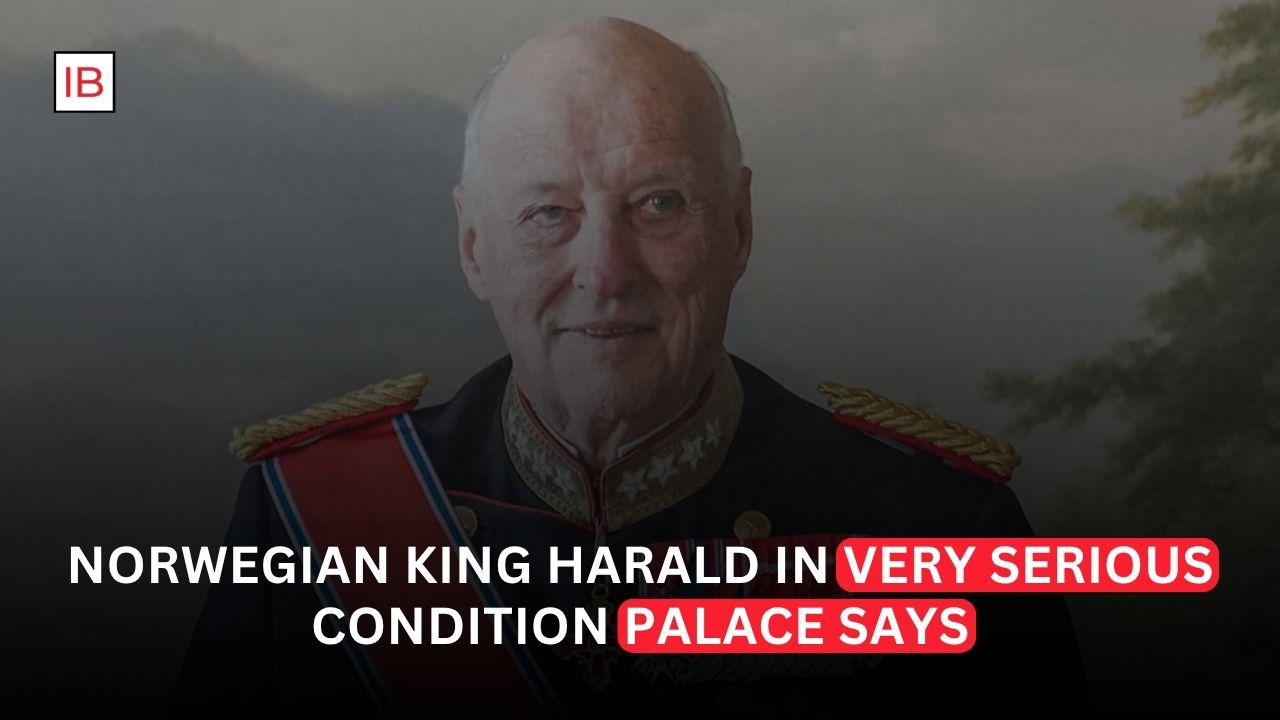
Norway’s King Harald V, 89, is in very serious condition after his health deteriorated while he remains hospitalized in Oslo, according to the Norwegian royal court. The development has prompted Crown Prince Haakon and Queen Sonja to cancel their scheduled engagements as attention turns to the condition of the country’s monarch.
The announcement marks a significant change from earlier updates, when the palace had described the king’s condition as stable despite complications from illness. Harald’s worsening health has now placed the Norwegian royal family under renewed pressure and has temporarily shifted the focus of official duties toward the crown prince.
King Harald’s Health Deteriorates
King Harald was hospitalized in Oslo earlier this month after developing a blood-related illness. He has been receiving treatment at Oslo University Hospital, where doctors have been monitoring his condition.
Earlier reports said he was being treated for haemolytic anaemia, a condition in which red blood cells are destroyed more rapidly than the body can replace them. The condition can cause symptoms including fatigue and shortness of breath.
His situation later became more complicated when he developed a bacterial infection in his bloodstream. The palace previously said he was responding to antibiotic treatment, although his health remained under close medical supervision.
The latest statement represents a further deterioration.
Royal Family Cancels Engagements
The seriousness of the situation is reflected in the decision by Queen Sonja and Crown Prince Haakon to cancel their scheduled public engagements.
Both have been closely involved as Harald remains in hospital, with Norwegian media reporting that members of the royal family have been at his bedside.
The cancellations are important because the Norwegian monarchy continues to carry out a substantial schedule of constitutional and ceremonial responsibilities.
With the king unable to perform his duties, Crown Prince Haakon has been acting as regent.
Crown Prince Haakon Takes on Greater Responsibilities
Crown Prince Haakon is the heir to the Norwegian throne and has previously served as regent during periods when his father was unable to perform official duties.
His current role means that the transition of responsibilities is not entirely unfamiliar to Norway.
Haakon has previously stepped in during his father’s medical treatment, including during earlier hospitalizations and periods when Harald was recovering from medical procedures.
This provides Norway with an established constitutional mechanism for maintaining continuity.
Harald Is Europe’s Oldest Reigning Monarch
At 89, King Harald is Europe’s oldest reigning monarch.
He became king in 1991 following the death of his father, King Olav V.
His reign has lasted more than three decades and has included significant changes in Norwegian society, politics and the role of the monarchy.
Despite his age and repeated health problems, Harald has remained committed to his position.
His earlier comments indicated that he did not intend to abdicate and viewed his constitutional oath as a lifelong commitment.
A Long History of Health Problems
The current hospitalization is part of a longer pattern of health problems for the Norwegian king.
Harald has previously undergone major medical procedures and has been hospitalized several times for infections and other conditions.
He received a pacemaker after experiencing heart problems, and his official workload has been reduced in response to his age and health.
Earlier in 2026, he was also hospitalized while on vacation in Tenerife for an infection and dehydration.
The repeated health setbacks have gradually increased the importance of Crown Prince Haakon’s role.
The Latest Hospitalization
Harald was admitted to hospital after doctors identified complications associated with anaemia.
His condition initially appeared manageable.
However, the development of a bacterial infection in his blood complicated his treatment.
The palace had previously reported that antibiotics were working and that his condition was stable.
That stability has now been replaced by a much more serious assessment.
Why Blood Infections Can Be Dangerous
A bloodstream bacterial infection can become serious because it may spread through the body and place significant stress on vital organs.
For an elderly patient already dealing with another medical condition, such an infection can present additional challenges.
However, the palace has not publicly disclosed detailed information about the king’s prognosis or provided a specific explanation for the latest deterioration.
That means it would be inappropriate to assume a particular outcome from the palace’s statement alone.
Norway’s Government Is Closely Watching
The king’s health is also a matter of national importance.
Although Norway’s monarchy is constitutional and the government exercises political power, the monarch performs important ceremonial and constitutional functions.
King Harald has traditionally maintained a strong public presence and has been regarded as a unifying figure.
His absence therefore has symbolic significance even when the country’s political institutions continue operating normally.
The Monarchy’s Constitutional Role
Norway is a constitutional monarchy.
The king’s powers are limited by the country’s political system, while elected officials and Parliament control government policy.
Nevertheless, the monarch formally carries out functions such as appointing governments and presiding over certain constitutional events.
When the king cannot perform his duties, the regent system allows those responsibilities to continue.
Crown Prince Haakon’s current role therefore helps ensure institutional continuity.
Public Reaction in Norway
News of the king’s deteriorating condition has attracted significant public attention.
Harald has been on the throne since 1991 and is one of the most familiar public figures in Norway.
For many Norwegians, his reign has covered most of their adult lives.
His public image has also been shaped by his willingness to address difficult moments affecting the country and by his emphasis on national unity.
Queen Sonja’s Role
Queen Sonja has been closely associated with Harald throughout his reign.
The couple married in 1968 after a relationship that was initially controversial because Sonja was a commoner.
Their marriage eventually became an important part of modern Norwegian royal history.
Sonja’s decision to cancel her official engagements underscores the seriousness of Harald’s current condition.
Rather than continuing with a normal public schedule, she has prioritized her husband’s situation.
The Importance of Crown Prince Haakon
Haakon’s current responsibilities provide a glimpse into the future of the Norwegian monarchy.
He has already gained extensive experience carrying out official duties on behalf of his father.
That experience could prove valuable if Harald remains unable to resume his schedule for an extended period.
For now, however, there has been no indication that Haakon is taking over as king.
The king remains on the throne, with Haakon acting as regent during his father’s illness.
No Immediate Abdication Announcement
The palace’s statement about Harald’s condition does not constitute an abdication announcement.
That distinction is important.
The king can remain monarch while temporarily unable to perform official duties.
Norway’s constitutional system allows a regent to act on his behalf.
Therefore, the current situation should not automatically be interpreted as the beginning of a formal transfer of the throne.
A Difficult Period for the Royal Family
The Norwegian royal family has faced several health challenges in recent years.
Harald’s repeated hospitalizations have been accompanied by health concerns involving other members of the family.
That has increased public attention on the family’s ability to maintain official duties while dealing with private medical circumstances.
The latest development is particularly serious because both Harald and his immediate family have had to step back from planned engagements.
Norway’s Monarchy Has Adapted
The Norwegian royal household has gradually adjusted to Harald’s declining health.
His public schedule has been reduced, and Crown Prince Haakon has taken on an increasingly visible role.
These changes are part of a broader adaptation to the reality of an aging monarch.
Rather than allowing health problems to disrupt the country’s constitutional functions, responsibilities have increasingly been shared within the royal family.
What Happens Next?
The immediate priority is the king’s medical treatment.
The royal palace is likely to provide further updates if there are significant changes in his condition.
For the government, the most important issue is maintaining continuity of constitutional duties.
For the royal family, the focus is clearly on Harald’s health.
Crown Prince Haakon is expected to continue acting as regent while his father remains unable to perform official responsibilities.
No Reason to Speculate Beyond Official Information
The phrase “very serious” naturally raises concerns about the king’s prognosis.
But the available public information does not provide enough detail to determine what will happen next.
The responsible approach is therefore to distinguish between confirmed facts and speculation.
What is confirmed is that Harald’s health has deteriorated, that he remains hospitalized and that Queen Sonja and Crown Prince Haakon have cancelled engagements.
Beyond that, the palace has not publicly provided enough medical information to draw definitive conclusions.
Broader Significance for Norway
Harald’s illness is unlikely to create an immediate political crisis because Norway has strong democratic institutions and an established constitutional framework.
The country’s government and Parliament continue to operate independently of the king’s health.
The greater significance is symbolic.
Harald has served as a long-term national figure and has represented Norway at home and abroad for decades.
His absence is therefore likely to be felt strongly by the public.
The Future of the Norwegian Monarchy
The current situation also inevitably raises questions about the future.
Crown Prince Haakon has been preparing for his eventual role as king for many years.
He has represented Norway internationally, carried out diplomatic duties and served as regent during previous periods of his father’s illness.
If Harald eventually leaves the throne, whether through death or another constitutional development, the transition to Haakon is expected to be orderly.
But there is currently no indication that such a transition has begun.
Conclusion
King Harald V’s deteriorating health has placed Norway’s royal family in a serious situation.
The 89-year-old monarch is hospitalized in Oslo and is now described by the royal court as being in very serious condition. His illness has involved anaemia and a bacterial infection, with the latest update indicating that his health has worsened.
Queen Sonja and Crown Prince Haakon have cancelled their planned engagements, while Haakon continues to act as regent.
The situation is significant because Harald has been Norway’s king since 1991 and remains Europe’s oldest reigning monarch.
Nevertheless, Norway’s constitutional system is designed to maintain continuity even when the monarch cannot perform his duties.
For now, the country is waiting for further medical updates while the royal family remains focused on Harald’s condition.
The immediate story is therefore about the health of an aging monarch, but it also highlights the stability of Norway’s institutions and the increasingly important role Crown Prince Haakon plays in the modern Norwegian monarchy.