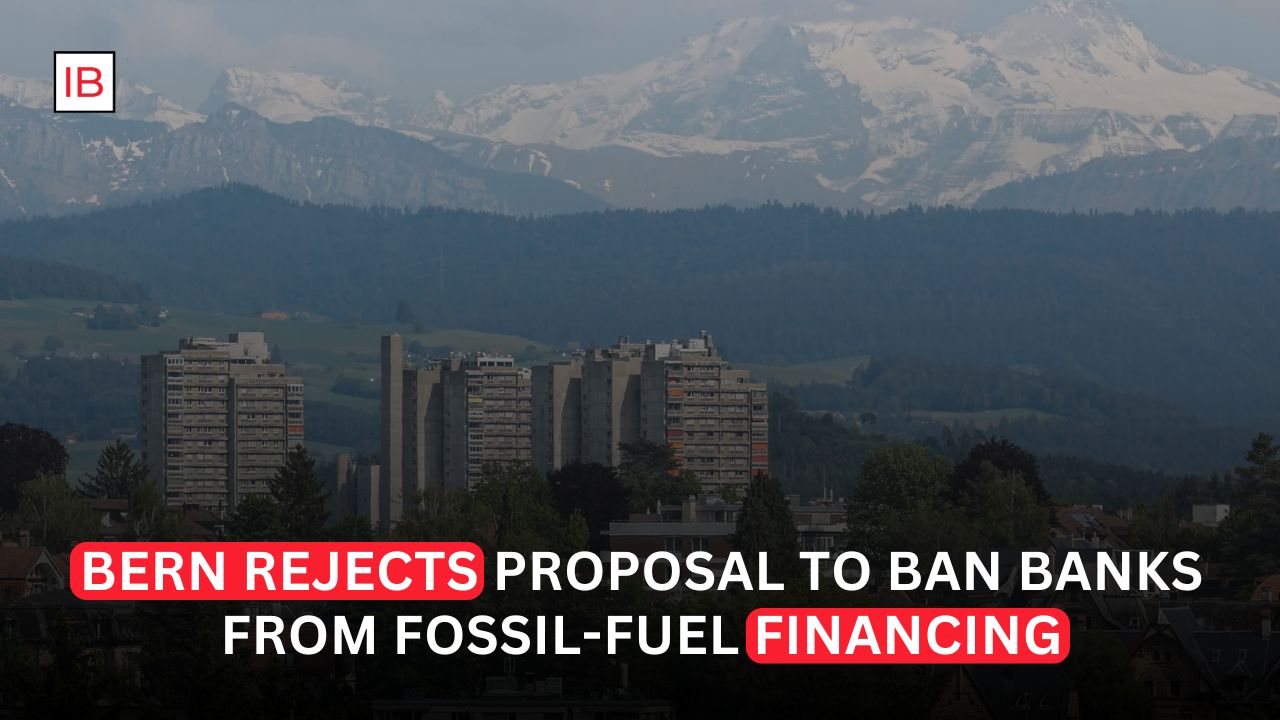
Swiss Government Says Existing Climate Rules Are Sufficient as Campaigners Push for Tougher Restrictions on Financial Institutions
The Swiss government has rejected a popular initiative that would have imposed new restrictions on banks, insurers and other financial institutions involved in fossil-fuel financing, arguing that the proposed measures would add unnecessary regulation while potentially pushing financial activity abroad.
The Federal Council decided on Aug. 12 to recommend that Parliament reject the “For a sustainable and future-oriented Swiss financial centre” initiative without presenting either a direct or indirect counterproposal. The government said Switzerland already has legislation and regulatory measures designed to align the financial sector with climate objectives.
The decision places Switzerland’s influential financial industry at the center of a growing debate over how much responsibility banks should bear for emissions generated by companies and projects they finance.
Initiative Sought Restrictions on Fossil-Fuel Financing
The proposed initiative aimed to make environmental sustainability a binding constitutional obligation for Switzerland’s financial center.
Under the proposal, Swiss financial-market participants would have been required to align their business activities abroad with international climate and biodiversity targets.
One of its most significant measures would have prohibited Swiss financial institutions from providing financing and insurance services for the development of new fossil-fuel reserves or the expansion of existing extraction activities.
The initiative also called for a new supervisory authority that would monitor compliance and have the power to impose sanctions.
Supporters argue that Switzerland’s financial sector has an environmental footprint far larger than the country’s domestic emissions because Swiss institutions finance companies and projects around the world.
Government Says Existing Rules Already Go Far Enough
The Federal Council has argued that many of the initiative’s objectives are already covered by existing Swiss climate and financial regulations.
Switzerland’s Climate and Innovation Act establishes a goal of reaching net-zero greenhouse-gas emissions by 2050 and includes provisions concerning the climate alignment of financial flows.
The government also points to the Climate Disclosures Ordinance, which took effect in 2024 and requires larger companies, including financial institutions, to disclose climate-related risks and impacts and prepare transition plans consistent with Switzerland’s climate objectives.
Officials say additional minimum requirements for financial institutions’ transition plans are already being developed.
From the government’s perspective, introducing another constitutional requirement and a new enforcement structure would therefore create duplication rather than close a major regulatory gap.
Financial Industry Faces Growing Climate Pressure
The debate comes as Switzerland’s financial sector faces increasing scrutiny over its contribution to global fossil-fuel emissions.
Switzerland is one of the world’s major financial centers, with banks managing trillions of Swiss francs in assets and providing financing to companies across global industries.
A recent Swissinfo analysis said Swiss-financed loans and equities in carbon-intensive sectors could account for an estimated 700 million to 900 million tonnes of CO₂ equivalent annually, several times larger than Switzerland’s domestic emissions.
That gap has become a central argument for environmental campaigners.
They contend that Switzerland cannot claim to be pursuing climate goals domestically while allowing its financial institutions to support fossil-fuel expansion abroad.
Campaigners Say Voluntary Measures Have Failed
Environmental organizations and other supporters of the initiative argue that voluntary climate commitments by financial institutions have not produced sufficient changes.
More than 145,000 signatures were submitted in April in support of the popular initiative, allowing the proposal to move forward in Switzerland’s direct-democracy system.
Supporters include environmental groups as well as politicians and figures from different parts of the political spectrum.
Their argument is that banks, insurers and pension institutions have an ability to influence corporate behavior because companies depend on access to financing and insurance.
By restricting financial support for new fossil-fuel development, they believe Switzerland could exert influence well beyond its borders.
Government Warns Activity Could Move Abroad
One of the Federal Council’s central objections is that unilateral Swiss restrictions may simply shift financial activity to other jurisdictions.
If Swiss banks are prohibited from financing particular fossil-fuel projects, international competitors could potentially step in and provide the financing instead.
The government therefore questions whether the environmental benefit would be large enough to justify the economic and regulatory costs.
According to the Federal Council, the proposed bans could result in financial and insurance services being offered by providers outside Switzerland, limiting the initiative’s effectiveness.
This concern is particularly relevant for a country whose economy is closely connected to international finance.
Switzerland’s Global Financial Role Complicates the Debate
Switzerland’s financial institutions operate across international markets.
Banks, insurers, asset managers and pension funds can finance companies and projects in countries where domestic regulations may be less restrictive.
That global reach creates both an opportunity and a challenge.
Supporters of the initiative see Switzerland’s financial influence as a tool for accelerating the energy transition.
Opponents argue that imposing restrictions on Swiss institutions alone could disadvantage them relative to international competitors without necessarily reducing global fossil-fuel investment.
The dispute therefore goes beyond climate policy and raises questions about the competitiveness of Switzerland’s financial center.
Biodiversity Rules Present Additional Challenges
The initiative went beyond fossil fuels.
It also sought to require financial activities abroad to comply with international biodiversity objectives.
The Federal Council said this would create significant uncertainty because internationally recognized and sufficiently transparent standards for measuring biodiversity impacts are not yet developed enough to support an immediate legal obligation.
Officials warned that financial institutions could face additional costs and uncertainty when attempting to determine whether overseas activities comply with biodiversity targets.
That issue contributed to the government’s conclusion that the initiative’s proposed framework would be difficult to implement.
New Supervisory Authority Would Increase Costs
Another major component of the proposal was the creation of a dedicated supervisory body.
The authority would have powers to monitor compliance and impose sanctions on financial institutions that violated the initiative’s requirements.
The Federal Council said establishing such an institution would generate additional administrative and enforcement costs.
Those expenses would ultimately need to be covered either by the Swiss government or through fees charged to financial-market participants.
For the government, the additional bureaucracy is difficult to justify when climate disclosure and transition-planning rules are already being expanded.
Pension Funds and Other Institutions Could Also Be Affected
The initiative’s impact would not have been limited to commercial banks.
Its requirements would also have applied to insurance companies, other financial institutions, occupational pension schemes and social-security institutions.
That could have affected investment decisions made by pension funds and other institutions managing large pools of capital.
The government warned that the initiative could interfere with their investment responsibilities and potentially narrow the range of assets available to them.
That adds another dimension to the debate because pension funds have a legal responsibility to manage assets in the interests of beneficiaries.
Swiss Banks Already Face Climate Disclosures
Switzerland has not ignored the climate risks facing its financial sector.
Large companies and financial institutions are already subject to climate-related disclosure requirements.
The framework requires companies to assess how climate change affects their businesses while also reporting the environmental consequences of their activities.
The Federal Council says these measures are designed to improve transparency and encourage companies to develop credible transition strategies.
The government also highlighted a 2022 sustainable-finance strategy as part of its broader approach to transforming the financial sector.
The Broader Fossil-Fuel Financing Debate
The Swiss debate reflects a much larger global argument about the role of financial institutions in the energy transition.
Banks are increasingly under pressure from governments, investors and environmental groups to reduce their exposure to coal, oil and gas.
At the same time, energy companies argue that continued investment in conventional fuels remains necessary to meet global energy demand, particularly during periods of geopolitical uncertainty.
Banks therefore face a difficult balancing act between climate commitments, customer demand, shareholder expectations and energy-security considerations.
Financial Institutions Face a Changing Investment Environment
The pressure on banks is likely to continue even without the initiative becoming law.
Investors increasingly assess financial institutions according to environmental, social and governance factors.
Banks that continue financing fossil-fuel expansion may face reputational risks, while those that withdraw too quickly may lose profitable clients or expose themselves to criticism over energy shortages.
Switzerland’s approach is therefore likely to remain closely watched by international financial markets.
Parliament Will Consider the Proposal
The Federal Council’s decision does not itself end the initiative.
Switzerland’s political system allows popular initiatives to proceed toward parliamentary consideration and potentially a nationwide vote.
The government has instructed the Federal Department of Finance to prepare its formal dispatch by April 16, 2027.
Parliament will therefore have an opportunity to debate the initiative before voters potentially have the final say.
That leaves open the possibility of significant political discussion over Switzerland’s role in global climate finance.
Looking Ahead
Bern’s rejection of the proposal highlights the difficult balance Switzerland faces between climate ambitions and the competitiveness of its financial industry.
The government believes existing legislation, climate disclosures and transition-planning requirements already provide a sufficient framework for moving financial flows toward climate goals.
Campaigners, however, argue that continued financing of fossil-fuel expansion demonstrates that voluntary and disclosure-based measures are not enough.
The debate is particularly important because Switzerland’s financial sector has an international footprint far larger than the country’s domestic economy. Swiss-financed activities can therefore influence emissions and environmental outcomes around the world.
The government is concerned that outright financing bans could simply move business to foreign institutions, reducing Switzerland’s ability to influence global emissions while creating additional costs for domestic financial firms.
For supporters of the initiative, however, that argument does not resolve the underlying issue. They believe Switzerland’s position as a major financial center gives it a responsibility to ensure that its capital does not contribute to new fossil-fuel development.
The coming parliamentary debate will determine whether the initiative gains enough political momentum to reach voters.
For now, Bern has chosen a more gradual approach: maintain existing climate-finance rules, strengthen disclosure and transition requirements, and avoid outright bans on fossil-fuel financing.
The decision ensures that the future of Swiss climate finance will remain a major political and financial issue as the country works toward its 2050 net-zero target.