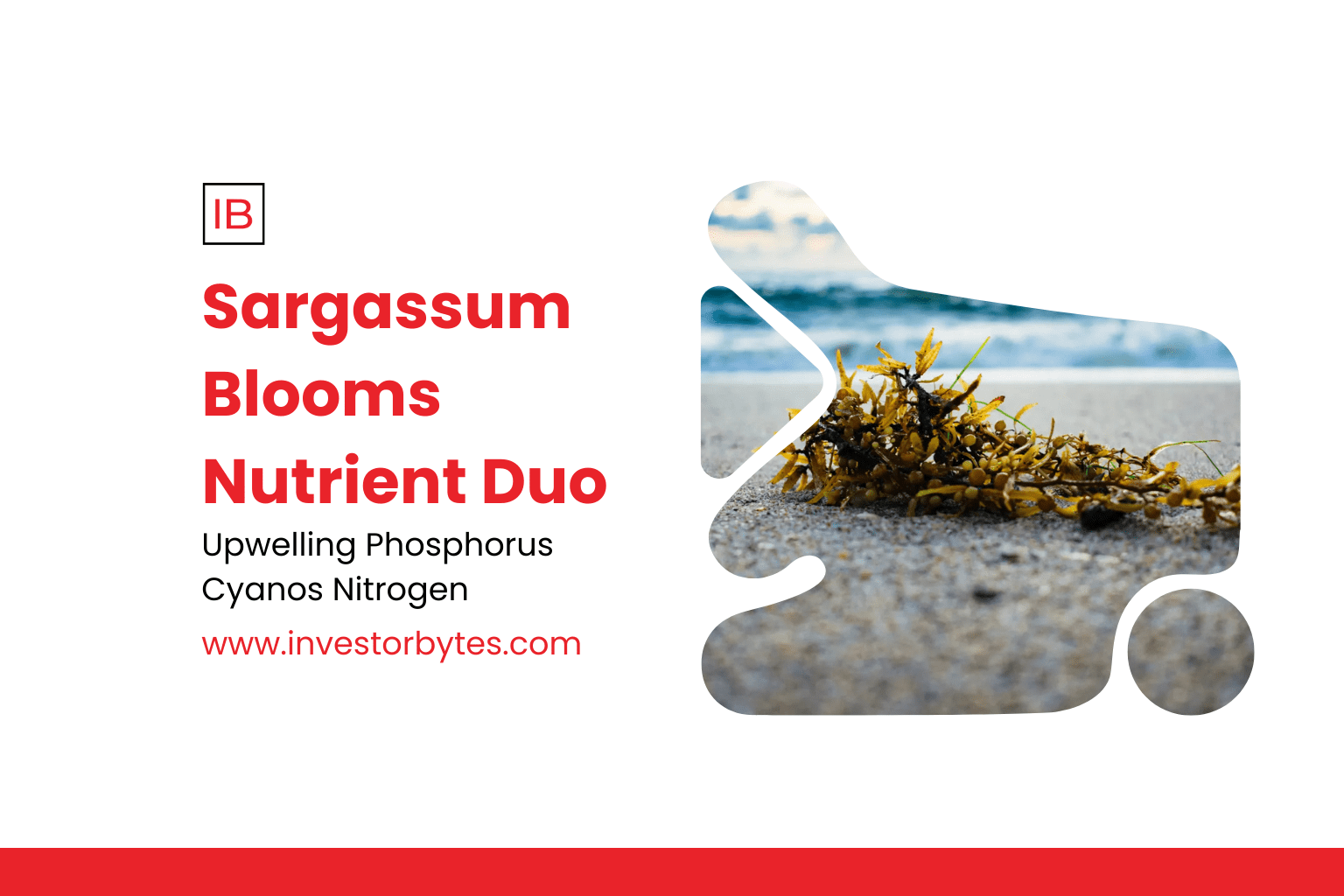
The Great Atlantic Sargassum Belt—Earth’s largest floating macroalgal ecosystem—exploded in 2025, blanketing 38 million tons across Caribbean shores by June, driven by a potent phosphorus-nitrogen duo unearthed in a November Nature Geoscience bombshell. Max Planck Institute chemists, analyzing Caribbean coral cores, pinpoint equatorial upwelling as the phosphorus pump: trade winds hoist nutrient-rich deep waters, spiking surface P by 40% since 2011, supercharging symbiotic cyanobacteria on Sargassum natans and fluitans to fix atmospheric N2 at triple historical rates.
This “dynamic duo” explains the belt’s biomass tripling to 35 million tons annually, per satellite altimetry. Upwelled P—sourced from ancient sediments—alleviates the tropical Atlantic’s chronic deficiency, enabling diazotrophs like UCYN-A to convert N2 into bioavailable forms, with fixation rates hitting 500 µmol N m⁻² day⁻¹ during negative Atlantic Meridional Mode phases. Riverine inputs from Amazon/Orinoco? Negligible, correlating <0.1 with bloom peaks. Instead, dust deposition and Saharan aerosols add trace iron, but P-N synergy dominates, per isotopic δ¹⁵N drops in Sargassum tissue.
Socio-ecological tolls mount: Mexico’s Yucatán beaches deploy $50 million yearly for cleanup, while Grenada fisheries lose 25% yields to hypoxic mats emitting H2S. Economically, tourism dips 15% in peak bloom zones; ecologically, turtle hatchlings face 40% mortality from entangled rafts. Yet, positives emerge: Sargassum sequesters 10 Gt CO2 since 2011, and biofertilizer pilots in Haiti yield 20% crop boosts.
2025’s nutrient duo sargassum blooms research debunks runoff myths, linking surges to climate-amplified winds—up 15% intensity per NOAA. Projections warn of 50% biomass hikes by 2030 under RCP8.5, unless geoengineering curbs upwelling. Mitigation strategies? International monitoring via NASA’s MODIS, plus P-stripping from ag runoff to temper feedbacks.
This revelation reframes Sargassum from menace to barometer: harnessing its N-P engine could spawn blue carbon credits, but unchecked, it heralds ocean upheaval. As blooms choke coastlines, science‘s nutrient decode demands swift, collaborative action to reclaim azure seas.