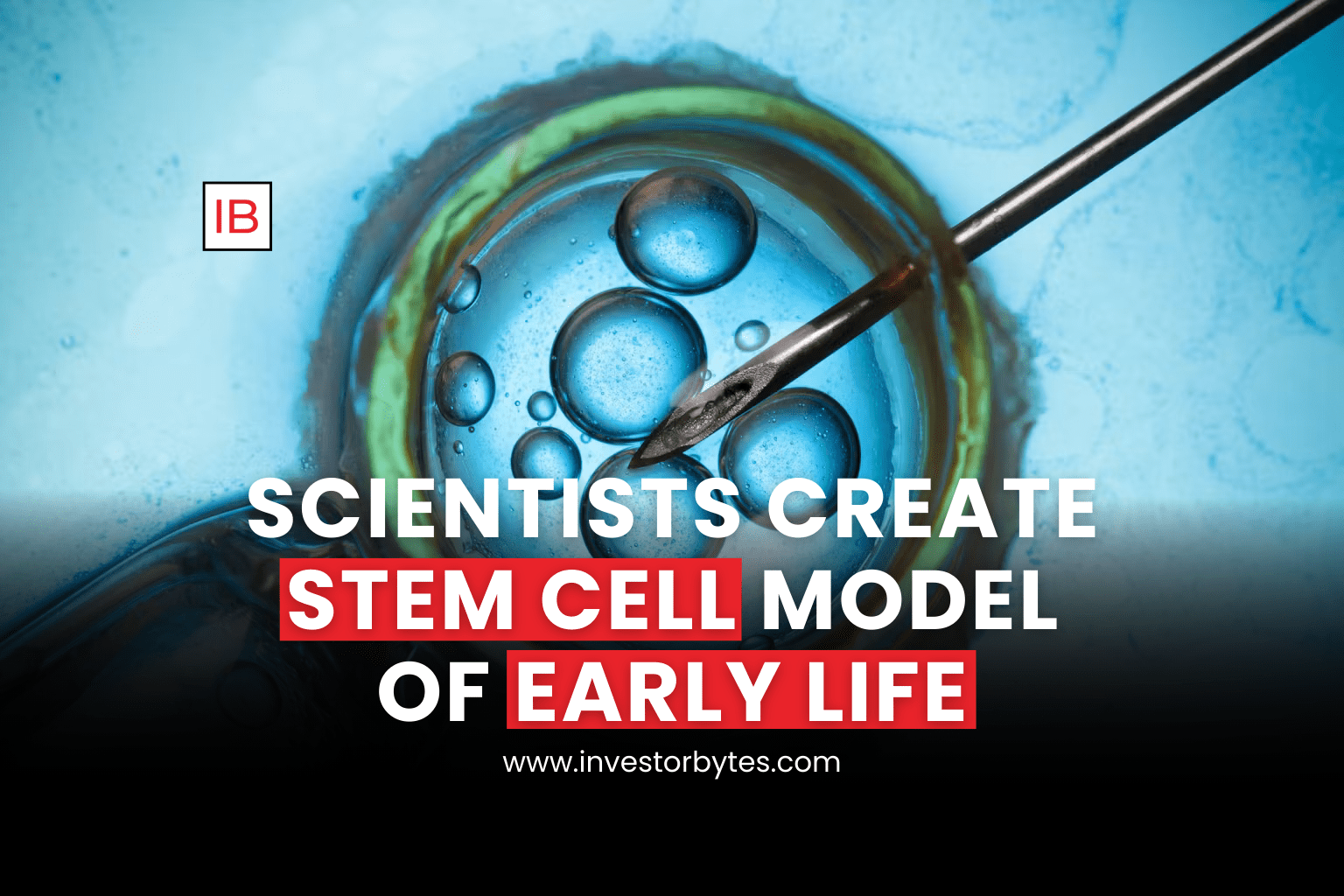
In a significant leap for reproductive science, teams of researchers—most notably from the University of Cambridge and Caltech—have successfully created the most complete synthetic models of human embryos using only stem cells.
This breakthrough, which made major waves in the scientific community throughout late 2024 and 2025, provides an unprecedented “front-row seat” to the second week of human development. This period, often called the “black box” of pregnancy, is when the embryo begins the high-stakes process of implantation into the mother’s womb—a stage where a significant number of pregnancies unfortunately fail.
The Science: Building Life from Scratch
Unlike traditional embryos formed by sperm and egg, these models are “grown” by reprogramming pluripotent human stem cells. These cells are nudged into self-organizing into three-dimensional structures that mimic a natural embryo.
Self-Organization: Remarkably, the stem cells do not need a “blueprint.” When placed in the right chemical environment, they autonomously sort themselves into the three essential layers that will become the baby (epiblast), the placenta (trophectoderm), and the yolk sac (hypoblast).
The “Black Box” Window: These models allow scientists to study the 7-to-14-day window after fertilization. During this time, the embryo must send complex chemical signals to the mother’s uterine lining to be “accepted.”
Genetic Manipulation: Because these are lab-grown models, researchers can “turn off” specific genes to see exactly which ones are responsible for successful attachment, something that is ethically and practically impossible to do with natural human embryos.
Why This Matters for IVF and Pregnancy
This research is not about “creating life” in a jar, but rather about understanding why it often fails to take hold.
| Research Goal | Potential Impact |
| Implantation Failure | Identifying why 30%–50% of embryos fail to implant during natural or assisted conception. |
| IVF Optimization | Testing different hormonal environments to see which ones best support “attachment” before transferring real embryos to a patient. |
| Genetic Screening | Understanding how early chromosomal abnormalities disrupt the “conversation” between the embryo and the uterus. |
| Toxicology | Testing how certain medications or environmental pollutants affect the earliest days of life without risking a real pregnancy. |
This breakthrough has reignited a global debate on bioethics. Most countries follow the “14-Day Rule,” which prohibits the culture of human embryos beyond two weeks (when the nervous system begins to form).
While these models are not “real” embryos—they lack a beating heart or a brain and cannot currently develop into a baby—they are so morphologically similar that regulators are racing to update guidelines. In September 2025, several international ethics boards proposed new “potential-based” frameworks to ensure this research remains focused on medical utility rather than “reproductive” goals.
“Our model gives us access to the developing structure at a stage that is normally hidden from us… it will let us test the function of specific factors to understand why so many pregnancies fail.” — Professor Magdalena Zernicka-Goetz, University of Cambridge/Caltech