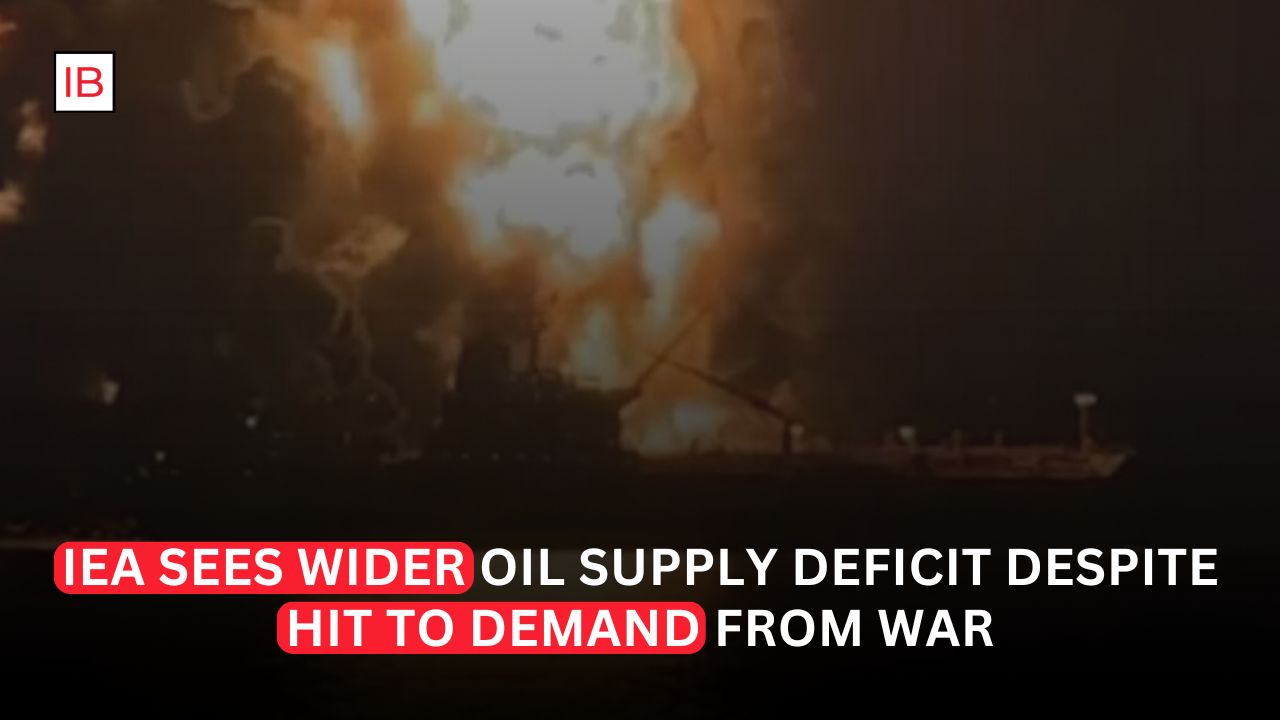
The global oil market is heading into a deeper supply deficit than previously expected, even as the war and resulting economic disruption weaken fuel consumption. The International Energy Agency has sharply reduced its forecast for global oil production, arguing that ongoing disruptions around key Middle Eastern shipping routes are overwhelming the impact of weaker demand.
The latest outlook highlights an uncomfortable reality for energy markets: a war can simultaneously destroy oil demand and create an even larger supply problem.
That dynamic is now becoming increasingly important as disruptions around the Strait of Hormuz and Bab el-Mandeb continue to restrict the movement of crude and petroleum products.
IEA Cuts Global Supply Forecast
The IEA now expects global oil supply to fall by approximately 4.3 million barrels per day in 2026, around 4% from the previous year.
That is a significant deterioration from its July forecast, when the agency had anticipated a decline of roughly 3.7 million barrels per day.
The new forecast puts total global oil supply at approximately 102.02 million barrels per day, the lowest level the IEA has projected for the year.
The revision reflects the continuing disruption caused by the conflict in the Middle East and the difficulty of restoring normal oil transportation through strategically important maritime routes.
Demand Is Falling Too
Normally, a major economic shock would be expected to reduce oil prices by destroying demand.
War can shut factories, reduce travel, weaken industrial production and cause consumers to cut fuel consumption.
The current situation is different because the reduction in demand is being accompanied by an even larger hit to supply.
The IEA has therefore lowered its demand expectations as well, but not enough to offset the production losses.
That is why the overall market balance is becoming tighter.
In other words, less oil is being consumed, but even less oil is available.
The Strait of Hormuz Remains Critical
One of the biggest problems is the continuing disruption around the Strait of Hormuz, a narrow waterway connecting the Persian Gulf with the Arabian Sea.
The route is critical to global energy markets because enormous volumes of crude oil and petroleum products normally pass through it.
The ongoing restrictions have forced producers and buyers to rely more heavily on alternative transportation routes, inventories and available production capacity elsewhere.
The IEA’s latest assessment indicates that the longer the disruption continues, the harder it becomes for alternative supply sources to compensate.
Bab el-Mandeb Adds Another Problem
The Strait of Hormuz is not the only vulnerable shipping route.
The Bab el-Mandeb Strait, connecting the Red Sea with the Gulf of Aden, has also faced disruptions.
That creates another bottleneck for energy shipments moving between the Middle East, Europe and Asia.
When multiple major maritime routes are impaired at the same time, the problem becomes more complicated than simply replacing lost production.
Oil may technically exist somewhere in the world, but getting it to the refinery that needs it becomes considerably harder and more expensive.
Inventories Are Acting as a Buffer
Global inventories are now playing an increasingly important role.
When production falls below consumption, oil companies, governments and traders can draw on stored crude and petroleum products.
That prevents an immediate physical shortage.
But inventories are not an unlimited solution.
Every barrel removed from storage reduces the cushion available for future disruptions.
The IEA’s earlier market assessments already warned that prolonged supply losses could create significant inventory depletion and leave the market vulnerable even after production begins recovering.
That is one of the biggest risks facing the market now.
Why the Supply Deficit Matters
A sustained supply deficit can push oil prices higher even when the global economy is weakening.
That creates a particularly difficult environment for governments and central banks.
Higher oil prices increase transportation and production costs, which can feed into inflation.
At the same time, weaker oil consumption can signal slower economic activity.
The result is a potentially uncomfortable combination of slower growth and persistent inflation pressure.
That is one reason energy-market disruptions can have consequences far beyond the oil industry.
Refiners Are Also Under Pressure
The problem is not limited to crude oil.
Refineries require reliable supplies of crude and other feedstocks to produce gasoline, diesel, jet fuel and other petroleum products.
If crude supplies become constrained or shipping costs rise, refined products can become more expensive even if overall fuel demand is weakening.
This creates another potential problem for consumers.
A weaker economy might normally push gasoline and diesel prices lower.
But supply disruptions can prevent that decline from happening.
Asia Faces Particular Exposure
Asian economies are especially important to the current oil market because many major importers depend heavily on Middle Eastern crude.
China, India, Japan and South Korea are among the world’s largest oil-consuming economies and have historically relied heavily on supplies moving through Middle Eastern shipping routes.
Any prolonged disruption therefore creates a major logistical challenge for Asian refiners.
Some countries can increase purchases from Russia, the Americas or other suppliers, but replacing large volumes quickly is not straightforward.
Alternative crude grades may also require refinery adjustments.
The US Can Provide Some Relief
US production and exports remain an important potential source of additional supply.
American shale production has transformed the global oil market over the past decade, making the United States one of the world’s largest producers.
But increasing output is not instantaneous.
Oil companies need time to respond to higher prices, drill new wells and expand infrastructure.
That means US production can provide a medium-term buffer, but it cannot necessarily replace a sudden multi-million-barrel-per-day disruption immediately.
The Market Is Entering a Dangerous Phase
The most concerning part of the IEA’s outlook is not simply the size of the projected deficit.
It is the combination of several problems occurring simultaneously:
- Middle Eastern production remains disrupted.
- Major shipping routes remain constrained.
- Global inventories are being drawn down.
- Alternative supply cannot fully compensate.
- Demand is weakening because of the economic shock.
- Refinery and transportation costs remain elevated.
Each factor alone could be manageable.
Together, they create a much more fragile market.
Don’t Assume Higher Oil Prices Are Guaranteed
There is also a counterargument that should not be ignored.
If the war causes a severe global recession, oil demand could fall much faster than current forecasts suggest.
That could eventually eliminate the deficit and potentially push the market back toward surplus.
The IEA itself has previously highlighted how dramatically oil demand can change following major economic disruptions. Earlier forecasts also showed the possibility of substantial supply returning if Middle Eastern conditions normalize.
So the current deficit should not be treated as a permanent structural condition.
The key variable is how long the supply disruption lasts.
What Happens If Hormuz Reopens?
A reopening of the Strait of Hormuz would fundamentally change the market outlook.
Large volumes of stranded or delayed oil could begin moving again.
Shipping bottlenecks would ease, inventories could stabilize and supply expectations would improve.
That could put significant downward pressure on prices.
But if the reopening is delayed for months, the cumulative inventory losses could make the eventual recovery more complicated.
The market would then have to rebuild depleted stockpiles even after normal production resumes.
Oil Markets Are Now Watching Geopolitics
The latest IEA forecast demonstrates how little the oil market can currently be analyzed through traditional supply-and-demand assumptions alone.
Geopolitics has become the dominant variable.
A military development in the Middle East can change shipping routes, production levels, insurance costs and refinery economics almost immediately.
That makes forecasts unusually uncertain.
The IEA’s sharp supply downgrade is therefore less about predicting exactly where oil prices will go and more about highlighting how vulnerable the global system has become.
The Bigger Picture
The oil market entered the year with expectations that additional production capacity could eventually create a comfortable supply situation.
The war has changed that calculation.
The IEA now sees global supply falling substantially, while demand is also being weakened by the economic consequences of the conflict.
The critical question is no longer simply whether demand is strong.
It is whether supply can recover before inventories are depleted too far.
If the conflict eases and shipping routes reopen, the market could stabilize relatively quickly.
If disruptions persist, however, the world could face a much more serious energy squeeze — one capable of keeping inflation elevated while simultaneously weakening economic growth.
For consumers and businesses, that is the worst combination.
For oil producers, it could mean a period of unusually strong pricing power.
And for investors, the biggest signal to watch is not just the next oil-price move, but whether the physical flow of crude through the world’s most important energy corridors begins returning to normal.