Landmark Mission Demonstrates New Capabilities as Investors Watch Company’s Most Important Rocket Program
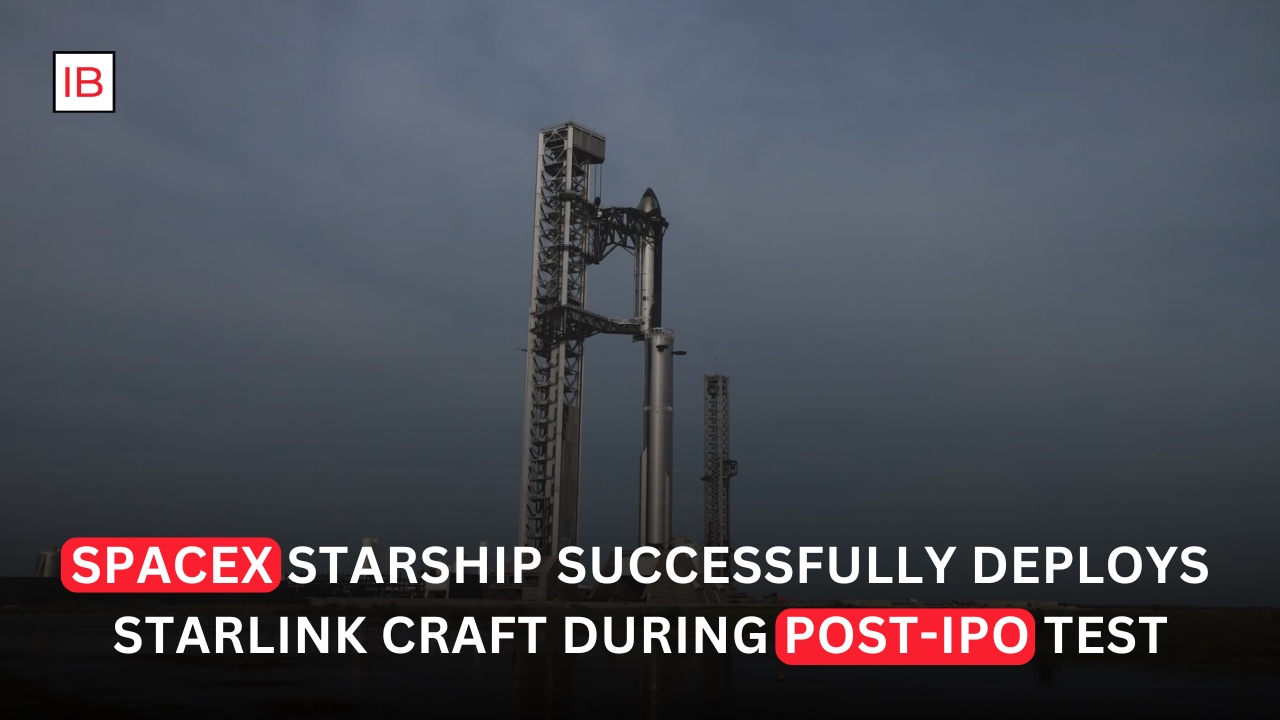
SpaceX has carried out one of its most closely watched Starship test flights, marking the first major mission since the company’s blockbuster initial public offering (IPO). The launch represented a critical milestone not only for SpaceX’s long-term ambitions but also for investors evaluating whether the company can successfully transition from its reliable Falcon rocket family to the fully reusable Starship system that underpins its future business strategy.
The mission successfully lifted off from Starbase in South Texas after earlier launch delays caused by technical issues and unfavorable weather. During the flight, Starship deployed 20 next-generation Starlink satellites, completed several important in-space demonstrations, and achieved its most successful atmospheric re-entry to date before making a controlled splashdown in the Indian Ocean. While the Super Heavy booster experienced problems during its return and failed to complete a fully controlled landing, SpaceX described the mission as a major step forward in gathering engineering data needed for future flights.
High Expectations After Historic IPO
The launch carried additional significance because it came shortly after SpaceX’s highly anticipated public market debut.
Following the IPO, investors have closely monitored Starship’s development, viewing the rocket as central to the company’s future growth beyond satellite launches.
Success is expected to unlock opportunities in:
- Deep-space exploration.
- Lunar missions.
- Mars transportation.
- Large-scale satellite deployment.
- Commercial cargo services.
- Future space infrastructure.
Although SpaceX already dominates commercial launch services through Falcon 9, executives have repeatedly emphasized that Starship is designed to dramatically reduce launch costs while carrying far larger payloads.
Important Technical Milestones
The latest mission introduced several firsts for the Starship program.
Among its key achievements were:
- Deployment of 20 advanced Starlink satellites.
- Successful upper-stage engine restart in space.
- Improved heat shield performance during re-entry.
- Most controlled Starship splashdown achieved so far.
- Collection of extensive engineering and flight data.
Six of the deployed satellites carried specialized cameras and sensors to monitor the spacecraft’s thermal protection system, allowing engineers to evaluate how the heat shield performed under the intense temperatures generated during atmospheric re-entry.
According to SpaceX, the mission produced the strongest re-entry results achieved by Starship to date, an important requirement before future missions involving astronauts or valuable cargo.
Booster Challenges Continue
Despite the successful upper-stage mission, the Super Heavy booster encountered problems during its return sequence.
The booster was unable to restart enough engines for a fully controlled landing and ultimately crashed into the Gulf of Mexico.
While this prevented complete mission success, SpaceX emphasized that the company expected to gather valuable performance data regardless of the landing outcome. The development philosophy behind Starship relies on rapid testing, learning from failures, and implementing improvements on subsequent flights.
Critical for NASA’s Artemis Program
The progress made during the flight also carries importance for NASA, which selected a modified version of Starship as the Human Landing System for the Artemis lunar program.
Future objectives include:
- Orbital refueling demonstrations.
- Docking with NASA spacecraft.
- Lunar landing missions.
- Transporting astronauts to the Moon.
Engineers continue viewing Starship as an essential component of future deep-space exploration because of its fully reusable design and enormous payload capacity.
Investors Remain Cautious
Despite the successful test, SpaceX shares remained under pressure following recent volatility.
Investors continue weighing:
- Technical progress.
- Launch reliability.
- Development costs.
- Commercial opportunities.
- Timeline for operational Starship missions.
Analysts note that repeated launch delays and technical setbacks have contributed to recent share-price weakness, even as Starship continues demonstrating measurable engineering improvements. Many believe future earnings and Starlink growth will remain equally important drivers of investor confidence alongside successful rocket development.
Long-Term Vision
Starship remains the centerpiece of Elon Musk’s long-term vision for SpaceX.
Beyond commercial satellite launches, the rocket is expected to support:
- Mars exploration.
- Space tourism.
- Lunar cargo transport.
- Global satellite deployment.
- Large-scale scientific missions.
Its unprecedented lifting capacity and fully reusable architecture could eventually transform the economics of space transportation if development milestones continue progressing successfully.
Looking Ahead
The latest Starship flight demonstrated meaningful progress at a time when SpaceX faces greater public and investor scrutiny than ever before. While the booster’s landing difficulties show that technical challenges remain, the successful deployment of Starlink satellites, improved heat shield performance, and controlled splashdown illustrate steady advancement toward operational capability.
For investors, the mission reinforced both the opportunities and risks associated with SpaceX’s long-term strategy. Starship has the potential to reshape the economics of spaceflight and support future missions to the Moon and Mars, but continued testing and refinement remain necessary before the system reaches full commercial operation. As SpaceX accelerates development, each successful flight brings the company closer to realizing its ambitious vision while providing markets with greater confidence in one of the most important aerospace projects of the decade.