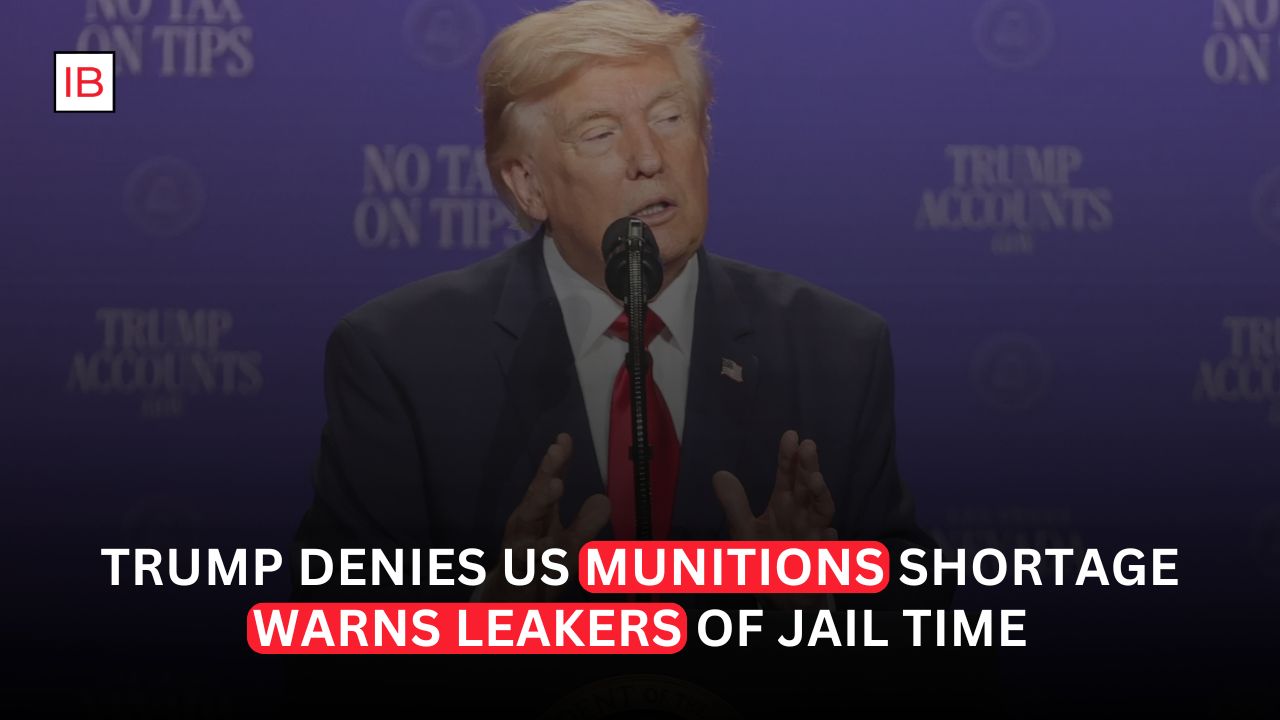
President Donald Trump denied Thursday that the United States is running low on munitions after months of fighting Iran, insisting the country possesses “massive amounts” of weaponry, while threatening lengthy prison sentences for officials he accused of leaking classified stockpile information to the press.
Trump’s Response to the Reports
“The U.S. has massive amounts of ‘munitions,’ especially of certain types. Additionally, large amounts are being manufactured and shipped to the U.S. as needed. Defense companies are building the largest number of plants and factories in our country’s history,” Trump wrote on Truth Social early Thursday. He went further in warning those responsible for disclosing stockpile details to reporters, writing, “The ‘leakers’ of these treasonous statements are being hunted down. Long term jail sentences will be sought!”
The post came just hours after the Washington Post reported that Trump had confronted Defense Secretary Pete Hegseth over munitions shortages during a meeting at Camp David the previous week, demanding to know why he had apparently been misled about the severity of the depletion.
What the Leaked Reports Actually Say
The reports Trump is disputing paint a detailed picture of strained American weapons stockpiles after months of sustained conflict with Iran. CNN reported this week, citing sources familiar with the latest inventory assessments, that the U.S. military has depleted nearly 80% of its Terminal High Altitude Area Defense, or THAAD, missile inventory compared with pre-war levels, and has used roughly half of its Patriot interceptors since fighting began. The Center for Strategic and International Studies had previously estimated the U.S. held approximately 452 THAAD missiles and around 2,200 of the two most modern Patriot interceptor variants before the war started.
Separately, CBS News reported that the U.S. has used nearly all of its global stockpile of long-range precision missiles during the conflict, including virtually its entire supply of Army Tactical Missile Systems, known as ATACMS, and Precision Strike Missiles, according to two sources with direct knowledge of the matter.
Concerns That Reportedly Shaped Recent Military Decisions
The stockpile concerns are not merely an abstract policy debate. CNN reported that the inventory issues were specifically raised again ahead of Trump’s decision last weekend to cancel planned new strikes on Iran, suggesting the munitions question has had direct, tangible influence on recent U.S. military decision-making in the conflict. Gulf nations that rely on American-provided air defense capabilities have separately expressed concern that depleted U.S. inventories could limit their own ability to intercept threats, particularly if they become targets amid any further escalation.
A Recurring Pattern of Denial
This is not the first time Trump has publicly dismissed reports of stockpile strain since the war began in late February. Back in March, after the Wall Street Journal reported that Joint Chiefs of Staff Chairman General Dan Caine had privately cautioned Trump about the risks of a prolonged campaign against Iran, Trump insisted the U.S. had a “virtually unlimited supply” of munitions and could fight the war “forever.” He simultaneously blamed former President Joe Biden for depleting American weapons stockpiles through military aid to Ukraine, while acknowledging in the same post that supplies of the “highest munitions grade” were not “where we want to be.”
Political Fallout in Washington
The renewed reporting on munitions shortages has drawn sharp reaction from Capitol Hill. The top Democrat on the Senate Armed Services Committee previously warned that Trump had launched a war without adequate weapons stockpiles in place, suggesting the administration’s repeated denials obscured a genuine strategic vulnerability rather than reflecting the confident public messaging officials have consistently offered.
What Comes Next
With Trump now threatening criminal prosecution against officials suspected of leaking stockpile information, even as reporting on the issue continues to emerge from multiple news organizations citing sources with direct knowledge of military inventories, the tension between the administration’s public assurances and internal concerns about weapons supply appears likely to persist. How that dynamic affects future U.S. military decision-making in the Iran conflict, and whether threatened prosecutions against leakers materialize, will likely remain closely watched developments in the weeks ahead.