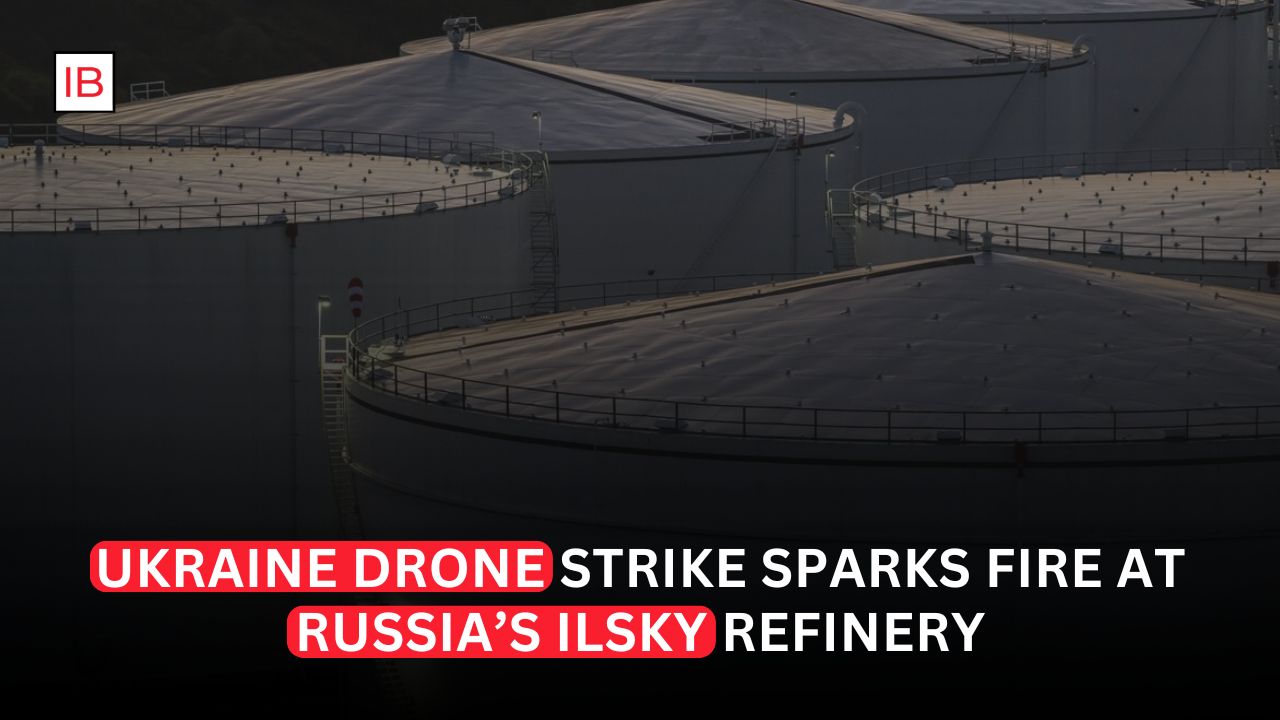
A fire broke out at Russia’s Ilsky Oil Refinery in the southern Krasnodar region after falling Ukrainian drone debris struck the facility, injuring five people, regional authorities said Saturday, as Russia and Ukraine exchanged another round of large-scale overnight attacks.
What Happened Overnight
Russia’s Defense Ministry said its air defenses intercepted and destroyed 397 Ukrainian drones overnight, underscoring the scale of the latest wave of strikes across Russian territory. The Ilsky refinery, located in the Krasnodar region and with a production capacity of around 138,000 barrels per day, caught fire after drone debris fell onto the facility, according to the regional task force. Five people were reported injured in the incident.
A Refinery Repeatedly Targeted
Saturday’s fire marks far from the first time the Ilsky Oil Refinery has come under attack during the war. The facility was struck by Ukrainian drones just weeks earlier, in early July, when officials in Krasnodar said debris again fell onto the refinery and caused a fire, along with damage to at least one nearby home and a commercial site. That earlier blaze was extinguished within hours, though the repeated targeting of the same facility underscores how central Ilsky has become to Ukraine’s broader campaign against Russian energy infrastructure.
Part of a Sustained Campaign Against Russian Energy Infrastructure
The Ilsky strike fits within a much larger pattern of Ukrainian attacks on Russian oil refineries and fuel depots that has intensified significantly over recent months. Just two days before Saturday’s fire, Ukrainian drones struck two major refineries deep inside Russian territory, including the Slavneft-Yanos facility in Yaroslavl Oblast, the largest oil refinery in central Russia and one of the five largest in the country overall, hit for a second consecutive night. That refinery has been targeted repeatedly throughout 2026, including four separate strikes in May alone.
Ukrainian President Volodymyr Zelensky has described the campaign explicitly as an effort to weaken Russia’s ability to sustain its war effort, framing each successful strike as reducing the resources available to what he has called Russia’s “war machine.” The campaign has expanded beyond refineries alone to include strikes on fuel depots, seaports handling oil exports, and electricity infrastructure, with attacks on facilities in Crimea’s Kerch and the port of Kavkaz among the recent targets, both of which play roles in supplying fuel to Russian forces along the front line.
The Toll on Russia’s Fuel Supply
Ukraine’s sustained campaign against energy infrastructure has had tangible effects on Russia’s domestic fuel situation. The repeated strikes have forced many refineries to suspend or halt production entirely at various points, contributing to fuel shortages and an energy crisis that has affected supplies across parts of the country, including the suspension of fuel sales in occupied Crimea following strikes on electricity plants supplying the peninsula.
A War Continuing Its Deadly Toll Elsewhere
The exchange of attacks has not been one-sided. Russian strikes on Kyiv and the surrounding area killed at least 17 people in an overnight ballistic missile attack around the same period, according to Ukrainian officials, underscoring that even as Ukraine intensifies its own long-range campaign against Russian infrastructure, Russia has continued its own pattern of near-daily strikes against Ukrainian cities that has defined the war since Russia’s full-scale invasion began in February 2022.
What Comes Next
With Ukraine showing no signs of scaling back its long-range drone campaign against Russian oil infrastructure, and Russia continuing to intercept hundreds of drones nightly while carrying out its own strikes against Ukrainian targets, the pattern of mutual attrition through energy and infrastructure strikes appears likely to persist. How much further sustained damage to facilities like the Ilsky refinery affects Russia’s broader fuel supply and war-fighting capacity will likely remain a key factor shaping the war’s trajectory in the months ahead.