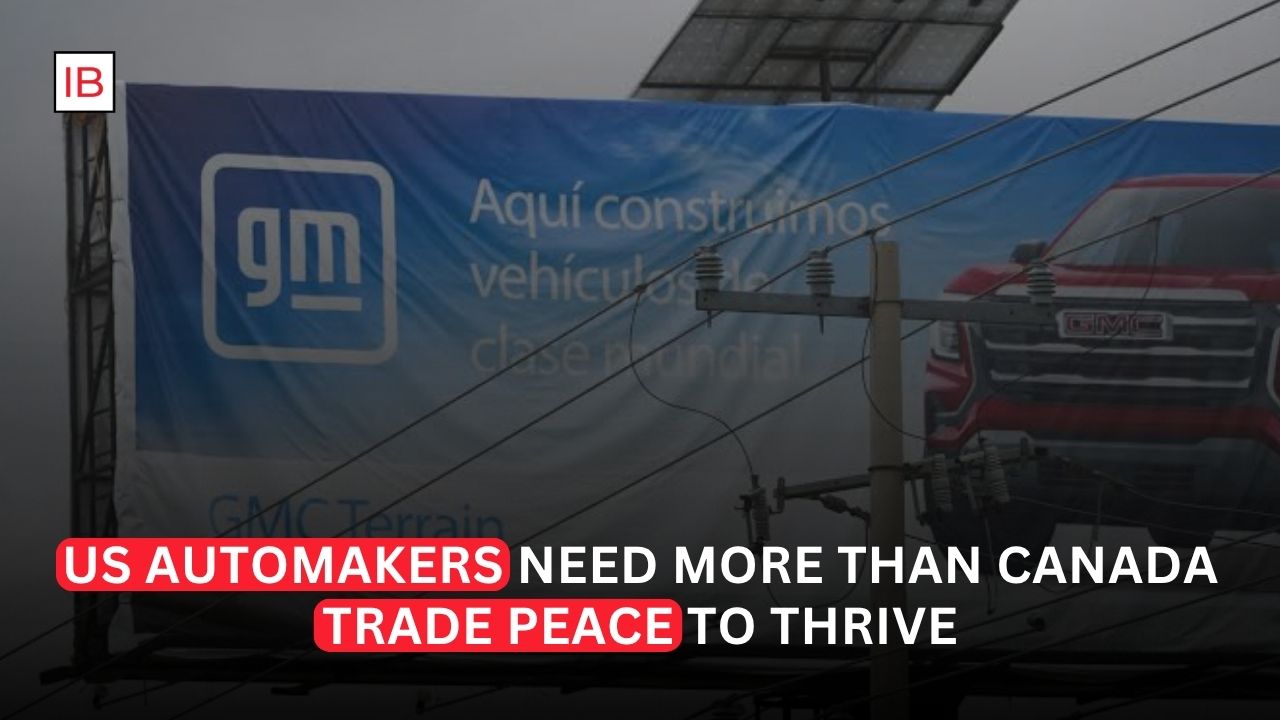
A temporary easing of trade tensions between the United States and Canada would be welcome news for American automakers, but it would not solve the deeper problems facing the industry.
The relationship between the two countries is too deeply integrated for tariffs and political disputes to be treated as isolated issues. Cars, engines, batteries, steel, aluminum and thousands of components cross the US-Canada border repeatedly before a finished vehicle reaches a customer.
That means even a reduction in tariffs would only remove one layer of pressure.
American automakers still face intense competition, expensive production, shifting consumer preferences, technological disruption and the enormous cost of transitioning toward electric and software-defined vehicles.
The central issue is therefore not simply whether Washington and Ottawa can reach a peaceful trade arrangement.
It is whether North America’s automobile industry can build a competitive industrial system capable of surviving the next decade.
Canada Is More Important to US Automakers Than It Looks
The US and Canadian automotive industries are deeply connected.
Vehicles are rarely manufactured entirely within one country.
A component can be produced in Canada, shipped to the United States for assembly, sent back across the border for another production stage and eventually incorporated into a finished vehicle.
This system developed over decades because companies found it more efficient to specialize production across North America.
That integration helped make the region one of the world’s major automobile manufacturing centers.
But it also creates vulnerability.
When governments impose tariffs or introduce new trade restrictions, the costs can spread through the entire supply chain.
The key problem is complexity.
Automakers cannot simply move one factory and eliminate the impact.
They must consider:
- Parts suppliers
- Assembly plants
- Steel and aluminum
- Engines and transmissions
- Batteries
- Logistics
- Labor costs
- Dealer networks
- Cross-border transportation
- Currency movements
A disruption in one area can quickly affect the economics of an entire vehicle program.
Tariff Peace Would Still Leave Higher Costs
Even if Washington and Ottawa reach an agreement that reduces trade tensions, automakers may not immediately return to their previous cost structures.
Companies make investment decisions years in advance.
Factories, supplier contracts and vehicle platforms can remain in place for decades.
Once tariffs or other trade restrictions force companies to redesign supply chains, reversing those decisions can be expensive.
This creates an important distinction between ending a trade dispute and restoring the old industrial system.
The first can happen relatively quickly.
The second may take years.
North American Integration Is an Advantage
There is also a strong argument for preserving the integrated system.
The US, Canada and Mexico together provide something few other regions can easily replicate: a huge consumer market combined with extensive manufacturing capacity.
Automakers can source materials, components and labor across three countries while selling vehicles throughout North America.
That scale can reduce costs.
It can also help companies compete against Asian and European manufacturers.
Breaking apart the system could therefore create unintended consequences.
Higher domestic production does not automatically mean lower prices.
If companies are forced to manufacture every component in the United States regardless of comparative advantage, production costs could rise.
Consumers would ultimately face some of those costs through higher vehicle prices.
The Real Competition Is Global
The biggest strategic mistake would be treating Canada as America’s main automotive competitor.
Canada is part of the same industrial ecosystem.
The much larger competitive challenge comes from companies based in Asia and Europe, particularly Chinese manufacturers that have developed significant advantages in batteries, electric vehicles and some automotive technologies.
Chinese automakers have become increasingly competitive because of their control over parts of the battery supply chain, manufacturing scale and aggressive pricing.
That means US automakers need to focus on improving competitiveness rather than simply protecting themselves from Canadian imports.
Electric Vehicles Have Changed the Equation
The automotive industry is undergoing one of the biggest technological transitions in its history.
Electric vehicles require different components than traditional gasoline-powered vehicles.
Internal-combustion engines depend on complex mechanical systems.
Electric vehicles rely heavily on batteries, electric motors, power electronics and software.
That changes the competitive landscape.
Companies that dominate battery technology can gain advantages across the entire vehicle industry.
For American automakers, building competitive EVs therefore requires more than converting existing factories.
It requires investment in:
- Battery production
- Critical minerals
- Charging infrastructure
- Software
- Semiconductor supply
- Manufacturing automation
- Vehicle platforms
- Supply-chain resilience
Canada can play an important role in several of these areas.
Canada Has Resources America Needs
Canada possesses significant natural resources that are strategically important to the automotive industry.
These include minerals used in batteries and other advanced technologies.
A stronger US-Canada industrial relationship could therefore help American manufacturers reduce dependence on potentially vulnerable overseas supply chains.
This is especially important as competition with China intensifies.
Instead of viewing Canada primarily through the lens of trade deficits, Washington could view the country as a strategic industrial partner.
That would require a different approach to economic policy.
The Battery Supply Chain Is Critical
Batteries represent one of the most important parts of an electric vehicle’s cost.
Control over battery materials, refining and manufacturing can therefore determine whether an automaker can compete on price.
North America has invested heavily in building domestic battery capacity.
Canada has attracted major battery and electric-vehicle investments, partly because of its access to resources, electricity and proximity to the US market.
That investment creates an opportunity for deeper continental integration.
But constant changes in trade policy can make companies hesitate before committing billions of dollars.
Policy Uncertainty Is Its Own Cost
For automakers, uncertainty can be almost as damaging as tariffs themselves.
A company planning a factory may expect the investment to operate for 20 or 30 years.
If government policy can change dramatically every few years, calculating the project’s economics becomes much harder.
Executives must consider multiple scenarios.
What happens if tariffs rise?
What happens if subsidies disappear?
What happens if rules of origin change?
What happens if another government reverses the policy?
That uncertainty can delay investment.
And delayed investment can eventually weaken competitiveness.
American Automakers Have Internal Problems Too
Trade policy is only one part of the problem.
US automakers also have to confront structural weaknesses within their own businesses.
Labor costs can be high.
Legacy factories can be difficult to modernize.
Companies still carry enormous pension and healthcare obligations.
Some vehicle programs have struggled to generate attractive returns.
And the transition to EVs has been slower and more complicated than many executives initially expected.
Blaming Canada for these problems would therefore be a mistake.
The industry needs to solve its own competitiveness challenges while governments create a stable environment for investment.
Consumer Preferences Are Changing
American consumers have also become more selective.
Large pickup trucks and SUVs remain extremely important to the US market, but buyers are increasingly sensitive to prices.
Higher interest rates have made monthly vehicle payments more expensive.
Insurance costs have also increased.
That puts pressure on automakers to deliver better value.
A vehicle that costs significantly more because of tariffs, supply-chain inefficiencies or expensive technology may struggle to attract consumers.
This creates another reason for manufacturers to control costs.
Automakers Need Scale
One of the advantages of the North American market is scale.
A manufacturer can design a vehicle for a market of hundreds of millions of people.
That allows companies to spread research and development costs across large production volumes.
But scale only works when supply chains are efficient.
If every border crossing creates additional costs, the advantages of scale begin to disappear.
That is why stable trade rules are so important.
Mexico Cannot Be Ignored
Any discussion about the future of North American automobiles must include Mexico.
The country has become a major manufacturing center for vehicles and automotive components.
US automakers and suppliers rely heavily on Mexican production.
This means Washington cannot realistically create a competitive North American automotive strategy by focusing only on the US and Canada.
The three-country relationship matters.
Canada provides resources, components and manufacturing capacity.
The United States provides a massive consumer market, advanced manufacturing and capital.
Mexico provides highly integrated manufacturing capabilities and a large industrial workforce.
The competitive advantage comes from combining these strengths.
Protectionism Has Limits
Protecting domestic production can be useful when strategic industries are threatened.
But protectionism can also create unintended consequences.
If tariffs make imported components more expensive, domestic automakers may face higher costs.
If American-made vehicles become more expensive, consumers may postpone purchases.
If foreign companies gain advantages because they can produce more cheaply elsewhere, American manufacturers may lose market share.
The objective should therefore not simply be to maximize domestic production.
It should be to maximize competitive production.
Those are not always the same thing.
What a Better North American Strategy Could Look Like
The US could pursue a more coordinated industrial policy with Canada and Mexico.
Stable trade rules
Companies need predictable tariff and customs policies.
Critical-mineral cooperation
North America should develop secure supply chains for battery materials.
Joint investment
Governments could coordinate incentives for strategically important factories.
Infrastructure development
Ports, railways, roads and border crossings need to operate efficiently.
Workforce training
Workers need skills for EV manufacturing, software and advanced automation.
Research and development
North America needs stronger cooperation in batteries, semiconductors and automotive software.
Such measures would address the industry’s deeper problems rather than simply resolving one political dispute.
The Border Needs to Work Better
For an integrated automotive industry, border efficiency is crucial.
A truck carrying automotive components cannot afford unnecessary delays.
Every hour spent waiting at a border can increase logistics costs.
Every additional inspection creates uncertainty.
Modernizing customs systems and improving infrastructure could therefore deliver benefits even without changing tariff rates.
This is a relatively unglamorous part of industrial policy, but it can have a significant effect on competitiveness.
The Future Is About Technology, Not Just Trade
The automobile industry is increasingly becoming a technology industry.
Vehicles now contain sophisticated software, sensors, connectivity systems and computing capabilities.
Artificial intelligence is beginning to influence manufacturing and vehicle development.
Autonomous-driving technology could eventually change the economics of transportation.
Battery improvements could reshape consumer adoption of EVs.
These developments mean American automakers cannot rely on traditional advantages forever.
A company with an efficient supply chain but weak software may still lose to a competitor with better technology.
US Automakers Need a Long-Term Strategy
The industry therefore needs something more durable than temporary trade agreements.
Executives need clarity about where factories should be located.
They need confidence that supply chains will remain viable.
They need access to competitive energy and raw materials.
They need workers with the right skills.
And they need to develop vehicles consumers actually want to buy.
Government can help create those conditions.
But it cannot manufacture competitiveness by itself.
Canada Should Be Treated as an Industrial Partner
The most useful conclusion from the current dispute may be that the US has more to gain by working with Canada than by treating the country primarily as a trade adversary.
The two economies are deeply connected.
They share infrastructure.
They share supply chains.
They share labor markets in some regions.
And they face many of the same competitive pressures from China and other global manufacturers.
A cooperative strategy could turn those connections into an advantage.
Conclusion
Peace with Canada would remove one important source of uncertainty for American automakers, but it would not solve the industry’s fundamental problems.
The US automotive sector needs more than lower tariffs.
It needs competitive supply chains, reliable access to critical minerals, investment in batteries and software, skilled workers, efficient infrastructure and predictable government policy.
Canada can be an important part of that strategy.
Rather than viewing the country simply as a trading partner whose imports need to be controlled, Washington could treat Canada as part of a broader North American industrial system.
That approach would make more sense at a time when the real competition is global.
China is rapidly developing automotive technology.
European manufacturers are investing heavily in electrification and software.
Consumer expectations are changing.
And the transition from gasoline-powered vehicles to electric and digitally connected vehicles is forcing manufacturers to rethink their entire business models.
The biggest danger for American automakers is therefore not simply losing a trade argument with Canada.
It is becoming less competitive while policymakers remain focused on the wrong problem.
A stable relationship with Canada would be useful.
But stability is only the foundation.
To remain globally competitive, US automakers need a North American industrial strategy that combines trade stability with technological investment, supply-chain security, productivity and long-term competitiveness.