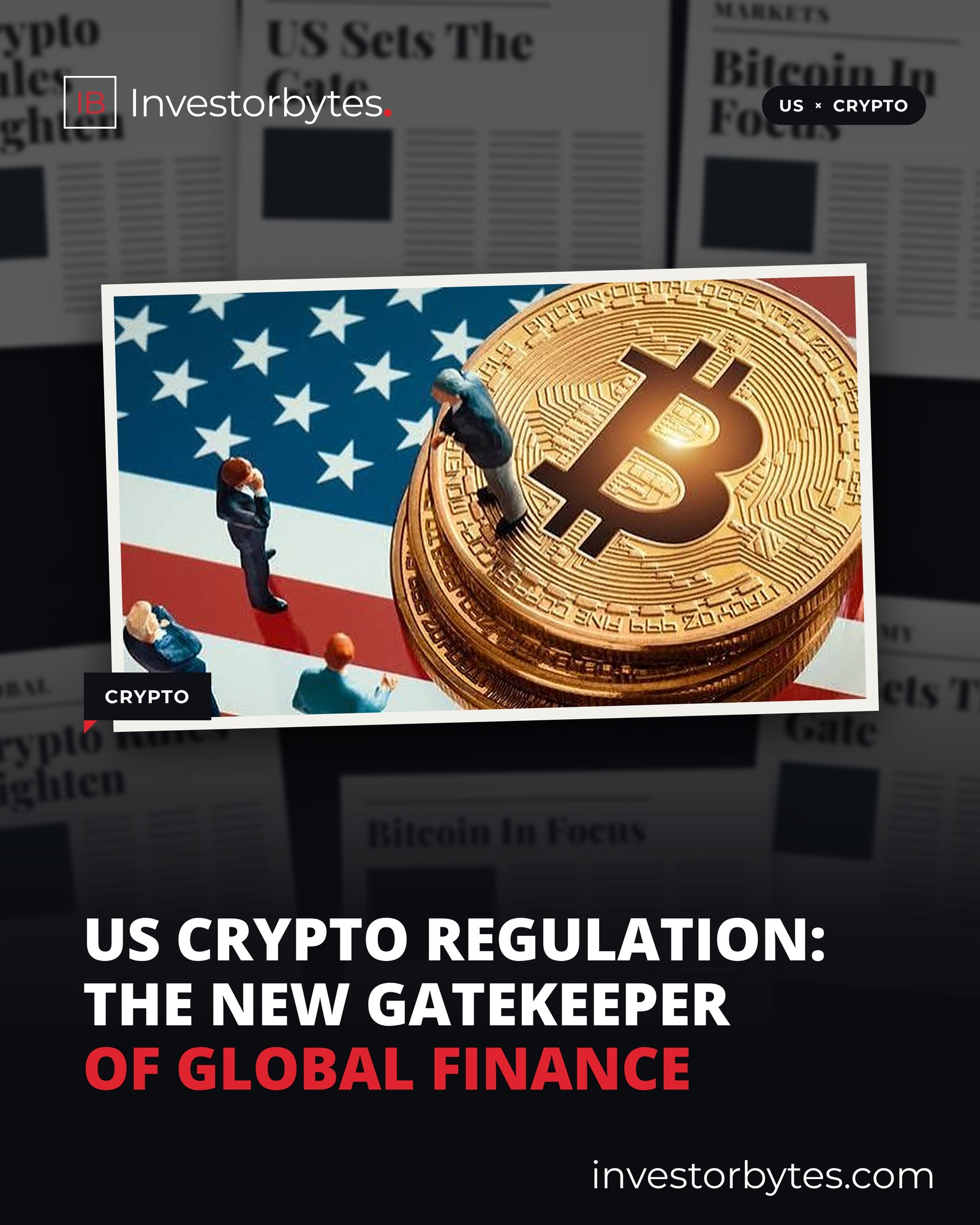
Digital finance has no shortage of technology. Tokens can be minted in minutes, payment rails can be copied, and an exchange can be run from almost any jurisdiction with a reliable internet connection. What is scarce is a rulebook that institutions everywhere recognise and trust. According to a recent World Finance opinion piece, US crypto regulation is set to fill that gap, turning Washington into the de facto gatekeeper for any fintech, payments company or digital asset fund that wants access to American capital.
The argument took shape in Paris, where the author spent three days with fintech executives, institutional investors and the people who design regulatory frameworks. The recurring theme was demand. Operators from São Paulo to Singapore and from Dubai to Ho Chi Minh City want a route into the US market, yet most have little idea how to secure one. That uncertainty, rather than any lack of ambition, is what holds many of them back.
Why rules now matter more than rails
For most of the post-war era, American financial power has rested on three foundations: the dollar’s status as the world’s main reserve currency, the unmatched depth of US capital markets, and an institutional infrastructure that became the default setting for international trade and settlement. None of these pillars is crumbling. But blockchain changes the competitive terrain. When anyone can replicate the infrastructure, infrastructure stops being a moat.
The piece makes the case that the real differentiator in this environment is a regulatory standard that is clear, enforceable and understood across borders. Markets reward predictability. A firm deciding where to issue a token, where to hold client assets or which partner bank to approach needs to know which regulator has authority and what obligations follow. Where those answers are missing, capital tends to wait on the sidelines or drift towards jurisdictions where they are available.
From the GENIUS Act to the CLARITY Act
The first major step was the GENIUS Act, which placed dollar-pegged stablecoins under formal supervision and set reserve requirements for their issuers. That gave the fastest-growing corner of the digital asset world a recognisable legal footing. It did not, however, settle the status of everything else. Tokenised securities, crypto commodities, decentralised finance protocols and tokenised Treasury products were left in a legal grey zone, and the author argues that this ambiguity has cost businesses in the US and abroad billions of dollars in missed opportunities and confusion.
The CLARITY Act is designed to close much of that gap. Its framework would draw a line between digital assets that count as securities and those that count as commodities, clarify where the authority of the Securities and Exchange Commission ends and that of the Commodity Futures Trading Commission begins, and set out a coherent regime for exchanges, broker-dealers and custodians. For a Brazilian fintech, a Vietnamese payments company or a Dubai-based digital asset fund, that would mean a defined set of requirements to meet before approaching a US bank or asset manager. The author reports that the reaction in Paris to this prospect was not scepticism but relief.
How US crypto regulation could become a global template
The boldest claim in the piece is that US crypto regulation will become a template that other jurisdictions choose to follow, because alignment is the price of access. That logic has precedent. Global banks have long shaped their anti-money laundering and sanctions controls around American expectations, simply because losing access to dollar clearing is too costly to contemplate.
Washington is not the only credible option. The European Union’s Markets in Crypto-Assets regulation (MiCA), the UAE’s Virtual Assets Regulatory Authority (VARA) and the Monetary Authority of Singapore all run well-developed regimes, and the author acknowledges their appeal. But the pull of US investors and dollar liquidity gives American standards a gravitational force that smaller markets struggle to match.
The author also predicts a trade-off. The US may win the contest to set the rules while ceding some product innovation to jurisdictions that are more relaxed about experimentation. The piece calls this a division of labour and argues it should be accepted rather than resisted, noting that past attempts to protect legacy systems by suppressing innovation have generally failed.
The rising cost of getting compliance wrong
If the opportunity is access, the threat is exclusion. The article points to a run of enforcement actions as evidence of a clear direction rather than a series of one-offs. Binance agreed to pay $4.3bn in 2023, at the time the largest corporate resolution secured by the US Department of Justice. TD Bank settled for $3.1bn in 2024 and became the largest US bank to plead guilty to a money laundering conspiracy. Revolut, meanwhile, was fined €3.5m over failures in transaction monitoring.
Yet the author suggests that for many firms the real penalty will be quieter than a headline fine. It will look like paralysis: controls that do not map to a counterparty’s expectations, transactions that are held or rejected, and onboarding processes that stall while better-prepared competitors sign up the same US investors. In cross-border finance, being slow is often indistinguishable from being shut out.
Compliance as a competitive advantage
Drawing on three decades of building technology for global financial institutions, the author observes that compliance has traditionally been treated as a cost centre or something bolted on after a product is built. That mindset, the piece argues, belongs to a previous era. In digital assets, the ability to prove compliance before a transaction is executed is becoming the main factor separating firms that capture the market from those locked out of it.
This fits a broader shift across finance. Supervisors increasingly expect controls to be embedded in systems rather than applied after the fact, and institutional clients want evidence of robust governance before they commit capital. For firms outside the US, investing now in compliance architecture that can map onto American rules, as well as onto MiCA or Singaporean standards, may prove far cheaper than retrofitting later under pressure.
There are caveats. Legislative timetables in Washington can slip, and political priorities can change quickly. A rulebook built around US market structures will not suit every economy, and some regulators will resist importing it wholesale. Still, for internationally ambitious firms, the direction of travel is hard to ignore.
Conclusion
The central message is simple. As tokens and payment rails become commodities, regulatory clarity becomes the scarce resource, and US crypto regulation is positioned to be the reference point for global market access. Firms that can confidently answer one question, whether they are compliant before they transact, will be best placed to benefit. Those that delay risk discovering that the window to close their compliance gaps cheaply has already shut, and that rivals have been onboarded first.