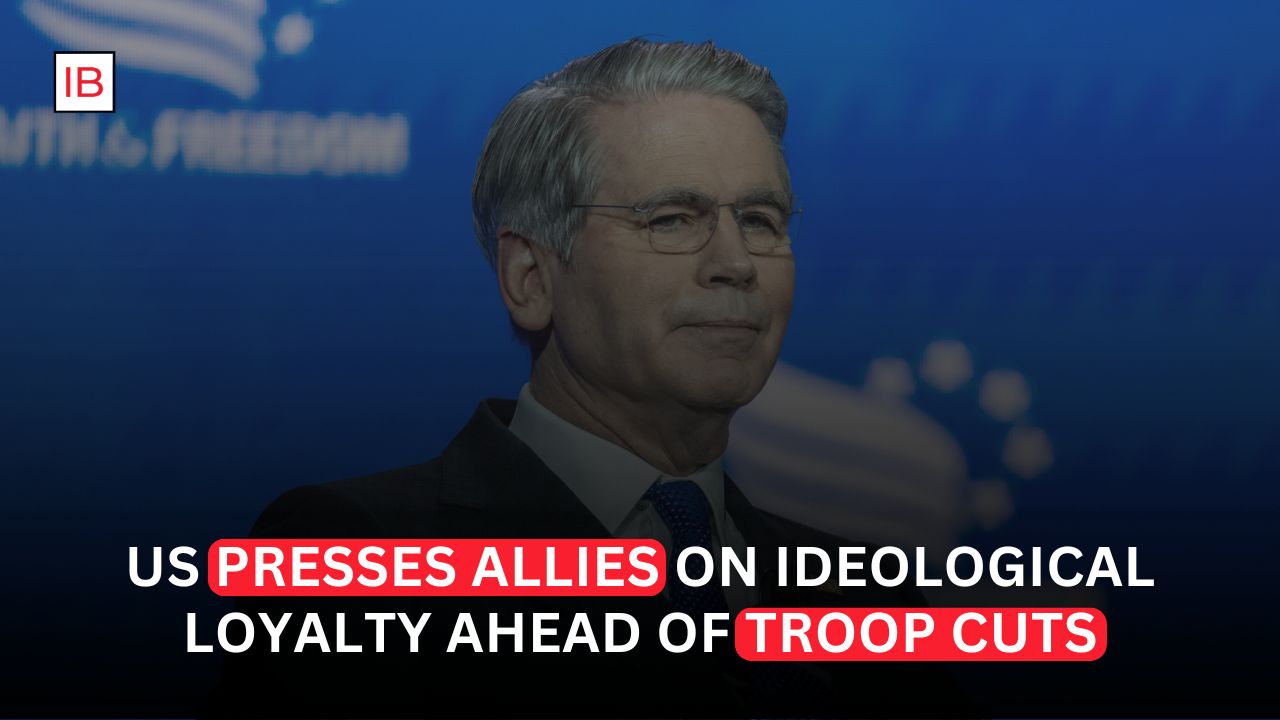
The Trump administration is increasingly tying US security commitments to political and ideological alignment with Washington, as it prepares to reduce parts of the American military presence abroad.
The important distinction is that this is not simply about cutting troops. Washington appears to be trying to change the terms of the alliance system itself: allies are being asked to contribute more, align more closely with US priorities and accept a smaller US military footprint.
Recent Pentagon messaging supports that broader shift. Undersecretary of Defense for Policy Elbridge Colby said the US is not abandoning Asia but wants “partnership, not dependency,” while urging regional allies to take greater responsibility for their own defense.
Troop Cuts Are Only Part of the Story
A straightforward reading would be:
Fewer US troops = weaker American commitment.
That’s too simple.
The administration’s emerging strategy appears closer to:
Fewer permanent US resources + greater allied spending + stronger political alignment + more selective US intervention.
That could still preserve substantial American influence.
The problem is that deterrence depends not only on money or weapons, but also on whether allies believe Washington will actually use its power when needed.
Europe Is Already Worried
European allies have been pressing Washington for greater clarity over potential troop reductions, particularly because US forces provide capabilities that European militaries cannot immediately replace.
The issue isn’t just the number of soldiers stationed in Europe.
The US contributes:
- Airpower
- Intelligence
- Logistics
- Air defense
- Strategic transport
- Command infrastructure
- Nuclear deterrence
- Rapid reinforcement capabilities
Removing some troops can therefore have a much larger effect than the raw troop count suggests.
Washington Wants Allies to Spend More
This part of the strategy is not new.
Trump has repeatedly argued that US allies have relied too heavily on American military protection.
The administration now appears to be turning that argument into policy.
The Pentagon’s message in Asia is particularly explicit: Washington wants partners to invest more in their own defense rather than depend on American forces.
That could eventually produce a stronger allied military structure.
But there is a transition problem.
European and Asian allies cannot instantly replace US capabilities.
Building aircraft, missile defenses, intelligence networks and strategic logistics takes years.
The Ideological Component Is More Complicated
The potentially bigger change is the emphasis on ideological loyalty.
Traditional alliances are usually based on overlapping security interests.
The Trump administration is increasingly emphasizing something broader:
Do allies share Washington’s political priorities?
That creates a different kind of alliance.
Countries may still be formally allied with the US while disagreeing with Washington over:
- Iran
- China
- Ukraine
- Trade
- Immigration
- Multilateral institutions
- Defense spending
- Military intervention
If ideological alignment becomes a prerequisite for security cooperation, those disagreements could become strategically consequential.
Asia Shows the New Model
Colby’s recent comments are revealing.
He argued that the US is not leaving Asia, but wants regional partners to take greater responsibility for their own defense.
The US is therefore attempting to maintain a favorable balance of power while shifting more of the burden onto countries such as Japan, South Korea, the Philippines and others.
That is different from outright isolationism.
It is closer to burden-sharing enforced through leverage.
Japan and South Korea Face a Difficult Calculation
Both countries have strong security incentives to maintain the US alliance.
But they also have to consider what happens if Washington’s commitments become conditional.
If the US reduces its military presence, Japan and South Korea may need to increase:
- Defense spending
- Missile defenses
- Naval capabilities
- Long-range strike capabilities
- Intelligence systems
- Domestic weapons production
That could strengthen their military autonomy.
But it could also increase regional tensions.
China and North Korea are unlikely to ignore a major increase in Japanese or South Korean military capabilities.
The Nuclear Question Matters
The most sensitive issue is nuclear deterrence.
Japan and South Korea rely heavily on the US nuclear umbrella.
If confidence in Washington’s commitment falls, pressure for greater independent deterrence could increase.
That doesn’t mean either country will immediately seek nuclear weapons.
But a less reliable US security guarantee could change the political debate over nuclear options.
That would be a major strategic consequence of troop reductions that doesn’t appear in a simple troop-count calculation.
The Same Problem Exists in Europe
Europe is in a similar position.
European governments have already increased defense spending and are discussing greater strategic autonomy.
That is partly a response to Russia.
But uncertainty over US commitments accelerates the process.
The result could eventually be a Europe that is more militarily capable but less dependent on Washington.
From one perspective, that’s exactly what Trump wants.
From another, it risks weakening NATO’s integrated deterrence during the transition.
The Short-Term Risk Is the Gap
The biggest weakness in the strategy is timing.
Suppose Washington reduces its military presence today.
European and Asian allies promise to compensate.
But their new capabilities take five or ten years to build.
You now have a capability gap.
That gap can be dangerous because adversaries don’t have to wait for the new system to mature.
This is one reason analysts have warned about reductions in US forces and equipment available to NATO.
China Benefits From Any Alliance Friction
China is probably the most important external beneficiary if the US-allied system becomes less cohesive.
Beijing does not necessarily need the US to withdraw completely.
It only needs allies to become less confident that Washington will act collectively.
If Japan, South Korea, the Philippines and European countries begin questioning American reliability, China gains more room to:
- Apply pressure around Taiwan
- Expand influence in Southeast Asia
- Challenge US military access
- Exploit disagreements among allies
- Present itself as a more predictable regional power
That is why alliance credibility matters almost as much as military hardware.
Russia Has a Similar Incentive
Russia also benefits from cracks inside NATO.
A divided alliance makes deterrence less credible.
But there is a counterargument here: European rearmament could ultimately make Europe stronger, even if US involvement declines.
The question is whether Europe can replace American capabilities quickly enough.
That’s not guaranteed.
The Strategy Could Work — But Only Under One Condition
The administration’s approach can succeed if allies respond by genuinely building stronger militaries.
In that scenario:
US reduces burden → allies spend more → allied capabilities rise → US concentrates on priority theaters.
That could produce a more balanced alliance system.
But if the result is instead:
US reduces commitment → allies become uncertain → coordination weakens → adversaries test the alliance,
then Washington could end up with less influence and weaker deterrence.
The difference is execution.
What Investors Should Watch
European Defense Spending
More uncertainty around US commitments should support long-term European defense investment.
US Defense Contractors
A shift toward allied burden-sharing could increase foreign demand for American weapons, particularly air defense, missiles and advanced aircraft.
NATO Procurement
Joint European procurement would signal that allies are moving beyond rhetoric.
Japan and South Korea Defense Budgets
These will show whether Washington’s pressure is actually producing greater allied military capacity.
US Troop Numbers
The headline troop count matters less than which capabilities are withdrawn.
Taiwan and Indo-Pacific Posture
The US may reduce some forces in one theater while increasing resources in another.
Nuclear Policy
Any serious discussion of independent European, Japanese or South Korean deterrence would represent a major strategic shift.
The Bigger Picture
The important story isn’t simply that the US is cutting troops.
It’s that Washington appears to be renegotiating the political and financial basis of its alliances.
The administration wants allies that are:
- More militarily capable
- More financially responsible
- More politically aligned
- Less dependent on US forces
The danger is the transition.
US allies may eventually become stronger because they are forced to carry more of the burden. But if American withdrawals happen faster than allied capabilities can replace them, the interim period could weaken deterrence.
That makes the next few years unusually important.
The question isn’t whether America can reduce its overseas military footprint. It can. The question is whether it can do so without reducing the credibility of the alliances that give Washington much of its global power in the first place.