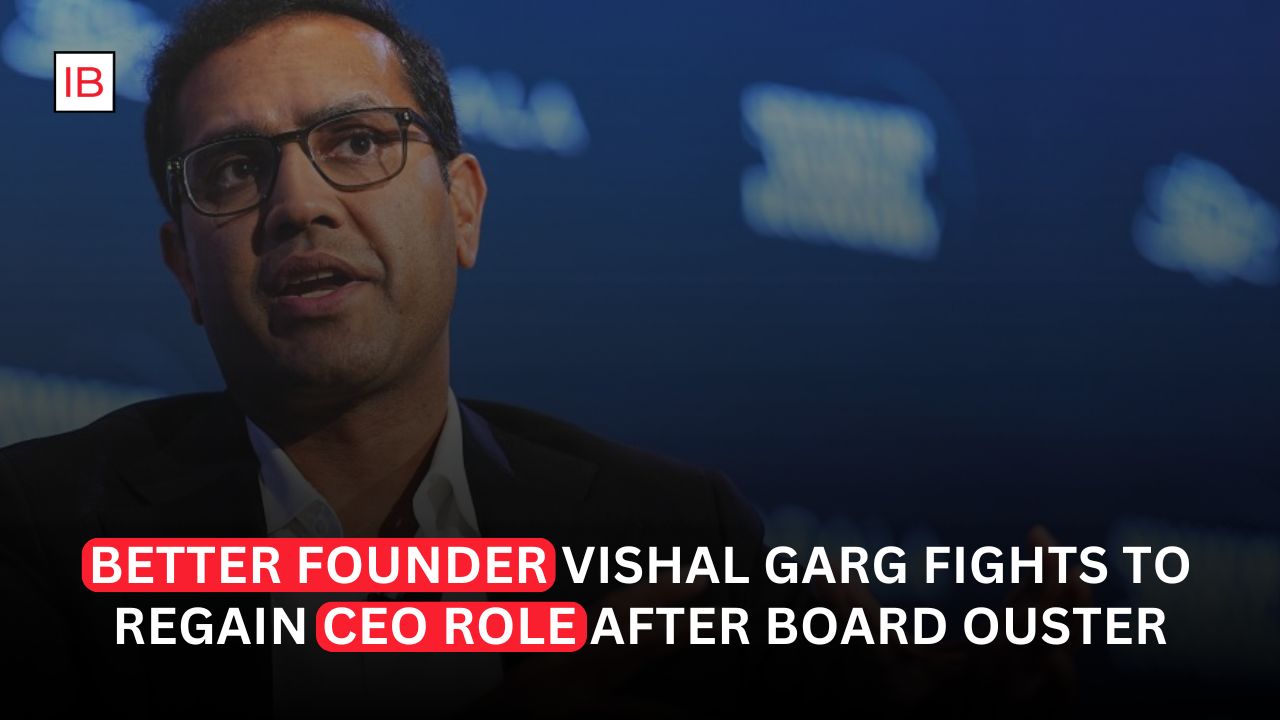
Vishal Garg’s removal from Better.com is more than a leadership shake-up. It is a test of whether a founder who built a company around aggressive execution can remain in control when the board decides that leadership style, judgment and governance have become liabilities.
Garg was removed as CEO on August 3, 2026, with board member Daniel Lewis taking over as interim CEO. Garg has since been pushing to regain control, backed by shareholders who collectively represent a majority of the company’s voting power.
Garg’s Biggest Problem Isn’t His Track Record
Garg has a legitimate case for himself.
Better has recently been growing rapidly. In Q1 2026, loan volume increased 89% year over year to about $1.64 billion, while revenue rose 52% to $48 million. Its AI-powered Tinman platform accounted for roughly half of loan volume.
The company also reported preliminary Q2 funded volume of about $1.67 billion, up 45% from a year earlier, with revenue around $54.7 million.
So the argument that Garg simply ran a stagnant company doesn’t hold.
The harder question is whether growth justifies the governance risk associated with keeping him in charge.
The 2021 Firing Still Matters
Garg became infamous in 2021 after firing roughly 900 employees during a Zoom call.
That episode became a symbol of his management style and triggered intense criticism of his treatment of employees.
But the current dispute is more serious because the issue isn’t merely employee morale.
The Better board reportedly cited concerns over Garg’s judgment, temperament and credibility, as well as issues surrounding the company’s financial reporting.
Those are much more consequential for a public company.
Better Has Already Warned Investors About Garg
This isn’t a new concern.
Better’s own SEC filings have previously warned that Garg’s control over operations and his status as the company’s largest shareholder created particular risks.
The company also acknowledged that negative publicity surrounding Garg’s leadership style had contributed to management and employee attrition and could make it harder to build relationships with lenders and customers.
That makes the current board decision easier to understand.
The board wasn’t suddenly discovering that Garg was controversial.
It had been publicly identifying the risk for years.
But Garg Has a Powerful Counterargument
Garg can point to the company’s recent transformation.
Better is trying to move beyond being a conventional digital mortgage lender and become an AI-native lending platform.
Its Tinman AI system is increasingly being distributed through partnerships, including Credit Karma. Better said Credit Karma Home Loans powered by Tinman had generated more than 30,000 mortgage pre-approvals within five months.
If that strategy works, Garg could argue that removing the founder just as the company reaches an inflection point is strategically reckless.
That’s the strongest argument in his favor.
But Growth Doesn’t Resolve Governance
This is where Garg’s case gets weaker.
A founder doesn’t automatically deserve control because the company is growing.
For a public company, investors also need confidence in:
Financial reporting
Board oversight
Executive judgment
Regulatory compliance
Capital allocation
Internal controls
If the board genuinely believes the CEO has become a governance risk, strong operating growth isn’t enough to erase that concern.
The Shareholder Revolt Changes the Equation
Garg isn’t simply asking the board to reconsider.
He is attempting to replace directors and regain influence through shareholders.
That makes this a corporate-control battle.
Reports indicate that investors representing roughly 52% of voting shares have backed efforts to remove Lewis and five directors.
If that support holds, the board could face a serious challenge.
But there is an important caveat:
Owning or controlling a majority of voting power doesn’t necessarily make the founder’s preferred outcome inevitable.
The exact shareholder agreements, voting structure and legal process matter.
Better’s Stock Is Sending Its Own Signal
The market has not treated the dispute as irrelevant.
Better Home & Finance shares fell about 8.5% on August 14, with the boardroom fight adding uncertainty around the company.
That’s not proof that investors prefer one side.
It is evidence that the market sees governance uncertainty as a cost.
And that matters for a mortgage company that needs confidence from lenders, investors and institutional partners.
The Real Question Is Who Can Execute the AI Strategy
Better’s most interesting asset may no longer be its mortgage brand.
It is the Tinman platform.
The company wants to use AI to automate and distribute mortgage origination through partners rather than relying entirely on direct-to-consumer marketing.
That could materially change Better’s economics.
But the strategy doesn’t necessarily require Garg personally.
This is an important distinction.
Garg may have created the strategy without being indispensable to executing it.
That’s what the board appears to be betting on.
The Interim CEO Faces a Difficult Test
Daniel Lewis has inherited a company that needs to prove several things simultaneously:
- Keep loan volume growing
- Expand Tinman
- Maintain lender relationships
- Improve profitability
- Resolve the governance dispute
- Retain employees
- Restore investor confidence
If performance deteriorates sharply after Garg’s departure, Garg’s argument becomes much stronger.
If Better continues growing without him, the board will have evidence that the company has successfully separated the business from the founder.
That could ultimately be the most important test.
Better Still Has a Profitability Problem
The growth figures shouldn’t obscure the financial reality.
Better reported a $70 million net loss in Q1 2026, despite the strong increase in revenue and loan volume.
Preliminary Q2 figures showed another net loss of roughly $30.6 million.
So Better is not yet a clean turnaround story.
It’s a high-growth company still trying to prove that its AI-driven model can produce sustainable profits.
That makes leadership execution particularly important.
The Founder vs. Board Debate Is a Distraction
The most dangerous outcome would be for the company to spend months fighting over control while competitors capture the opportunity Better is trying to pursue.
Mortgage technology is moving quickly.
The company needs to focus on:
Lower acquisition costs → faster underwriting → higher conversion → better margins.
A prolonged governance fight works against all four.
What Happens Next Matters More Than the Headlines
There are three plausible outcomes.
1. Garg Regains Control
The shareholder revolt succeeds and the board is substantially replaced.
That would represent a major defeat for Better’s current directors.
2. Garg Remains a Large Shareholder but Loses Operational Control
This is potentially the cleanest compromise.
Garg retains economic exposure while a professional management team runs the company.
3. The Board Wins
Lewis remains CEO and the board survives.
Better then has to prove that the company can execute its AI strategy without its founder.
The Bigger Picture
Vishal Garg’s situation exposes a recurring problem in founder-led companies:
The traits that help build a company aren’t necessarily the traits required to govern a public company.
Aggression, speed and unconventional decision-making can be valuable during a startup’s growth phase.
But once billions of dollars of shareholder capital, lenders and regulatory obligations are involved, judgment and governance become part of the product.
Garg can point to Better’s accelerating loan volume and AI strategy as evidence that his leadership still works.
The board can point to governance concerns and argue that the company has outgrown its founder’s management style.
The market now gets to decide which argument is more credible.
The decisive question isn’t whether Vishal Garg is a good entrepreneur. It’s whether Better.com is better with Vishal Garg running it.