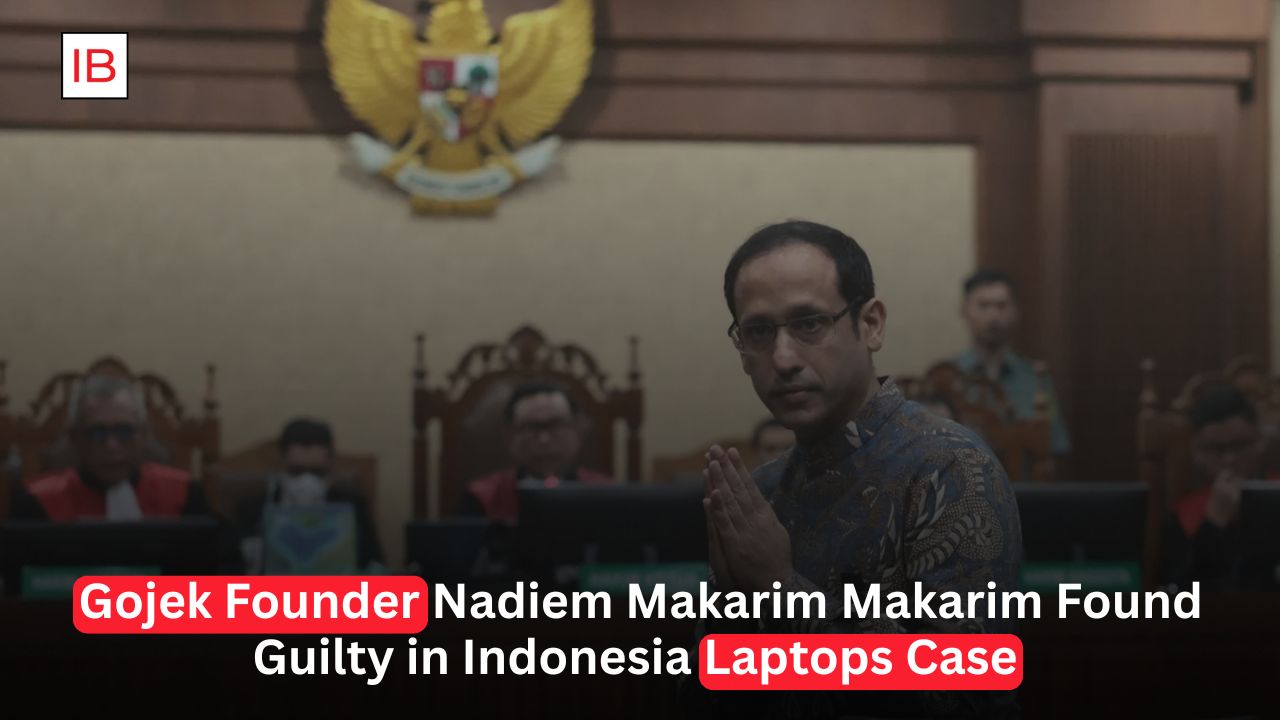
An Indonesian court has sentenced former Education Minister and Gojek co-founder Nadiem Makarim to 10 years in prison after finding him guilty in a major corruption case linked to a government school laptop procurement program.
An Indonesian court has convicted Nadiem Makarim, the co-founder of ride-hailing giant Gojek and the country’s former education minister, in one of the nation’s most closely watched corruption trials. The Central Jakarta District Court sentenced the 41-year-old entrepreneur to 10 years in prison after ruling that he abused his authority during a government program to procure Chromebook laptops for schools between 2020 and 2022.
Although prosecutors had sought an 18-year prison sentence, the court imposed a reduced term. Makarim was also fined 1 billion rupiah (about $56,000) and ordered to repay approximately 800 billion rupiah ($45 million). If he fails to make the repayment, he could face an additional five years in prison.
Court Finds Abuse of Authority
The court concluded that Makarim abused his position while overseeing the Education Ministry’s Chromebook procurement initiative, causing estimated state losses of around $125 million.
However, judges stopped short of finding that Makarim personally enriched himself through the project. Instead, the conviction focused on misuse of official authority and irregularities surrounding the procurement process.
The laptop program was launched during the COVID-19 pandemic to accelerate digital learning in Indonesian schools, but investigators later alleged serious flaws in the purchasing process.
Makarim Denies Wrongdoing
Following the verdict, Makarim maintained his innocence and announced plans to appeal the decision.
He has consistently argued that the case is politically motivated, claiming his efforts to reform Indonesia’s education system and combat corruption created powerful opponents. Several academics, policy experts, and human rights advocates have also questioned aspects of the investigation, arguing that legitimate policy decisions should not automatically be treated as criminal offenses.
His legal team is expected to challenge both the conviction and the sentence through Indonesia’s appeals process.
From Tech Entrepreneur to Government Minister
Before entering politics, Makarim became one of Southeast Asia’s best-known entrepreneurs after co-founding Gojek, which transformed from a motorcycle ride-hailing service into one of the region’s largest digital platforms offering transportation, food delivery, logistics, and financial services.
His success in the technology sector led then-President Joko Widodo to appoint him as Indonesia’s education minister in 2019, where he introduced a series of ambitious education reforms aimed at modernizing schools and expanding digital learning.
The Chromebook procurement program later became one of his administration’s largest and most controversial initiatives.
Investors Monitor Governance Concerns
The high-profile conviction has attracted significant attention from investors, who view the case as another test of Indonesia’s legal and regulatory environment.
Analysts say the verdict may reinforce concerns about governance, transparency, and policy certainty in Southeast Asia’s largest economy. Indonesia has already faced pressure from international investors due to market volatility, a weakening rupiah, and questions surrounding regulatory consistency.
Some market observers believe prolonged uncertainty surrounding major legal cases could influence foreign investment decisions if concerns over institutional stability continue to grow.
Landmark Corruption Trial
The case is regarded as one of Indonesia’s most significant corruption prosecutions involving a prominent technology entrepreneur and former cabinet minister.
While anti-corruption enforcement remains a major priority for Indonesian authorities, the trial has also sparked debate over the distinction between criminal misconduct and disputed government policy decisions.
Supporters argue that public officials must be held accountable for misuse of public funds, while critics warn that criminalizing administrative decisions could discourage innovation and reform within government institutions.
Appeal Expected as Case Continues
Makarim’s legal battle is expected to continue as his defense team prepares an appeal against the conviction.
The outcome will be closely watched by Indonesia’s political leaders, business community, and international investors, given Makarim’s prominence in both the country’s technology sector and public service.
As one of Indonesia’s most recognizable entrepreneurs, his conviction marks a significant moment in the country’s anti-corruption campaign and is likely to remain at the center of public debate over governance, accountability, and the rule of law for months to come.