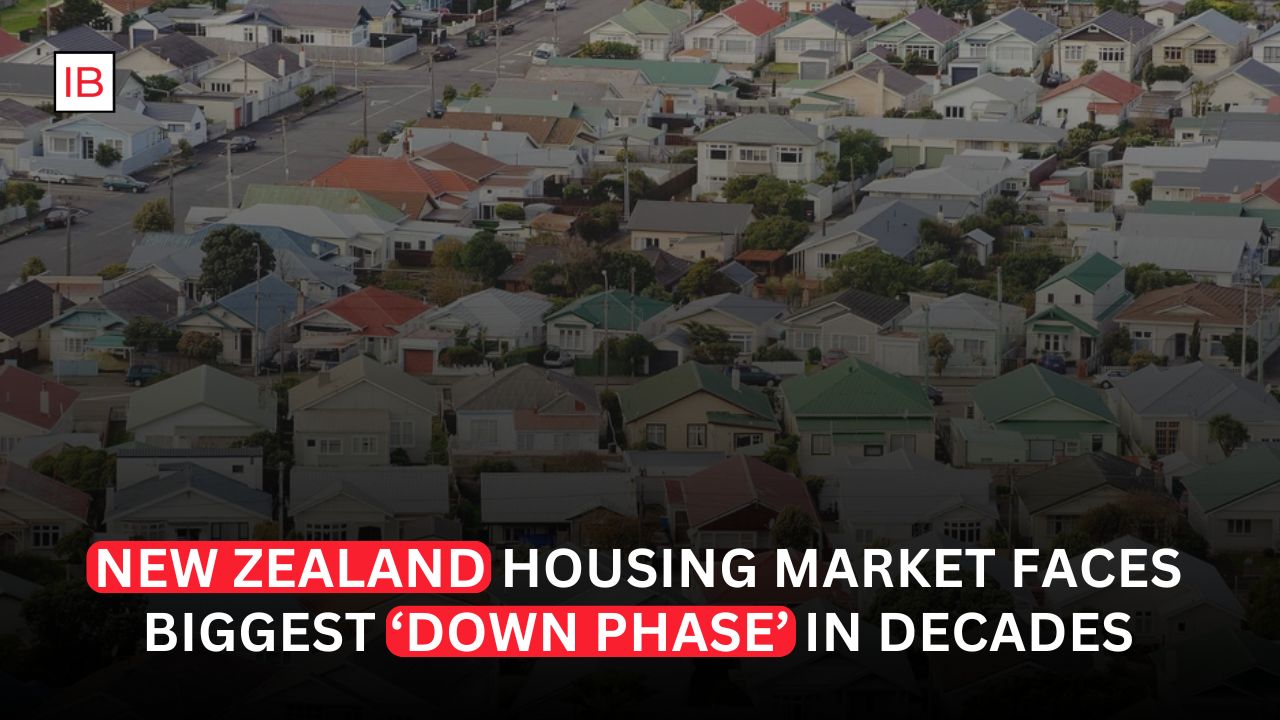
New Zealand’s housing market has slipped to a three-year low, with property data firm Cotality confirming the country is now enduring its longest and deepest downturn in at least 30 to 40 years, as prices continue grinding lower more than four years after the market’s pandemic-era peak.
Prices Hit a Fresh Three-Year Low
National property values fell 0.3% in July, following a similarly sized 0.3% decline in June, according to Cotality’s Home Value Index released Saturday in Wellington. The national median value now stands at NZ$804,303, roughly $473,051, down 1.0% over the past three months and 0.7% lower than the same time a year ago. Prices are now sitting at their lowest level since July 2023, and remain roughly 17.7% to 18% below the market’s January 2022 peak, even though values remain about 16% above where they stood just before the pandemic reshaped the country’s borrowing costs and housing demand.
The Longest Downturn on Record
Cotality Chief Property Economist Kelvin Davidson said July’s figures simply extended the subdued pattern that has defined the first half of 2026, noting that property sales volumes have edged lower this year but remain at relatively normal levels overall. The country is now four and a half years into the current slump, putting it on track to surpass the previous record for the longest downturn in modern New Zealand history — a five-year peak-to-trough decline recorded between 1975 and 1980, in data stretching back to 1962.
Even the aftermath of the Global Financial Crisis, which included a brief return to growth in 2009, saw the market bottom out within four years, meaning the current downturn has already outlasted that historical benchmark in duration, even if not yet in depth.
A Deeply Uneven Regional Picture
The pain has not been distributed evenly. Auckland, New Zealand’s largest city, fell 0.6% in July, while Tauranga dropped 0.7% and Wellington slid 0.5%. Hamilton posted a smaller 0.2% decline, while Dunedin and Christchurch bucked the trend entirely, each posting modest 0.2% gains. Invercargill recorded the strongest annual price growth of any major center over the past year, highlighting how sharply conditions have diverged between the country’s largest urban centers and smaller regional markets.
Davidson noted that Auckland in particular appears to be lacking economic confidence at the moment, weighing on both housing activity and prices in the country’s largest city, even as the pipeline of new housing supply remains relatively large.
First-Home Buyers Step In as Investors Retreat
One notable shift in market composition has been the growing dominance of first-home buyers, who have accounted for a record share of purchases even as investor activity has remained comparatively subdued. Davidson described first-home buyers as a particularly interesting group in the current environment, since lower prices combined with a large number of listings should theoretically create favorable buying conditions for them.
Investors, by contrast, appear to be pulling back the hardest, with speculation that a potential change in government could bring a capital gains tax, adding further uncertainty to an already cautious segment of the market.
Falling Prices Without a Wave of Defaults
Despite the prolonged slide in values, credit ratings experts have pushed back against the assumption that falling prices automatically translate into a wave of mortgage defaults or forced sales. Analysts note there have been relatively few forced sales throughout the downturn, meaning most vendors have not been compelled to accept steep discounts, even as buyers have gained meaningfully more negotiating power than they held during the market’s earlier boom years.
Why This Downturn Runs So Deep
The roots of the current slump trace back to New Zealand’s extraordinary pandemic-era housing boom, when values surged roughly 40% in an 18-month stretch through November 2021, fueled by historically low interest rates and government stimulus. When that bubble burst, aggressive interest rate hikes from the Reserve Bank of New Zealand combined with increased housing supply to drive nominal prices down by close to 20% nationally, and as much as 30% in some cities. Once inflation is factored in, real New Zealand house values are now down more than 31% from their late-2021 peak, according to Herald calculations based on Statistics New Zealand data.
What Comes Next
With sales volumes holding at relatively normal levels and first-home buyers continuing to step into the market despite broader caution, some analysts see the current environment as a genuine, if painful, market correction rather than a full-blown crash. Still, with the downturn already rivaling the longest slumps in New Zealand’s modern economic history, and historical precedent suggesting a full recovery back to 2021-era price levels could take the better part of a decade, the coming months will offer an important test of whether stabilization is finally within reach or whether the market’s weakest stretch in generations still has further to run.