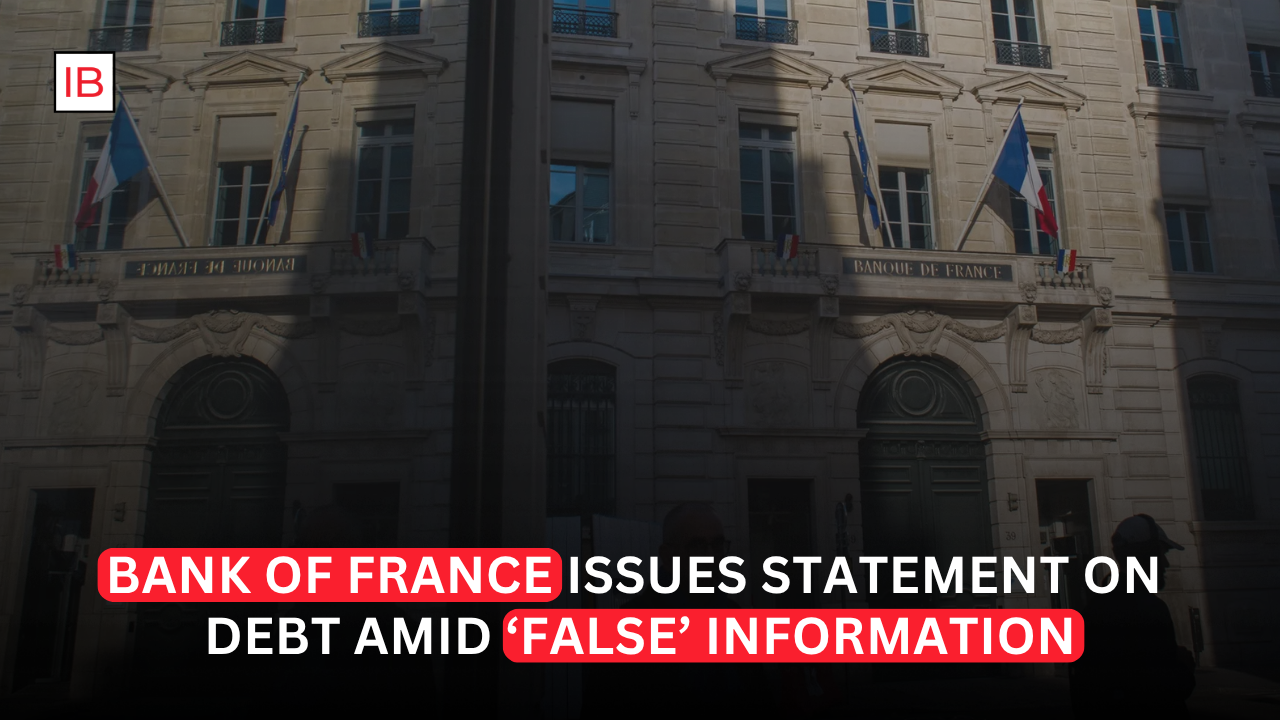
The Bank of France has moved to defend its position on France’s worsening public-finance situation after a political dispute over debt cancellation escalated into accusations that the central bank was spreading false information.
The controversy centers on a proposal from Jean-Luc Mélenchon, leader of the left-wing La France Insoumise movement, to cancel a portion of France’s public debt held by the central bank. Bank of France Governor Emmanuel Moulin rejected the idea in forceful terms, describing it as illegal, dangerous and unnecessary. Mélenchon subsequently accused Moulin of disseminating “false information,” turning a technical debate about sovereign debt into a highly political confrontation ahead of France’s 2027 presidential election.
Mélenchon’s proposal focuses on debt accumulated by the European Central Bank and national central banks through monetary-policy asset purchases. His argument is that cancelling part of that debt could create fiscal room for the French government without requiring equivalent tax increases or spending cuts. Supporters of the proposal say central-bank-held debt is different from debt owned by private investors because the public sector ultimately receives much of the interest paid within the system.
Moulin has rejected that reasoning, arguing that cancelling the debt would not solve France’s underlying budget problem. He has warned that such an action would conflict with European legal rules and could damage confidence in French public finances. According to Reuters, he also said the move could increase inflation and borrowing costs and effectively amount to a sovereign default, potentially causing severe damage to France’s financial credibility.
The disagreement comes as investors are already demanding higher compensation to hold French government bonds. The 10-year French yield was around 4.45% on Sept. 11, a level not seen since 2008, while the spread over German government debt has widened sharply. The increase reflects concerns about France’s fiscal position, political uncertainty and the government’s ability to agree on measures capable of stabilizing the debt trajectory.
France’s economic outlook has also deteriorated. Finance Minister Roland Lescure said the government now expects the economy to grow only 0.5% in 2026, down from a previous forecast of 0.7%. The government is also expected to miss its target of reducing the budget deficit to 5% of gross domestic product. At the same time, debt-servicing costs are projected at about €65 billion this year, roughly €4.5 billion above the amount previously budgeted.
That combination is making the debt debate particularly sensitive. France’s public debt stood at roughly €3.5 trillion, equivalent to about 117.6% of GDP in the first quarter, according to recent figures cited by the Financial Times. The country therefore faces a difficult equation: slower growth limits tax revenue, elevated interest rates increase refinancing costs, and political fragmentation makes large fiscal adjustments harder to implement.
Moulin has nevertheless stressed that France is not facing an economic catastrophe. He has pointed to strengths including relatively affordable energy, a diversified economy and signs of industrial investment in areas such as data centers, defense and aerospace. His message is that the immediate problem is fiscal sustainability rather than an economy fundamentally incapable of generating growth.
The dispute is taking place against an increasingly polarized political backdrop. Mélenchon is positioning debt reduction as part of a broader argument for greater public spending and social investment, while financial authorities are emphasizing credibility with bond investors and compliance with European monetary rules. The disagreement is therefore likely to remain prominent as parties prepare for the 2027 presidential contest.
Financial markets are watching the political debate closely. France is already paying a higher risk premium than it did during much of the past decade, and hedge funds have become an increasingly important presence in the French government-bond market. Recent reporting indicates that hedge funds now account for more than half of weekly purchase requests for French debt, adding another layer of market sensitivity should investors suddenly reassess the country’s fiscal outlook.
The Bank of France’s response ultimately reflects a broader concern: France cannot rely on accounting changes alone to resolve a structural budget deficit. Whether debt cancellation could legally be implemented remains contested politically, but central-bank officials argue that the fundamental challenge is restoring confidence in the government’s ability to control spending, raise sustainable revenues and reduce borrowing needs.
With bond yields rising and the 2027 election approaching, the dispute over debt cancellation is likely to become a much larger test of France’s economic strategy. For investors, the central question is increasingly whether political leaders can agree on credible fiscal reforms before higher borrowing costs make the adjustment even more difficult.