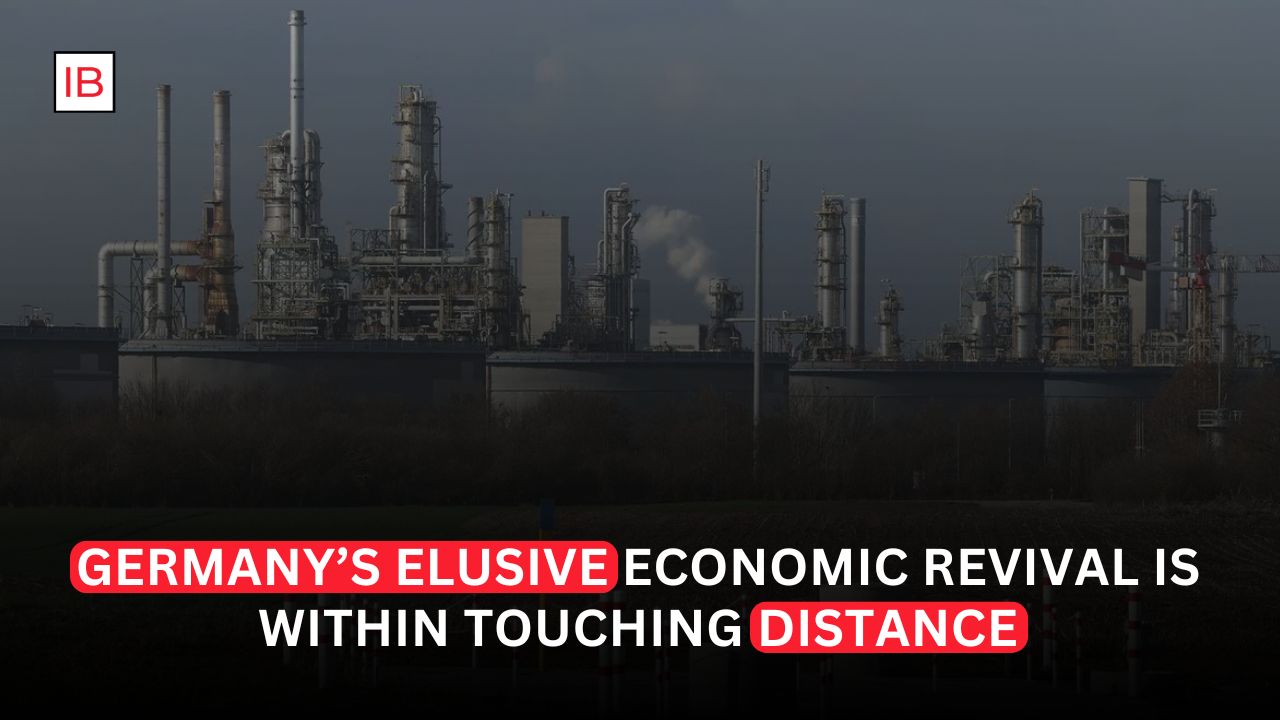
Germany’s economy grew for a second consecutive quarter in the three months through June, official data showed this week, offering the clearest signal yet that Europe’s largest economy may finally be pulling out of a prolonged stretch of stagnation that has weighed on the continent for years.
Two Straight Quarters of Growth
Gross domestic product rose 0.2% in the second quarter compared with the first three months of the year, according to provisional figures from Germany’s Federal Statistical Office, Destatis, released Thursday. The reading beat economist expectations of just 0.1% growth and followed an upwardly revised 0.4% expansion in the first quarter, itself stronger than the 0.3% originally reported. On an annual basis, GDP climbed 0.9% compared with the same quarter a year earlier.
Exports provided much of the momentum, rising for a fourth straight month through May and continuing to strengthen into the second quarter after adjustment for price, seasonal, and calendar factors. Consumer spending, by contrast, remained notably subdued, while capital investment actually declined during the quarter, painting a mixed picture beneath the encouraging headline number.
A Long Road to Get Here
The modest rebound follows one of the most difficult stretches for the German economy in decades. Germany suffered back-to-back annual contractions in 2023 and 2024, and full-year 2025 growth came in at a barely perceptible 0.2%, following an earlier reported 0.5% contraction for 2024 that Destatis has since revised up to flat growth as part of a broader historical revision covering 2011 through 2025. Industry association DIHK has previously highlighted just how stark Germany’s underperformance has been relative to peers, noting that since 2019 the US economy had grown roughly 15% and Italy around 6%, while Germany’s had barely grown at all.
Fiscal Stimulus Finally Starting to Bite
Much of the cautious optimism building around Germany’s outlook traces back to a major fiscal policy shift enacted earlier this year, when the government relaxed its constitutionally enshrined “debt brake” rule and established a roughly 500 billion euro off-budget fund for infrastructure and defense spending. Bundesbank President Joachim Nagel has said growth is expected to strengthen markedly starting from the second quarter of 2026, driven mainly by government spending and a resurgence in exports, with early signs of increased government orders already emerging.
Economists caution the fiscal expansion’s full effects will take time to materialize, given the sluggishness of Germany’s federal decision-making processes — it took until late last year for parliament to approve the 2026 budget and dozens of associated military procurement contracts. Still, forecasters broadly expect defense spending to remain largely within the domestic economy given the rapid expansion of German defense production capacity, a dynamic some view as a potential positive surprise for growth later this year.
Forecasts Point to a Gradual, Not Dramatic, Recovery
Official projections remain relatively modest even amid the improving data. The European Commission expects German GDP to expand by 0.6% in 2026 and 0.9% in 2027, while the OECD projects slightly stronger growth of 0.7% in 2026 and 1.1% in 2027. The German government’s own outlook is somewhat more optimistic, projecting growth of around 1% this year and 1.3% in 2027. Across nearly all these forecasts, the consistent theme is that any recovery will be gradual and back-loaded, with public investment and exports leading the way while private consumption and business investment lag behind.
Headwinds That Haven’t Gone Away
Even with the improving trajectory, significant challenges remain unresolved. German unemployment has risen by roughly 500,000 people over the past four years, a deterioration that has continued even as growth has ticked higher, reflecting the depth of the structural challenges facing German industry. Elevated energy costs continue to weigh on corporate sentiment, though the government’s plan to reduce those costs to roughly a third of current levels could offer meaningful relief if fully implemented. The unresolved conflict tied to Iran has also added fresh uncertainty, given Germany’s heavy reliance on imported raw materials and energy, with economists expecting its effects on the German economy to linger for some time.
What Comes Next
With two consecutive quarters of growth now in the books and a substantial fiscal stimulus package still working its way through the economy, Germany’s long-awaited recovery finally appears to be gaining tangible traction rather than remaining a purely forward-looking promise. Whether that momentum can translate into the more robust, broad-based expansion officials have been forecasting for 2027 will likely depend on how quickly public investment translates into private sector confidence, and whether persistent headwinds like energy costs and geopolitical uncertainty continue to ease in the months ahead.