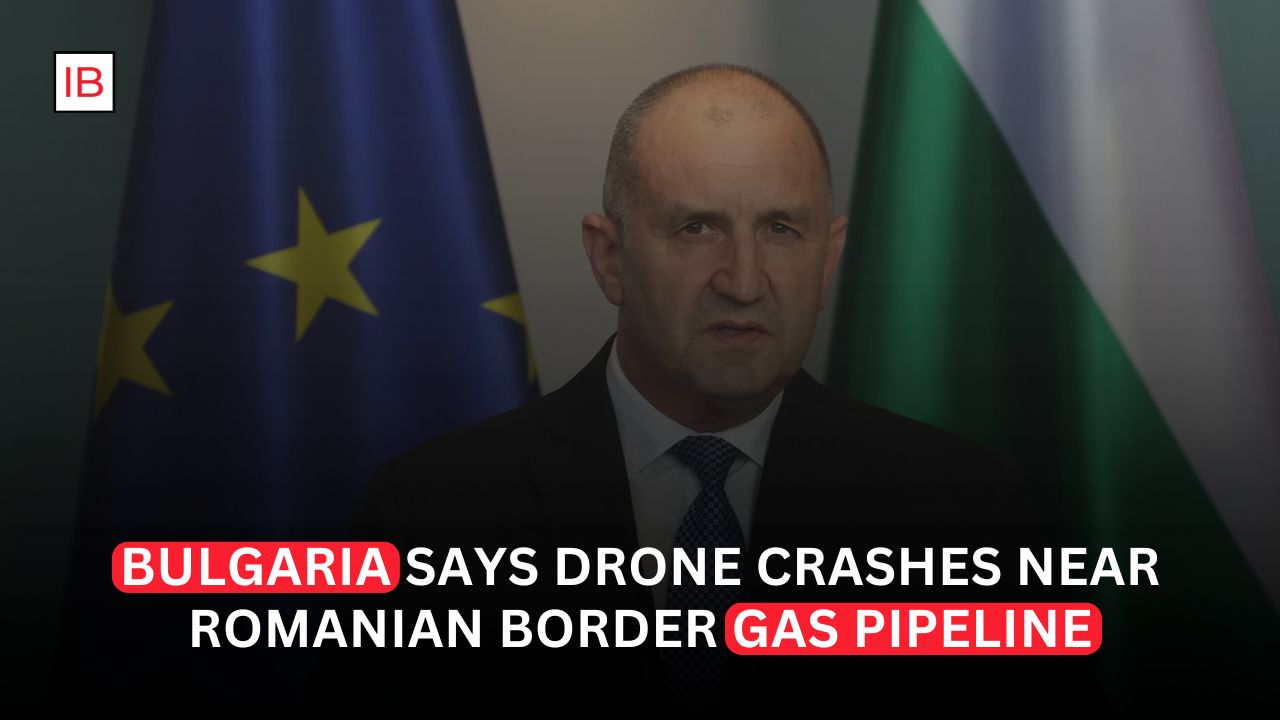
The incident raises fresh security concerns along NATO’s eastern flank after an unidentified drone exploded close to critical energy infrastructure near the Bulgarian-Romanian border.
An unidentified drone entered Bulgarian airspace from Romania and exploded near the border on Saturday, prompting authorities to strengthen security measures around the area and investigate the origin of the aircraft. Bulgarian Prime Minister Rumen Radev said the drone crashed in a sunflower field near Kardam, roughly 1,000 meters from a Bulgarian compressor station on the Trans-Balkan gas pipeline. No casualties or infrastructure damage were reported.
The incident comes as drone activity linked to the wider Russia-Ukraine conflict continues to raise concerns across NATO’s eastern flank. Bulgaria and Romania are both members of NATO and the European Union, making the breach particularly sensitive for regional security.
Drone Crosses Into Bulgarian Airspace
According to Radev, the drone entered Bulgarian territory at about 8:10 a.m. local time before exploding shortly afterward. Romanian border police detected the sound of the aircraft, while Bulgarian border patrol officers heard the subsequent explosion and located the crash site.
Authorities have cordoned off the area while police and defense officials investigate the wreckage and attempt to determine what type of drone was involved. Radev said neither Bulgarian nor Romanian authorities detected the drone through their air-surveillance systems before the incident.
The failure to detect the aircraft is likely to become an important part of the investigation as officials assess whether existing surveillance systems are sufficient to protect Bulgaria’s border and critical infrastructure.
Gas Pipeline Raises Additional Concern
The location of the crash has increased the seriousness of the incident because it occurred close to the Trans-Balkan gas pipeline. The pipeline is part of a broader regional energy network connecting southeastern and central European markets.
Although the explosion caused no damage, the proximity to a compressor station has highlighted the vulnerability of energy infrastructure to potential drone attacks. Officials are expected to increase monitoring around strategic facilities as a precaution.
The Trans-Balkan route has also gained importance as European countries seek to diversify natural-gas supplies and strengthen alternative routes across southeastern Europe.
Bulgaria Strengthens Border Monitoring
Following the incident, Bulgaria said it would increase surveillance along its border with Romania and strengthen its ability to detect and respond to drones.
Radev said drone-detection and counter-drone equipment would be redeployed toward the Romanian border from other areas, reflecting the government’s concern that the threat may be increasing in the region.
The move follows several drone incidents in neighboring Romania. Romanian forces reportedly shot down three drones in late July, with at least one identified as being of the Shahed type used by Russian forces.
Wider NATO Security Concerns
The latest incident adds to concerns among NATO members that drones associated with the Russia-Ukraine war could increasingly enter the airspace of neighboring alliance countries.
While there is currently no confirmed attribution for the Bulgarian drone, officials are examining whether the incident could be connected to the broader pattern of drone activity around the Black Sea and nearby territories.
The Bulgarian government is expected to raise the incident with NATO allies as regional countries discuss ways to improve surveillance and protect their airspace from increasingly sophisticated unmanned aircraft.
Energy Infrastructure Faces Greater Risks
The incident also illustrates the growing security challenges facing Europe’s energy infrastructure. Pipelines, compressor stations, ports, electricity networks, and other strategic facilities are increasingly viewed as potential targets during periods of geopolitical tension.
Even when an attack causes no physical damage, a drone incident can trigger inspections, temporary restrictions, higher security costs, and concerns among energy companies and investors.
For Bulgaria and its neighbors, protecting infrastructure will therefore become increasingly important as the region remains exposed to the consequences of the war in Ukraine.
Investigation Remains Underway
Authorities have not identified who operated the drone or explained why it entered Bulgarian airspace. Investigators are examining the aircraft and surrounding evidence to establish its origin and purpose.
For now, officials have stressed that there was no damage to the gas pipeline or other infrastructure. However, the incident has prompted immediate security changes and renewed attention to gaps in regional air surveillance.
Looking Ahead
The drone crash near Kardam is unlikely to be treated as an isolated aviation incident given its proximity to critical energy infrastructure and the broader increase in drone activity across the region. Bulgaria will now face pressure to strengthen border surveillance while working with Romania and NATO allies to improve early detection and counter-drone capabilities.
The absence of casualties or infrastructure damage has limited the immediate impact, but the incident highlights a growing security challenge for countries bordering the Black Sea. As drone warfare continues to evolve, protecting civilian airspace and critical infrastructure is expected to become an increasingly important priority for Bulgaria, Romania, and their NATO partners.