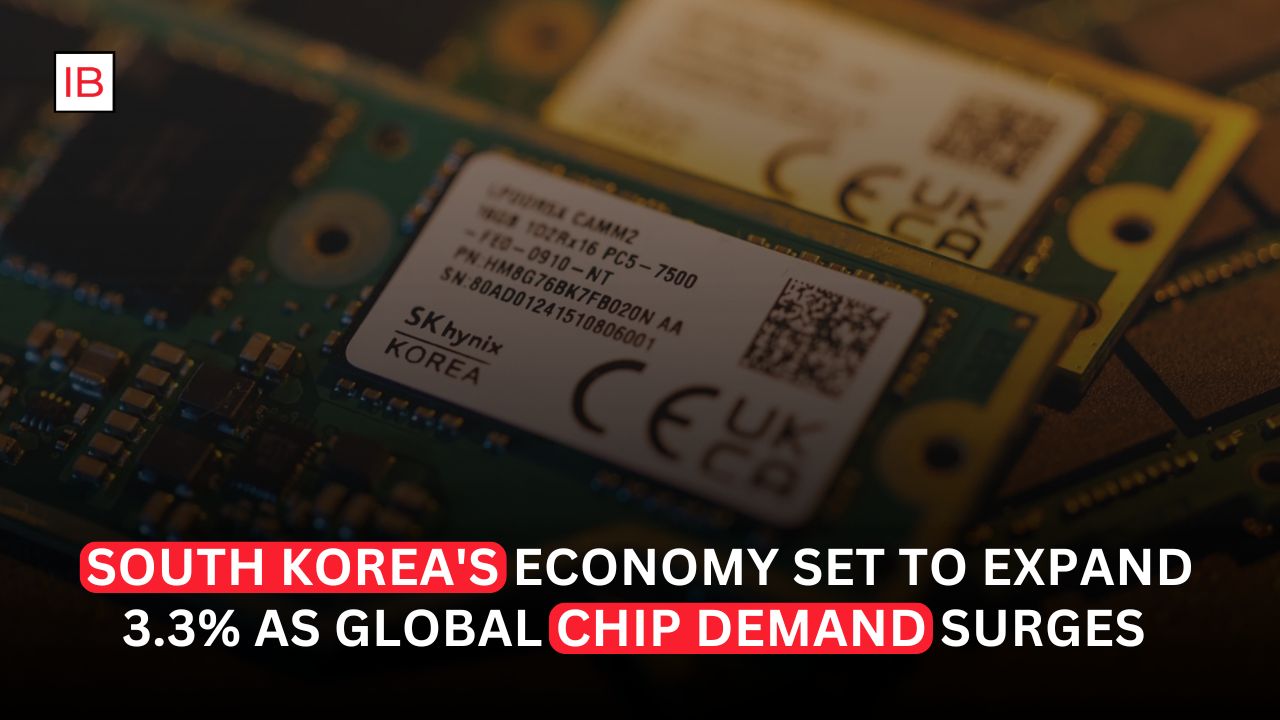
Economists now expect South Korea’s economy to expand even faster than the government’s already-upgraded forecast this year, with projections pointing to growth accelerating to around 3.3%, as the country’s AI-driven semiconductor boom continues outpacing even recently revised official estimates.
A Forecast That Keeps Climbing
The latest projection builds on a dramatic upward revision the South Korean government itself made in July, when the finance ministry raised its 2026 growth forecast to 3.0% from a previous estimate of just 2.0%, marking the strongest expected growth since 2021. Deputy Prime Minister and Finance Minister Koo Yun-cheol attributed that revision directly to record profits at memory chipmakers Samsung Electronics and SK Hynix, whose advanced chips have become essential components for the global AI buildout. That the private sector is now pointing to growth exceeding even that upgraded government forecast underscores just how forcefully the semiconductor supercycle has been reshaping expectations for Asia’s fourth-largest economy.
The Numbers Behind the Optimism
South Korea delivered its strongest quarterly growth in nearly six years in the first quarter of 2026, driven by booming chip exports amid the global surge in AI investment. Semiconductor exports reached $44.82 billion in a single recent month, topping $40 billion for the first time in the country’s history. Export growth has been similarly extraordinary on an annual basis, with South Korea’s exports surging 48.3% year-on-year in March to a record $86.13 billion, the strongest growth pace since August 1988, with semiconductor sales alone surging 151.4% to a fresh high of $32.83 billion.
The government’s own nominal GDP growth forecast, which incorporates inflation, was revised up even more dramatically, from an initial 4.9% to 12.3%, matching the rate last seen in 1996 and marking the first double-digit nominal growth figure since 2002. Officials have also projected the country’s current account surplus will more than double to a record $290 billion this year, driven overwhelmingly by soaring semiconductor shipments.
An Economy Betting Its Future on Chips
South Korea’s government has framed the current boom not just as a cyclical upswing but as an opportunity to permanently raise the economy’s underlying growth potential. Koo Yun-cheol laid out what officials have called a “3-4-5 vision,” aiming for a sustained potential growth rate of 3%, a position among the world’s top four exporters, and per-capita national income of $50,000, up from an expected $40,000 this year. President Lee Jae-myung has separately described the surge in tax revenue generated by AI-driven chip profits as a “golden window” of opportunity, pledging to channel the windfall into a new “future response fund” targeting future industries, youth development, regional growth, and education.
Samsung Electronics and SK Hynix are also involved in an 800 trillion won, or roughly $540 billion, public-private investment to build a major chip hub in southwest South Korea, part of a broader push to address regional economic inequality while cementing the country’s semiconductor dominance for years to come.
Not Without Risks and Trade-Offs
Despite the bullish trajectory, officials and economists have flagged genuine concerns beneath the surface. The finance ministry raised its inflation forecast for 2026 to 2.6%, up from 2.1%, citing elevated oil prices tied partly to the ongoing Middle East conflict alongside a weaker won. Some economists have also cautioned that the chip-driven boom has not translated proportionally into job creation, with employment gains forecast at just 150,000 for the year, reflecting the semiconductor industry’s relatively limited capacity to generate broad-based hiring compared with its outsized contribution to headline growth figures. Vice Finance Minister Lee Hyoung-il acknowledged that “while exports offer opportunities, there remain tasks that our economy needs to overcome at the same time.”
A More Bullish View Than International Forecasters
South Korea’s government has notably positioned itself well ahead of international institutions in its optimism. The International Monetary Fund’s own 2026 growth forecast for South Korea, published just before the government’s revision, stood at 2.6%, meaningfully below both the government’s official 3.0% projection and the even higher 3.3% figure now circulating among private economists. Officials have maintained that the AI-driven semiconductor boom will continue outweighing the drag from the Middle East conflict, even as they expect growth to moderate to around 2.2% in 2027 as current uncertainties persist.
What Comes Next
With growth forecasts continuing to climb and semiconductor exports showing few signs of slowing, attention will turn to whether South Korea’s economy can sustain this exceptional pace through the remainder of 2026, or whether risks tied to inflation, regional conflict, and uneven job creation eventually temper the current wave of optimism. How the Bank of Korea calibrates monetary policy against this backdrop of unusually strong growth alongside elevated inflation will likely remain one of the key storylines shaping the country’s economic trajectory in the months ahead.