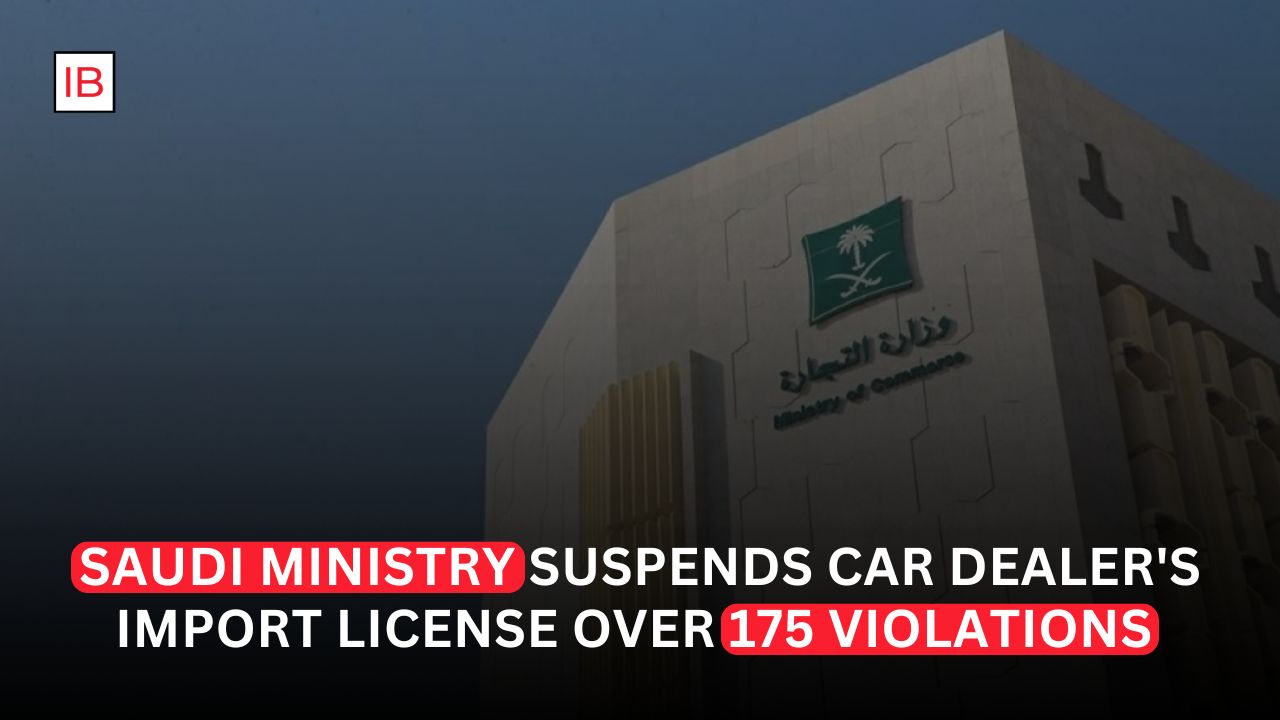
The Ministry of Commerce has taken major enforcement action against a Saudi car dealer after identifying 175 violations involving consumer protection, vehicle warranties, spare parts, maintenance services, and commercial agency requirements.
Saudi Arabia’s Ministry of Commerce has suspended the import license of a car dealer after authorities identified 175 violations linked to the company’s handling of vehicle sales and after-sales services. The dealer has also been fined SR8.12 million, marking a significant regulatory action against a company accused of failing to meet obligations toward customers.
The violations were identified through a specialized investigation carried out by the ministry. Authorities said the case involved breaches of consumer-protection requirements as well as provisions of Saudi Arabia’s Commercial Agencies Law and its executive regulations.
The ministry has also taken steps to address the impact on affected customers, including contacting consumers and working to ensure that their complaints and outstanding issues are resolved.
Consumer Protection at the Center of the Case
The violations reportedly involved several areas of after-sales service that are particularly important to vehicle owners.
Authorities found problems involving the availability of spare parts, vehicle maintenance, manufacturing warranties and the provision of replacement vehicles when customers’ cars were undergoing repairs.
For consumers, access to spare parts and warranty services is a fundamental part of purchasing a vehicle through an authorized dealer. When those services are delayed or unavailable, customers can face significant financial and practical difficulties, particularly when a vehicle is required for daily transportation or business activities.
The Ministry of Commerce’s intervention demonstrates the importance it places on ensuring that automotive companies fulfill their obligations after completing a vehicle sale.
The investigation also involved direct contact with affected consumers. Authorities sought to determine the extent of the problems and take measures designed to provide customers with appropriate remedies.
Import License Suspended
One of the most significant consequences for the dealership is the suspension of its vehicle import license.
The measure prevents the company from continuing to import vehicles under its existing authorization, creating immediate commercial pressure while regulators address the violations.
The suspension goes beyond a conventional financial penalty because it directly affects the company’s ability to operate its vehicle-import business. For an automotive dealer, access to vehicle imports is central to maintaining inventory, serving customers and sustaining relationships with manufacturers.
The action therefore sends a strong signal to other companies operating in Saudi Arabia’s automotive sector that repeated or serious violations can result in restrictions on core business activities.
SR8.12 Million Fine
In addition to the import-license suspension, the dealer was fined SR8.12 million.
The size of the penalty reflects the seriousness and scale of the violations identified by authorities. It also highlights the increasing financial risks for companies that fail to comply with consumer-protection and commercial regulations.
Saudi regulators have increasingly emphasized that businesses must not only complete transactions with customers but also fulfill their contractual and legal responsibilities afterward.
For automotive companies, this includes maintaining adequate service facilities, ensuring access to spare parts, honoring warranty commitments and responding appropriately when vehicles require significant repairs.
Spare Parts and Maintenance Problems
One of the key concerns identified in the investigation involved access to spare parts.
A shortage or delay in obtaining essential components can leave customers without usable vehicles for extended periods. This can be particularly damaging when repairs involve imported vehicles for which replacement parts are not readily available through local suppliers.
The ministry’s action reinforces the expectation that authorized automotive dealers should maintain adequate supply chains and service capabilities.
Maintenance is another area under scrutiny. Customers who purchase vehicles from authorized dealers generally expect access to professional servicing and repairs throughout the applicable warranty period and beyond.
Failure to provide those services can undermine consumer confidence and create additional costs for vehicle owners.
Warranty Obligations Also Examined
Manufacturing warranties were another important part of the investigation.
Vehicle warranties are designed to protect customers against certain manufacturing defects and other covered problems. Dealers and authorized agents are expected to process legitimate warranty claims according to applicable rules and agreements.
When warranty services are delayed or improperly handled, customers may be forced to pay for repairs that should have been covered or wait for extended periods before their vehicles are returned.
The ministry’s investigation indicates that warranty obligations are being treated as a significant part of consumer protection rather than simply a private matter between customers and dealers.
Replacement Vehicles for Customers
Authorities also identified issues involving replacement vehicles for customers whose cars were undergoing maintenance.
Providing an alternative vehicle can be particularly important when repairs take a long time or when a vehicle cannot safely be driven.
The ministry has sought to address these concerns by contacting affected customers and taking steps intended to ensure that appropriate replacement vehicles or other remedies are provided where required.
This part of the case demonstrates that regulators are paying attention not only to whether a vehicle is eventually repaired but also to the inconvenience and economic impact experienced by consumers while repairs are taking place.
Manufacturer Also Summoned
The investigation has not ended with the dealership.
Saudi authorities have also summoned the vehicle manufacturer involved in the case and are monitoring compliance with recommendations and corrective procedures.
The involvement of the manufacturer is significant because automotive service problems can extend beyond the individual dealership. Spare-parts supply, warranty procedures, technical support and recall campaigns often depend on cooperation between manufacturers and their authorized agents.
The ministry has indicated that it will continue monitoring the situation to ensure that corrective measures are implemented.
Possible Change of Vehicle Agent
Another major development could involve the transfer of the vehicle brand to a different agent.
Authorities said any potential transfer would take place only after the capabilities and resources of the proposed new agent have been verified.
This is important because simply replacing one dealer with another would not necessarily solve the underlying service problems unless the new company has sufficient infrastructure, inventory, trained personnel and financial capacity.
A replacement agent would need to demonstrate that it can provide reliable maintenance, warranty services, spare parts and customer support across the market.
Wider Message to Saudi Automotive Sector
The case carries implications beyond the individual dealership.
Saudi Arabia has a large and expanding automotive market, supported by population growth, infrastructure development and the country’s broader economic transformation. As more international vehicle manufacturers seek opportunities in the kingdom, the quality of after-sales services is becoming increasingly important.
Consumers have greater expectations regarding warranty coverage, repair times, spare-parts availability and customer support.
Regulatory enforcement can therefore play an important role in maintaining confidence in the market.
The ministry’s decision may encourage other dealerships to review their own compliance procedures, particularly in areas involving warranty claims, spare-parts inventory, maintenance obligations and customer complaints.
Stronger Regulatory Environment
Saudi Arabia has been strengthening its commercial and consumer-protection framework as part of broader economic reforms.
The country’s economic transformation has encouraged greater private-sector participation and international investment. Maintaining clear commercial standards is therefore important for both consumers and businesses.
For international manufacturers, regulatory enforcement also creates an incentive to carefully select local agents and monitor their performance.
A manufacturer may have a strong global reputation, but customers’ experiences can depend heavily on the quality of the local dealership responsible for sales and service.
Looking Ahead
The suspension of the import license and SR8.12 million fine represent a major enforcement action following the discovery of 175 violations. The case also highlights the increasing importance of consumer rights in Saudi Arabia’s automotive industry.
Authorities are now focused on ensuring that affected customers receive appropriate remedies while monitoring the dealership, manufacturer and any future changes to the brand’s representation in the kingdom.
For automotive companies, the message is increasingly clear: selling vehicles in Saudi Arabia comes with significant responsibilities after the transaction is completed. Dealers must maintain adequate spare-parts supplies, provide reliable maintenance, honor warranties and meet applicable commercial regulations.
For consumers, stronger enforcement could improve accountability and encourage dealerships to provide more reliable services. As Saudi Arabia’s automotive market continues developing, the quality of after-sales support is likely to become just as important as vehicle pricing, availability and technology.
The case ultimately demonstrates that Saudi regulators are prepared to use substantial financial and commercial penalties when businesses fail to meet their obligations. The outcome could encourage greater compliance across the sector while reinforcing the government’s broader effort to strengthen consumer protection and commercial standards throughout the Saudi economy.