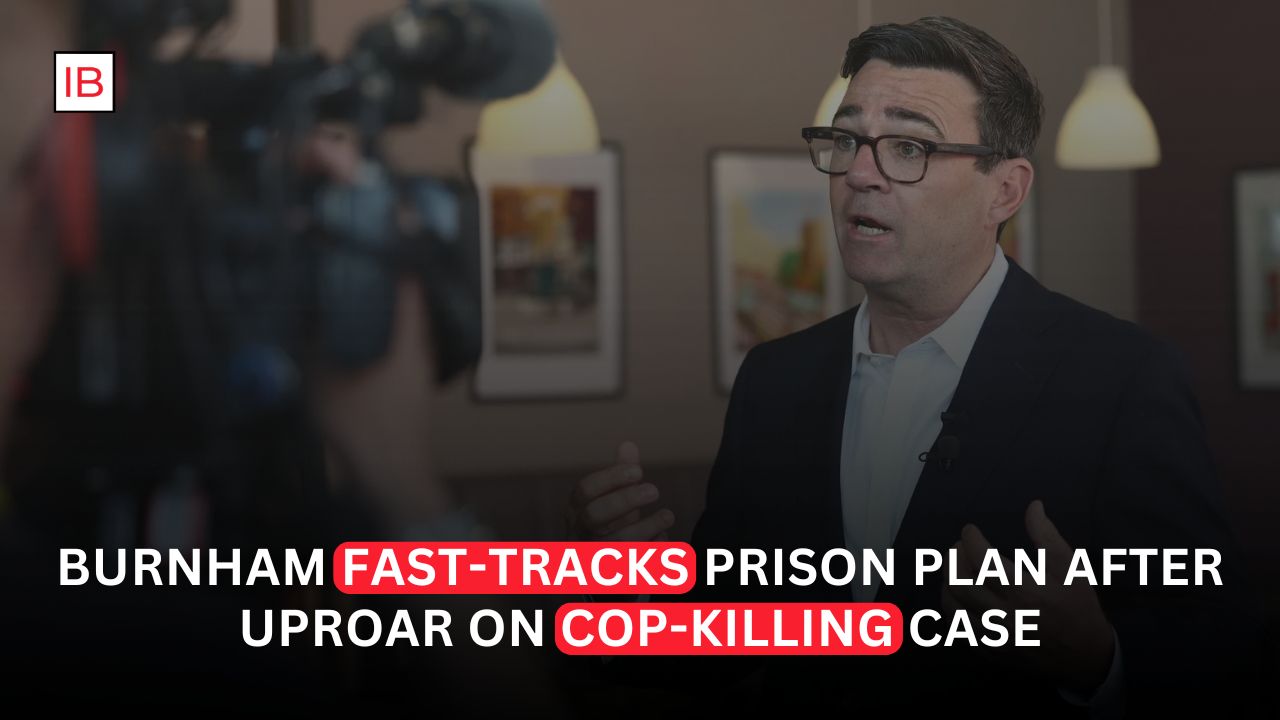
UK Prime Minister Andy Burnham is accelerating plans to increase prison capacity after intense public and political criticism over the possible early release of two men convicted in the killing of police officer Andrew Harper.
The controversy has placed the government’s prison-release policy under growing pressure and forced Burnham to consider broader changes to a scheme designed to reduce overcrowding across prisons in England and Wales.
Burnham said Tuesday that he was becoming increasingly confident that the government could create enough additional prison space to reduce the number of inmates released early and prevent the early release of those convicted of the most serious offences.
The issue has become particularly sensitive because of the case of PC Harper, who was killed while responding to a theft in 2019.
The Harper Case at the Centre of the Controversy
Harper was killed after becoming caught in a strap attached to a vehicle that was being driven away by offenders. His death shocked the UK and prompted renewed debate about protections for police officers and other emergency workers.
Three men were convicted over his death.
Henry Long, the driver, received a 16-year extended sentence and is not expected to qualify for the early-release arrangements. Jessie Cole and Albert Bowers, who were passengers in the vehicle, were sentenced to 13 years for manslaughter.
The controversy arose because Cole and Bowers could potentially qualify for release before completing their full sentences under the government’s plans to reduce pressure on overcrowded prisons.
The possibility generated widespread anger among police representatives, politicians and Harper’s family.
A public petition opposing their early release has attracted hundreds of thousands of signatures, with reports putting the figure close to 900,000.
Government Faces a Difficult Prison-Capacity Problem
The dispute cannot be separated from the UK’s broader prison overcrowding crisis.
Prisons in England and Wales have been operating close to capacity, leaving the government under pressure to create additional space.
The emergency release programme is intended to reduce overcrowding by allowing thousands of prisoners to leave custody before serving their full sentences.
The government has been preparing to release around 5,000 prisoners early from October as part of the latest measures.
But the Harper case exposed a major political weakness.
The original rules excluded certain categories of serious offenders, including rapists and child-sex offenders, but did not automatically exclude all prisoners convicted of manslaughter.
That distinction became difficult to defend publicly when the potential early release involved men convicted in a case widely regarded as particularly serious.
Burnham Orders Faster Action
Burnham has now instructed Justice Secretary Alex Norris to rapidly develop options for increasing prison capacity and reducing the need for early releases.
The measures being considered include speeding up the deportation of foreign national offenders, reviewing prisoners serving old Imprisonment for Public Protection sentences and making greater use of existing prison capacity.
Officials have also considered whether parts of the prison estate currently used for women could potentially provide accommodation for male prisoners.
These proposals are intended to create additional capacity without relying as heavily on early releases.
Burnham has said he would prefer not to see any prisoner released early, although the practical and legal limitations of achieving that remain substantial.
Why the Policy Is So Difficult to Change
One of the government’s problems is that simply creating an exception for two prisoners may not be legally or administratively straightforward.
If the government excludes prisoners convicted in Harper’s case, it could also face pressure to exclude other people convicted of manslaughter or crimes involving the deaths of emergency workers.
That could substantially expand the number of prisoners affected.
Officials have therefore been examining broader solutions rather than creating a narrow exemption specifically for Cole and Bowers.
The government’s challenge is to design a system that is legally defensible while also addressing public concerns about serious offenders serving shorter periods in custody.
Critics Say the Government Has Lost Control
Opposition parties have seized on the controversy to attack the government’s handling of the prison system.
Critics argue that ministers should have anticipated the political consequences of the early-release policy before announcing it.
The Conservatives have called for emergency legislation to prevent the release of Harper’s killers, while other opposition parties have also criticised the government’s approach.
The political pressure is particularly uncomfortable for Burnham because the controversy comes early in his tenure as prime minister.
His response could influence perceptions of his leadership on crime, policing and public safety.
The Government’s Broader Problem
The immediate controversy involves two prisoners, but the underlying problem is much larger.
Britain has spent years dealing with pressure on its prison estate.
When prisons approach capacity, governments have limited options.
They can build new prisons, expand existing facilities, transfer prisoners, accelerate deportations of foreign offenders, change sentencing rules or release some prisoners earlier.
Every option carries political or financial costs.
Building prisons takes years and requires significant public spending.
Changing sentencing rules can trigger criticism from victims’ groups.
Early release can undermine public confidence, particularly when serious offences are involved.
That leaves governments trying to balance public safety, punishment, rehabilitation and the physical limits of the prison system.
Harper’s Case Has Broader Implications
The controversy has also renewed attention on the treatment of people convicted of killing emergency workers.
Harper’s Law, introduced after the officer’s death, requires courts to impose a life sentence on people convicted of killing emergency workers while they are carrying out their duties in certain circumstances.
However, the law did not apply retrospectively to Harper’s killers.
That means the men convicted in his case remain subject to the sentencing arrangements that existed when the crime occurred.
This has contributed to frustration among Harper’s family and supporters, who argue that the seriousness of the crime should prevent the men from benefiting from early-release arrangements.
The Risk of a Wider Prison Crisis
There is also a counterargument that cannot simply be ignored.
The government cannot solve overcrowding by indefinitely keeping every prisoner in custody beyond the point allowed by existing sentencing rules.
If prisons are already close to capacity, blocking large numbers of releases without creating additional space could create operational problems of its own.
The Times reported that the prison estate was operating at around 97% capacity, highlighting how limited the government’s room for manoeuvre has become.
That is why Burnham is focusing on capacity as well as sentencing policy.
The government needs more prison places if it wants fewer early releases.
Political Pressure Is Driving the Timetable
The speed of Burnham’s latest response reflects the intensity of the backlash.
Earlier in July, Burnham had already said he would review the entire early-release policy after concerns were raised over Harper’s killers.
The government initially faced the argument that there was no practical way to exempt only a small number of prisoners.
Now ministers are attempting to find a broader solution that could allow the most serious offenders to remain behind bars while reducing pressure elsewhere in the system.
That represents a significant shift.
Rather than treating the Harper case as an isolated exception, Burnham is attempting to use it to accelerate changes to the wider prison system.
What Happens Next
The government is expected to develop its proposals over the coming weeks, with a formal plan to address the issue expected to come before Parliament in September.
The immediate objective is clear: create enough prison capacity to prevent the early release of prisoners considered too dangerous or serious to benefit from the scheme.
But the longer-term challenge is much harder.
Britain needs a sustainable prison strategy that does not repeatedly force governments to choose between overcrowding and controversial early releases.
For Burnham, the Harper case has turned that structural problem into an immediate political test.
His government now has to demonstrate that it can protect public confidence in the justice system while dealing realistically with the shortage of prison places.
The outcome will determine not only whether Harper’s killers remain behind bars, but also how the UK handles thousands of other prisoners caught between overcrowded prisons and demands for tougher punishment.