The UK economy expanded by 0.4% in the second quarter of 2026, showing more resilience than many investors had feared as the country dealt with the economic fallout from the war involving Iran, higher energy prices and continued pressure on households and businesses. However, the headline growth figure masks a more complicated picture: momentum has weakened from the start of the year, while rising energy costs could create a much tougher environment during the second half.
The latest figures from the Office for National Statistics show that gross domestic product increased 0.4% between April and June, compared with 0.6% growth in the first quarter. The result was broadly in line with economists’ expectations, suggesting that the economy managed to avoid a major shock from the geopolitical turmoil during the quarter.
But describing the result simply as a strong performance would be misleading. The UK economy is still growing slowly, and the factors supporting growth in the second quarter may not be powerful enough to continue offsetting higher energy costs and inflationary pressure.
Services Remain the Main Growth Engine
The biggest source of support came from the services sector, which expanded 0.5% during the second quarter.
Services account for the overwhelming majority of UK economic activity, so their performance is critical to overall GDP. Within the sector, information and communication businesses performed particularly well, with computer programming among the stronger areas. Advertising also benefited from increased activity surrounding the World Cup.
This matters because the UK has become increasingly dependent on services to compensate for weakness elsewhere in the economy.
Manufacturing and other industrial activity did not provide the same boost.
Production was broadly flat during the quarter, while construction increased by 0.3%.
The pattern suggests that the economy is still expanding, but not evenly.
June Provided an Unexpected Boost
The quarterly number was helped by a stronger-than-expected performance in June.
Monthly GDP increased 0.3%, following no growth in May and a 0.1% decline in April.
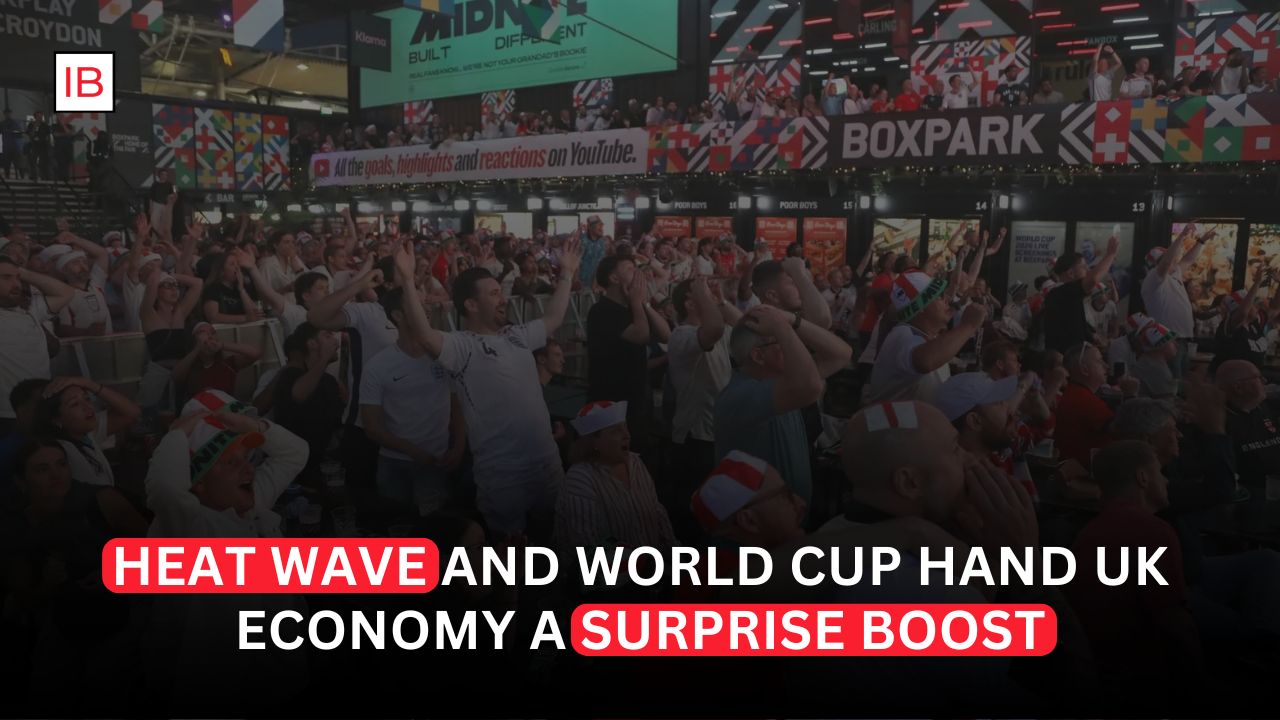
The June rebound was partly supported by unusually warm weather and spending associated with the World Cup.
That creates an important qualification to the headline figure.
Some of the strength may have been temporary rather than evidence of a major improvement in underlying economic momentum.
Extreme weather can increase spending on hospitality and leisure, while a major sporting tournament can boost restaurants, advertising, entertainment and retail activity.
Those factors can support GDP for a period without necessarily changing the economy’s longer-term growth trajectory.
The Iran War Is Creating a New Economic Problem
The bigger challenge is the energy shock.
The conflict involving Iran has contributed to higher global energy prices, putting additional pressure on businesses and households.
For the UK, this is particularly important because higher energy prices can feed through to transportation costs, manufacturing expenses, household bills and the prices of goods and services.
The initial economic impact was partly cushioned by the UK’s energy-price cap.
However, that protection became less effective as higher wholesale costs filtered through to consumers.
Household energy bills increased by around 13% from July, according to reporting on the latest figures.
That creates a difficult combination for policymakers.
Higher energy prices can push inflation upward at the same time that they reduce consumers’ disposable income.
Inflation Could Become the Bigger Threat
The biggest concern may therefore not be whether the economy grows 0.3% or 0.4% in a particular quarter.
It is whether the energy shock creates a renewed inflation problem.
If households have to spend more on electricity, gas and transportation, they have less money available for discretionary purchases.
Businesses face a similar problem.
Higher energy and transportation costs can squeeze profit margins or force companies to increase prices.
That can create a cycle in which inflation remains elevated even as economic growth slows.
The Bank of England therefore faces a difficult policy environment.
Normally, weak growth would strengthen the case for lower interest rates.
But if energy prices cause inflation to rise again, policymakers may have less room to ease monetary policy.
The UK Has Shown Resilience — But That Doesn’t Mean the Risk Is Gone
The 0.4% growth figure is evidence that the UK economy has absorbed the initial shock relatively well.
Economists have described the performance as resilient, particularly given the geopolitical uncertainty and energy-price pressures.
But resilience should not be confused with strong underlying growth.
The economy still faces structural challenges involving productivity, investment and weak business confidence.
The latest figures show that businesses have managed to keep activity moving.
They do not necessarily show that the economy has entered a period of sustainable acceleration.
That distinction will become increasingly important as the effects of higher energy prices become more visible.
Businesses Are Already Adjusting
Some companies have responded to the geopolitical disruption by changing inventories and supply chains.
Manufacturers and other businesses have reportedly increased stockpiling in anticipation of possible shortages and further price increases.
That activity can temporarily support GDP because producing and storing goods contributes to economic activity.
But inventory accumulation is not necessarily a sign of healthy demand.
If companies are stockpiling because they fear future disruption, the short-term boost can later reverse when inventories are reduced.
This is another reason why investors should be cautious about interpreting the 0.4% figure as evidence of a broad economic acceleration.
Households Face a Difficult Second Half
For consumers, the next few months could be more challenging.
Higher energy bills reduce disposable income, while elevated prices for other goods and services continue to affect household budgets.
The World Cup and summer weather may have supported spending in June, but those temporary boosts cannot be relied upon indefinitely.
If households begin cutting discretionary spending, sectors such as retail, restaurants, entertainment and travel could come under pressure.
That would weaken the services sector that has been carrying much of the economy’s growth.
The Government Faces More Pressure
The latest economic figures also arrive at an awkward time for the government.
Chancellor John Healey is preparing for his first budget in October, and the combination of weak underlying growth and higher household costs could increase political pressure for additional support.
The government has to balance two competing objectives.
It needs to encourage investment and economic growth while avoiding policies that could add excessive demand and make inflation worse.
At the same time, households facing higher energy costs may expect the government to provide assistance.
That makes the autumn budget particularly important for businesses and investors.
The Bank of England Has a Difficult Choice
Monetary policy could become the biggest economic question.
If growth weakens, the Bank of England could face pressure to support the economy through lower interest rates.
But if the Iran-related energy shock pushes inflation higher, cutting rates too aggressively could make the inflation problem worse.
This creates a classic stagflation risk: slower growth combined with higher prices.
The UK is not necessarily in a stagflationary environment yet.
But the combination of weak underlying growth and an external energy shock is moving the economy in that direction.
What Investors Should Watch
The next set of economic data will be more important than the headline second-quarter number.
Investors should pay particular attention to:
- monthly GDP growth;
- consumer spending;
- business investment;
- manufacturing activity;
- energy prices;
- inflation;
- wage growth;
- unemployment;
- retail sales;
- Bank of England interest-rate expectations.
If services growth remains strong while energy prices stabilize, the UK could continue expanding at a modest pace.
If energy prices remain elevated and consumer spending weakens, the outlook could deteriorate quickly.
The Bigger Picture
The UK economy’s 0.4% second-quarter growth demonstrates that the country has so far managed to withstand the early economic consequences of the Iran war better than some feared.
But the data should not be interpreted as a clean victory.
Growth slowed from 0.6% in the first quarter, production remained broadly unchanged and much of June’s strength came from factors that may prove temporary.
The bigger threat is now moving from geopolitics into household finances and business costs.
Higher energy prices can weaken demand, increase inflation and restrict the Bank of England’s ability to cut rates.
That leaves the UK economy facing a delicate balancing act.
For now, the economy is growing.
The question is whether it can keep growing once the temporary World Cup and summer-weather boost fades and the full cost of the energy shock becomes clearer.