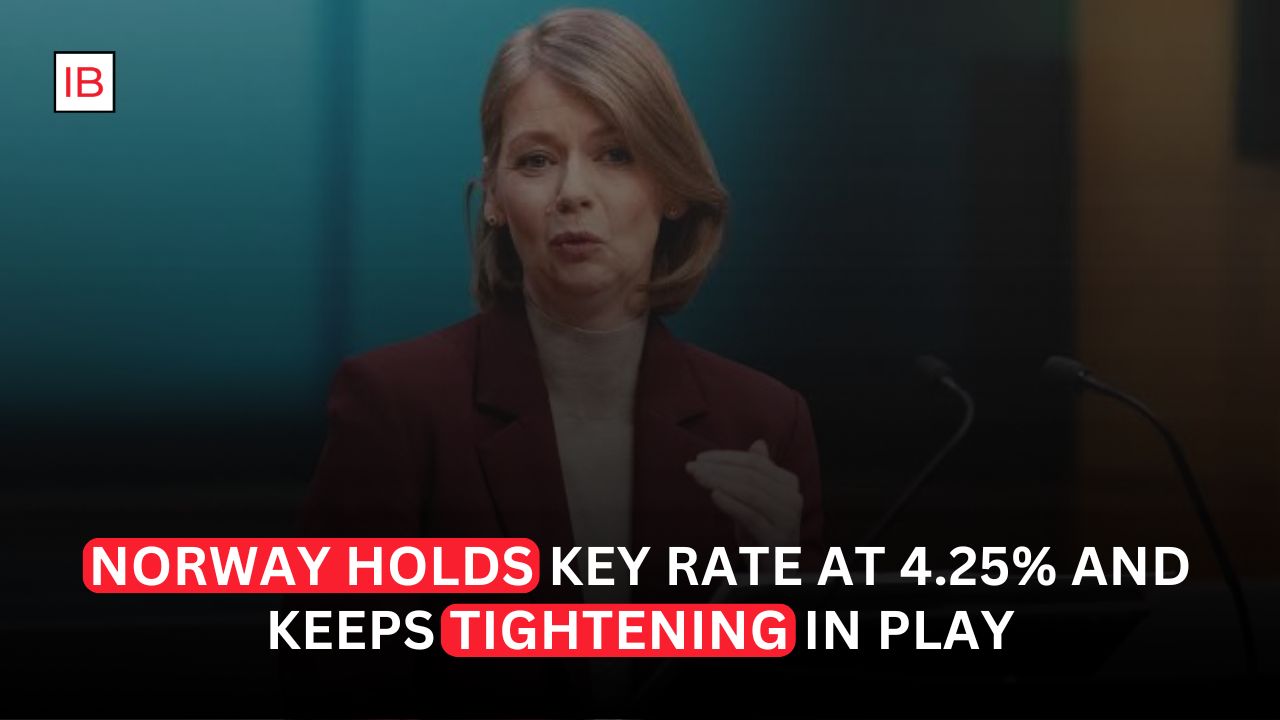
Norway’s central bank has kept its key interest rate at 4.25%, choosing to pause after a period of monetary tightening while leaving the door open to another rate increase if inflation remains too high.
The decision reflects a difficult balance. Norway’s economy has remained relatively resilient, but inflation is still above the central bank’s preferred level, while higher energy prices and geopolitical uncertainty are creating additional risks for the outlook.
The Norges Bank is therefore signaling that the fight against inflation is not finished.
Interest Rates Remain at 4.25%
Keeping the policy rate at 4.25% gives Norges Bank time to assess the impact of previous increases.
Central banks often pause after a series of rate moves because monetary policy works with a lag. Higher borrowing costs gradually affect mortgages, business investment, consumer spending and housing activity.
Moving rates too aggressively can unnecessarily weaken the economy.
But waiting too long can allow inflation to become entrenched.
Norway’s decision suggests policymakers believe the current rate is restrictive enough for now, while retaining the option of further tightening if necessary.
Inflation Is Still the Main Problem
The central issue is inflation.
Although price growth has come down significantly from its earlier peaks, it remains uncomfortable for policymakers.
Services inflation is particularly important because it tends to be more persistent than temporary changes in energy or commodity prices.
When wages and service costs continue rising, inflation can remain elevated even after global supply-chain pressures ease.
That makes it harder for a central bank to declare victory.
Norges Bank therefore needs to see convincing evidence that underlying inflation is moving sustainably toward its target.
Why Another Rate Hike Is Still Possible
The central bank’s decision to keep tightening “in play” is important.
It means the pause should not be interpreted as the beginning of an automatic rate-cutting cycle.
If inflation remains stubborn, policymakers could raise rates again.
That possibility is particularly relevant because Norway faces several external inflation risks.
Energy prices are one.
The country is a major energy producer, which gives it a different exposure to oil and gas prices than most European economies.
Higher energy prices can increase domestic inflation through transportation, electricity and other costs.
At the same time, stronger energy revenues can support Norway’s overall economy.
That creates an unusual combination of risks and benefits.
Norway’s Economy Is Relatively Resilient
Compared with some other European economies, Norway has significant financial advantages.
The country has accumulated enormous sovereign wealth through its oil and gas revenues.
Its government can therefore support the economy without facing the same financing constraints as many heavily indebted countries.
Household finances are also relatively strong by international standards, although Norwegian borrowers are highly sensitive to interest rates because of the structure of the country’s mortgage market.
That means monetary policy still has a meaningful effect on household spending.
The Housing Market Matters
Interest rates are particularly important for Norway’s housing market.
A large proportion of Norwegian households have mortgages, making higher borrowing costs a direct pressure on disposable income.
When rates remain high, potential homebuyers may delay purchases.
Existing homeowners may also reduce discretionary spending to accommodate higher mortgage payments.
That can gradually weaken domestic demand.
But if the housing market remains too strong, it can also create concerns about asset-price inflation and financial stability.
Norges Bank therefore has to watch housing alongside consumer prices.
The Norwegian Krone Is Another Variable
The Norwegian krone also matters.
A weaker krone makes imported goods more expensive and can therefore increase inflation.
A stronger currency has the opposite effect.
Interest-rate expectations can influence the krone because investors compare Norwegian returns with those available in other major markets.
If Norges Bank is perceived as becoming too dovish relative to the Federal Reserve or European Central Bank, the krone could weaken.
That could increase imported inflation and make the central bank’s job harder.
Norway Has a Different Relationship With Energy Prices
Norway’s position as a major oil and gas exporter makes the current global energy environment particularly unusual.
For many economies, higher oil prices are almost entirely negative.
They increase import bills and put pressure on consumers.
Norway can benefit from higher export revenues.
The government also receives substantial income from the petroleum sector.
But the domestic economy is not immune to energy inflation.
Higher global energy prices can still affect Norwegian households and businesses.
The central bank therefore cannot simply ignore the inflationary consequences.
Global Central Banks Are Also Important
Norges Bank does not operate in isolation.
The Federal Reserve, European Central Bank and other major central banks influence global financial conditions.
If other central banks begin cutting rates while Norway maintains a relatively high rate, the krone could receive support.
But if global rates remain high for longer, Norway may need to maintain restrictive policy simply to avoid excessive currency weakness.
This is one reason why the path of global interest rates will remain important for Norway’s policy decisions.
Higher Rates Carry Economic Costs
The argument for keeping rates high is straightforward: inflation needs to come down.
But there is a cost.
High rates make borrowing more expensive.
Businesses may postpone investment.
Consumers may reduce spending.
Housing activity can weaken.
Construction can slow.
If these effects become too powerful, economic growth could fall below the level policymakers consider healthy.
That is why central banks generally prefer to avoid unnecessary additional tightening.
The challenge is determining whether current rates are already sufficient.
The Risk of Cutting Too Soon
The opposite mistake could be more dangerous.
If Norges Bank cuts rates before inflation is firmly under control, demand could strengthen again.
A weaker krone could increase imported prices.
Inflation expectations could rise.
Policymakers might then have to reverse course and raise rates again.
That would be particularly damaging to confidence.
A cautious pause therefore gives Norges Bank more time to determine whether inflation is genuinely declining or merely temporarily lower.
What Investors Should Watch
The next major signals from Norway’s economy will come from inflation, wages, household spending and the currency.
Investors should monitor:
- headline and core inflation;
- wage growth;
- household consumption;
- housing prices;
- mortgage activity;
- business investment;
- oil and gas prices;
- the Norwegian krone;
- global interest rates;
- Norges Bank’s forward guidance.
The interaction between these indicators will determine whether another rate increase becomes necessary.
The Bigger Picture
Norway’s decision to hold the key rate at 4.25% is best viewed as a pause, not necessarily a pivot.
The central bank appears unwilling to declare the inflation battle finished.
At the same time, it does not want to tighten policy unnecessarily and risk weakening an economy that is already adjusting to elevated borrowing costs.
The result is a deliberately cautious policy stance.
For financial markets, the most important message is that investors should not assume that the next move will automatically be a rate cut.
If inflation remains sticky, Norges Bank has retained the option to tighten further.
That gives the central bank flexibility, but it also means Norwegian borrowers and businesses may need to prepare for interest rates to remain elevated for longer.
The ultimate test will be whether inflation continues moving lower without requiring another aggressive round of monetary tightening.
For now, Norway is choosing to wait.
The 4.25% rate remains restrictive, but the threat of another increase is still very much part of the policy equation.