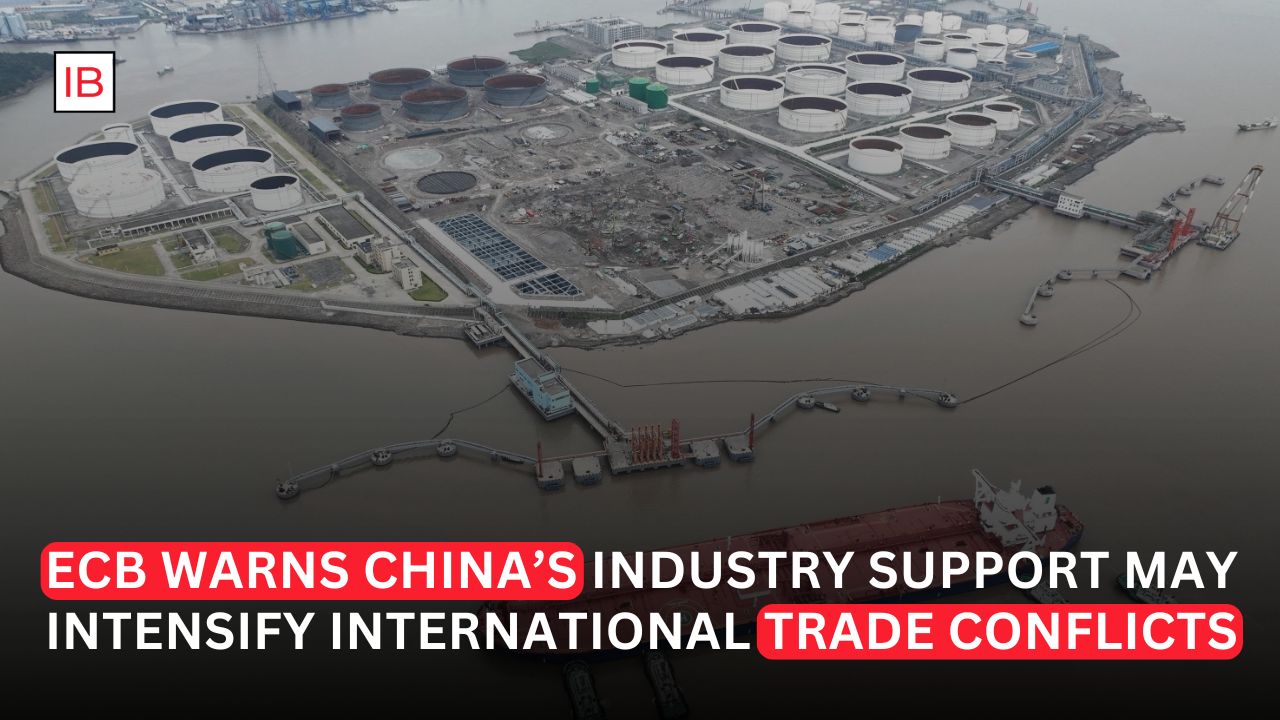
Heavy State Support Is Helping Chinese Manufacturers Expand Globally, but the Resulting Export Surge Could Increase Pressure on European Producers and Deepen Trade Frictions
China’s extensive support for strategic industries risks intensifying trade tensions with Europe and other major economies as state-backed companies expand production and push increasingly competitive goods into global markets.
The issue has become more important as China seeks to strengthen its position in advanced manufacturing while domestic demand remains relatively weak. Large-scale support for sectors considered strategically important can help companies invest, develop technology and gain market share, but it can also contribute to excess capacity and greater competition abroad.
The European Central Bank has repeatedly highlighted the risks that China’s expanding exports pose to euro-area manufacturers. ECB research has found that stronger Chinese competition could put pressure on European production and employment, particularly as trade tensions with the United States potentially redirect Chinese exports toward Europe.
Strategic Industries Receive Major Support
China has spent years developing industries that Beijing considers critical to the country’s economic and technological future.
These include:
- Electric vehicles
- Batteries
- Solar equipment
- Renewable-energy technology
- Electronics
- Machinery
- Advanced manufacturing
- Semiconductor-related industries
Government support can take many forms, including financing, tax incentives, infrastructure investment and other industrial policies.
The objective is to strengthen domestic companies and reduce China’s reliance on foreign technology while increasing the country’s global competitiveness.
That strategy has helped create highly competitive Chinese manufacturers.
Export Growth Raises Concerns
The success of these industries has also contributed to a dramatic increase in Chinese exports.
China recorded 24% year-over-year export growth in July 2026, according to recent Reuters reporting, while its trade surplus reached about $113 billion for the month. The figures highlight the growing importance of external demand at a time when China’s domestic economy remains comparatively weak.
The combination of strong production and weak domestic consumption can create pressure for Chinese companies to seek customers overseas.
That can intensify competition in foreign markets.
For European manufacturers, the concern is particularly significant because Chinese companies are no longer competing only in low-cost consumer goods.
They are increasingly competing in sophisticated industries where European companies have historically held strong positions.
Europe Faces a New China Shock
The situation is increasingly being described as a new version of the China shock.
The first major China shock followed the country’s integration into global trade in the early 2000s. Chinese manufacturers became major suppliers of inexpensive goods, putting pressure on producers in Europe and the United States.
The current phase is different.
China is now competing in higher-value sectors, including electric vehicles, batteries, clean-energy technology and advanced industrial equipment.
ECB research has examined the impact of China’s industrial rise on the euro area and found that Chinese competition is increasingly affecting European industries across different levels of technological sophistication.
Subsidies Can Create Overcapacity
One of the central concerns surrounding industrial support is overcapacity.
When governments provide strong incentives for companies to expand production, businesses may build factories faster than domestic demand can absorb the resulting output.
If domestic consumers cannot purchase enough of those products, manufacturers have an incentive to look overseas.
That can lead to lower export prices and greater competition in foreign markets.
China’s current economic structure makes this issue particularly important because domestic demand has remained weaker than policymakers would like.
Weak Domestic Demand Adds Pressure
China’s economy has struggled with subdued consumer demand, a prolonged property-sector downturn and weak pricing power in several industries.
That creates a difficult environment for manufacturers.
Companies that have invested heavily in production capacity still need to generate revenue.
Export markets therefore become increasingly important.
Recent analysis has described China’s current export boom as partly driven by the combination of weak domestic demand, technological upgrading and industrial policy.
The result is a growing imbalance between China’s ability to produce goods and the strength of demand inside the country.
Electric Vehicles Become a Flashpoint
Electric vehicles provide one of the clearest examples.
Chinese EV manufacturers have rapidly expanded their global presence, benefiting from large domestic supply chains, technological development and significant production capacity.
Companies such as BYD and Geely have become increasingly important international competitors.
Europe has responded with trade measures designed to protect domestic manufacturers from what officials view as unfair competition.
The EV sector therefore illustrates how industrial policy can produce both economic benefits for China and political challenges in its relationships with trading partners.
Green Technology Faces Similar Pressure
The issue extends beyond automobiles.
China has developed enormous production capacity in batteries, solar panels, wind equipment and other clean-energy technologies.
Those industries are important to Europe’s energy-transition plans because cheaper Chinese products can reduce the cost of deploying renewable technologies.
But the same low prices can put European manufacturers under severe pressure.
This creates a difficult policy dilemma.
European governments want access to affordable green technology while also trying to maintain domestic industrial capacity.
Cheaper Chinese Goods Can Help Europe
The relationship is not entirely negative.
The ECB has noted that stronger Chinese competition can reduce import prices and lower inflation in the euro area.
Cheaper imported products can benefit European consumers.
They can also reduce production costs for European businesses that use Chinese components as inputs.
This means European policymakers must balance two competing objectives.
Protecting domestic industries may preserve jobs and investment, but excessive trade restrictions can increase prices and make European businesses less competitive.
Trade Diversion Could Make the Problem Worse
The United States is another important factor.
Higher US tariffs on Chinese goods can encourage Chinese exporters to seek alternative markets.
Europe could become one of the destinations for products that face greater restrictions in the American market.
The ECB has warned that this kind of trade diversion could increase Chinese import penetration in the euro area and intensify pressure on European producers.
That possibility has become more important as global trade becomes increasingly fragmented.
Europe Is Considering Its Response
European policymakers have several options.
They can impose tariffs or other trade defenses on selected products.
They can strengthen industrial policy and provide support for strategically important European industries.
They can also seek negotiations with Beijing aimed at improving market access and reducing trade imbalances.
Each approach carries risks.
Trade barriers could provoke retaliation from China.
Additional European subsidies could create a broader global competition over industrial support.
And allowing imports to expand without restrictions could weaken European manufacturing.
Trade Tensions Could Spread
The consequences extend beyond individual industries.
If Europe responds aggressively to Chinese imports, Beijing could retaliate against European exports.
That could affect companies operating in industries such as automobiles, luxury goods, machinery and chemicals.
The resulting tensions could also affect investment decisions.
Companies may increasingly choose to manufacture products locally in Europe, China or other markets to avoid tariffs and reduce supply-chain risks.
That could accelerate the fragmentation of global production.
China’s Global Manufacturing Role Is Growing
China’s expanding industrial capacity is difficult for other economies to ignore.
The country has built extensive supply chains, large pools of engineering talent and enormous manufacturing infrastructure.
Its growing technological capabilities mean that competition is no longer based primarily on low labor costs.
Chinese companies are increasingly competing on price, scale, technology and speed.
That makes the current challenge more difficult for advanced economies than the original China shock.
The ECB’s Broader Concern
The ECB’s research points to a wider transformation in the global economy.
China has gained significant economic influence through both its ability to supply critical intermediate goods and its importance as an export market.
An ECB discussion paper published in 2026 describes China’s growing geoeconomic power and increasing importance in global manufacturing supply chains.
This means trade policy is becoming increasingly connected to national security and economic resilience.
European policymakers are no longer looking only at prices and efficiency.
They are also considering strategic dependencies.
Europe Must Balance Prices and Industrial Policy
The biggest challenge for Europe will be finding a middle ground.
Consumers benefit when Chinese products are affordable.
European companies benefit when inexpensive components lower their costs.
But excessive dependence on foreign suppliers can create vulnerabilities, while sustained pressure on domestic manufacturers can reduce Europe’s industrial base.
The answer is therefore unlikely to be complete economic separation.
Instead, Europe may increasingly focus on protecting specific strategic industries while maintaining trade in areas where Chinese competition provides clear benefits.
Looking Ahead
China’s support for strategic industries is helping the country strengthen its position in global manufacturing, but the resulting export surge could create a new wave of trade tensions with Europe and other major economies.
The combination of strong industrial capacity, technological upgrading and weak domestic demand is encouraging Chinese companies to look increasingly toward overseas markets. Recent data showing 24% export growth in July underline the scale of that shift.
For Europe, the challenge is complicated.
Chinese competition can lower prices, reduce inflation and provide cheaper inputs for European businesses. At the same time, it can threaten European manufacturers in industries such as automobiles, machinery, electronics and clean technology. ECB research has highlighted both sides of this relationship.
The situation could become even more difficult if US trade restrictions push additional Chinese goods toward European markets.
That could encourage the EU to strengthen trade defenses and industrial policies, potentially creating another cycle of tariffs and retaliation.
The debate is therefore moving beyond whether Chinese subsidies are good or bad for global trade. The larger question is how Europe can benefit from China’s manufacturing strength without allowing strategic industries to become permanently dependent on it.
As China continues to expand its role in advanced manufacturing, trade policy is likely to become an increasingly important part of Europe’s economic strategy.
The result could be a more fragmented global trading system in which governments compete not only over markets, but also over technology, production capacity and industrial leadership.