Nvidia is no longer simply selling chips to the companies building the AI economy. Its latest holdings show that it is increasingly investing directly in the companies that form the infrastructure around AI.
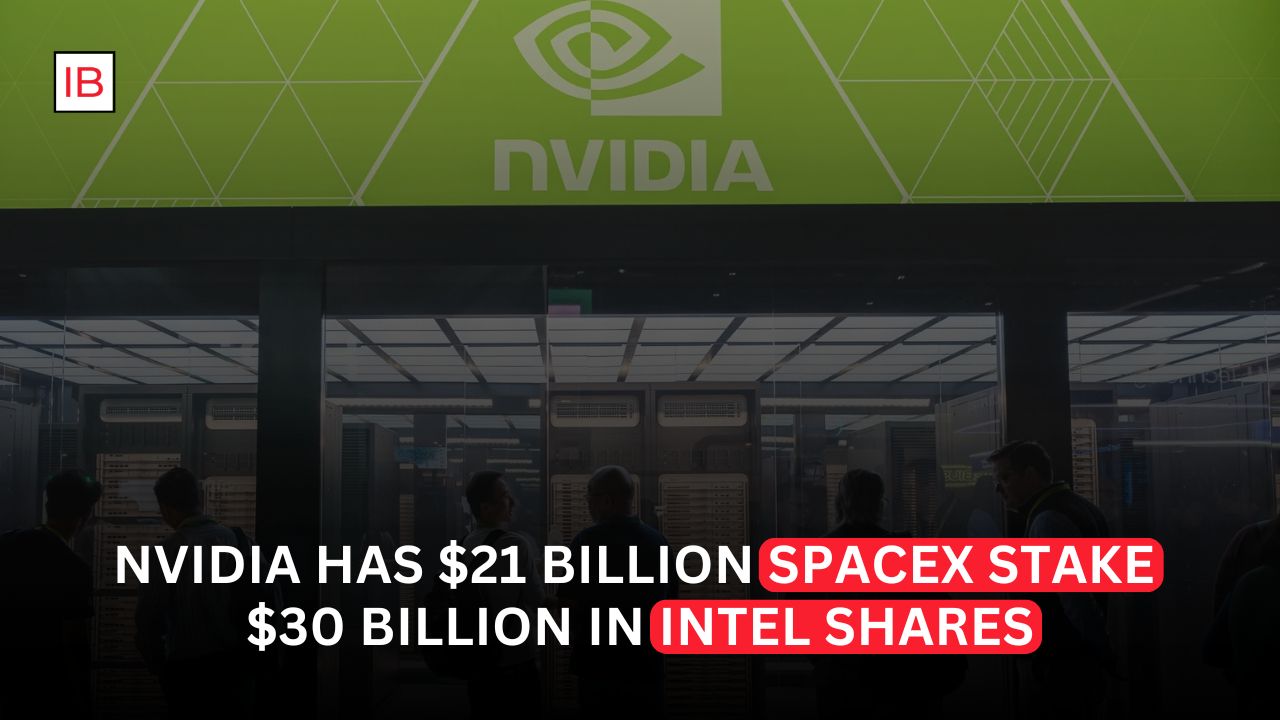
As of June 30, Nvidia held about 122.8 million SpaceX Class A shares, worth roughly $21 billion, along with about 214.8 million Intel shares.
That makes these investments far more significant than ordinary corporate stakes.
Nvidia Is Becoming a Strategic Investor
The SpaceX investment is particularly interesting.
Nvidia originally invested $10 billion in xAI, Elon Musk’s AI company. When SpaceX acquired xAI, Nvidia’s investment was converted into SpaceX shares.
So Nvidia effectively transformed an investment in an AI-model company into a major stake in one of the world’s largest space and infrastructure businesses.
That’s strategically important because SpaceX is also building substantial AI computing capacity.
The relationship therefore runs in both directions:
Nvidia supplies the computing infrastructure → SpaceX buys Nvidia technology → Nvidia owns part of SpaceX.
That is a very different business model from simply selling GPUs.
The Intel Investment Is Even More Strategic
Nvidia’s Intel position is also substantial.
The company held roughly 214.8 million Intel shares, representing a position valued around $30 billion based on the latest disclosure.
The investment originated from an agreement under which Intel issued Nvidia 215 million shares for $5 billion, completed in December 2025.
Nvidia therefore has a major financial interest in Intel’s turnaround.
That creates an unusual relationship between two companies that have historically competed across parts of the semiconductor industry.
Why Would Nvidia Invest in Intel?
The obvious answer is manufacturing.
Nvidia is overwhelmingly dependent on external manufacturers for producing its most advanced chips.
Intel is attempting to rebuild itself as a major contract chip manufacturer.
If Intel succeeds, Nvidia could potentially gain another strategically important manufacturing partner.
That matters because advanced AI chips require enormous amounts of manufacturing capacity.
The bottleneck isn’t always demand.
Sometimes it’s simply:
Can enough advanced chips physically be produced?
Nvidia Is Building an AI Ecosystem
The broader investment portfolio makes the strategy clearer.
Nvidia’s disclosed positions also include companies involved in:
- AI cloud infrastructure
- Optical components
- Semiconductor design
- Networking
- Data centers
- AI software
The company has reportedly invested more than $100 billion across AI companies and infrastructure over the past two years.
That’s not a traditional semiconductor strategy.
It’s closer to building an AI ecosystem around Nvidia’s technology.
The Strategy Has a Powerful Feedback Loop
Consider the basic structure:
Nvidia invests in AI infrastructure
↓
AI company expands
↓
AI company needs more Nvidia chips
↓
Nvidia sells more chips
↓
Nvidia’s investment potentially becomes more valuable
↓
Nvidia has more capital to invest elsewhere
That’s a potentially powerful flywheel.
But it also creates a risk.
The Biggest Risk: Circular AI Economics
Investors should be careful about treating these investments as independent evidence of AI demand.
Suppose Nvidia invests billions in an AI company.
That company uses the money to buy Nvidia GPUs.
Nvidia then reports higher revenue.
The investment increases in value because the AI company is growing.
That can create the appearance of extremely strong organic demand even though capital is circulating within the same ecosystem.
This doesn’t mean the demand is fake.
It means investors need to distinguish between:
externally generated customer demand
and
growth partly supported by strategic financing.
That distinction will become increasingly important as AI investment becomes more interconnected.
SpaceX Adds Another Layer
SpaceX is particularly interesting because it isn’t merely an AI company.
It operates:
- Rockets
- Satellites
- Starlink
- Communications infrastructure
- Space systems
- AI computing infrastructure
Its enormous satellite network creates potential demand for advanced computing, communications and semiconductor technology.
Nvidia therefore gets exposure to an unusually broad infrastructure platform.
SpaceX has also committed to Nvidia’s Vera Rubin architecture for its data centers, further strengthening the commercial connection.
But SpaceX Is Not a Normal Investment
There’s another problem.
SpaceX’s valuation is extremely high.
The company went public in June at a valuation around $1.8 trillion, making it one of the world’s largest companies almost immediately.
Nvidia’s $21 billion position was valued at the end of June.
Since then, SpaceX shares have fallen significantly from their June high, meaning the current market value of Nvidia’s position is lower than the $21 billion headline figure.
So investors shouldn’t treat $21 billion as today’s precise value.
It’s the value reported at the quarter-end measurement date.
Nvidia Is Taking More Balance-Sheet Risk
This strategy has an obvious benefit.
Nvidia can use its enormous cash generation to secure relationships with companies that could become major future customers.
But there is a cost.
Instead of simply holding cash or returning it to shareholders, Nvidia is increasingly exposing its balance sheet to:
Private companies + emerging technologies + infrastructure projects + strategic partners.
If those investments work, returns could be substantial.
If AI valuations fall, Nvidia could experience investment losses alongside weaker chip demand.
That creates more earnings volatility.
Intel Is the More Complicated Bet
The Intel investment may ultimately be more strategically important than the SpaceX position.
Intel is attempting one of the hardest turnarounds in the semiconductor industry:
Build leading-edge manufacturing + attract external customers + compete with TSMC + generate acceptable returns on enormous capital expenditure.
Intel recently raised $20 billion through an upsized share offering, with the funds supporting its broader turnaround and capital needs.
Nvidia’s stake gives it exposure to whether that turnaround works.
But Nvidia doesn’t control Intel.
So it is effectively betting on a company whose execution remains uncertain.
Nvidia’s Position in the AI Economy Is Becoming Unusual
Most technology companies operate within a supply chain.
Nvidia increasingly operates across the supply chain.
It sells:
GPUs
It invests in:
AI model companies
It invests in:
AI cloud providers
It invests in:
chip manufacturers
It invests in:
networking and semiconductor infrastructure
And those companies often become Nvidia customers.
That creates a much more integrated ecosystem.
The Strategic Advantage
The biggest advantage is that Nvidia can potentially influence the direction of the AI infrastructure market without having to own every company outright.
A relatively small investment can secure:
- A major customer relationship
- Preferred access to future technology
- Strategic alignment
- Greater ecosystem adoption
- Potential financial upside
The SpaceX and Intel stakes are extreme examples of that approach.
The Strategic Risk
The same strategy can become dangerous if Nvidia starts confusing ecosystem growth with independent economic growth.
If AI companies depend heavily on Nvidia financing while Nvidia depends on those companies for future chip demand, the ecosystem becomes increasingly interdependent.
That works extremely well during an AI boom.
It becomes much more fragile if capital spending slows.
What Investors Should Watch
AI Capex
The biggest driver remains how much hyperscalers and AI companies continue spending on infrastructure.
Nvidia’s Investment Gains
Investors should separate operating performance from gains or losses on strategic investments.
Intel’s Manufacturing Progress
Nvidia has a major financial interest in Intel’s ability to become a credible advanced foundry.
SpaceX AI Expansion
Growing data-center and AI capacity at SpaceX could create significant additional Nvidia demand.
Customer Concentration
Nvidia needs AI customers to remain financially healthy enough to keep buying chips.
Capital Allocation
Investors should ask whether Nvidia’s strategic investments generate better returns than simply returning capital to shareholders.
The Bigger Picture
The $21 billion SpaceX stake and roughly $30 billion Intel position reveal something bigger about Nvidia.
The company is trying to shape the AI economy, not merely supply it.
That can give Nvidia enormous strategic leverage.
But it also means the company is becoming more exposed to the success, valuations and financing needs of the very ecosystem it is helping create.
The bullish interpretation is straightforward:
Nvidia is using today’s AI profits to secure tomorrow’s AI infrastructure.
The skeptical interpretation is more uncomfortable:
Nvidia is increasingly investing in companies that may then use that capital to buy Nvidia’s own products.
Both can be true.
The next stage of the AI boom will reveal whether this ecosystem creates genuine independent economic value—or simply makes the same pool of AI capital circulate through more companies.