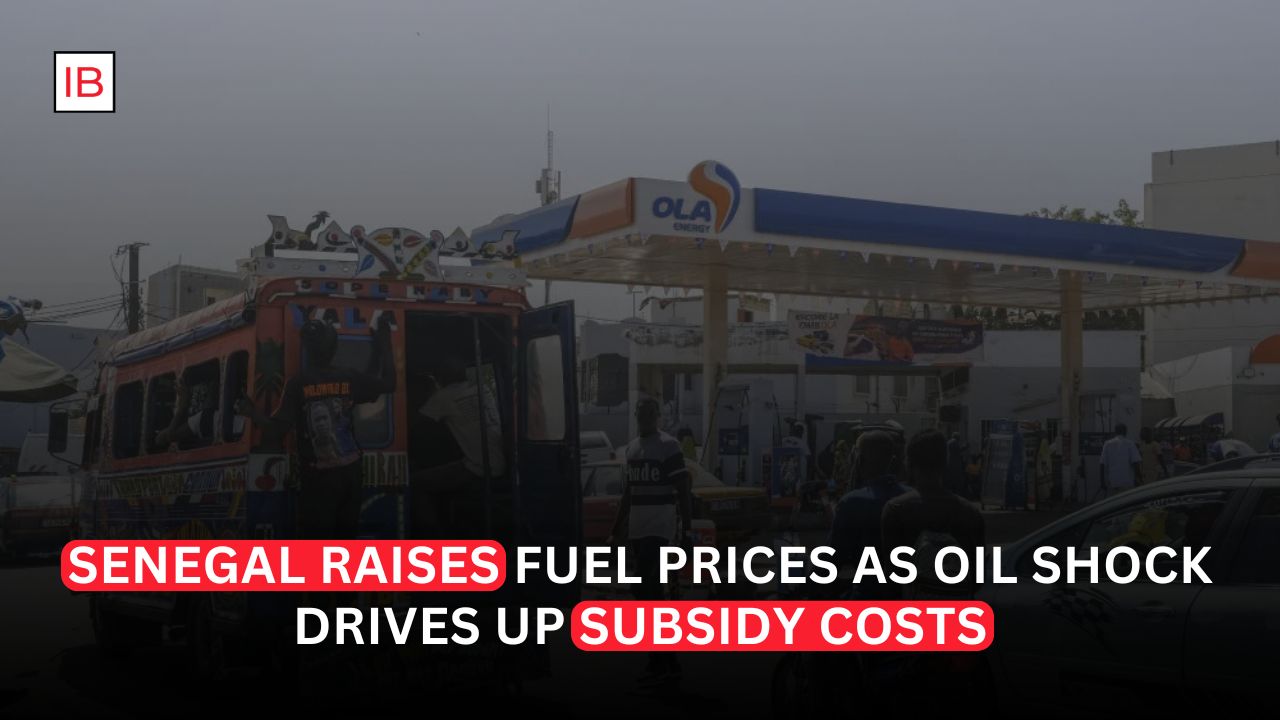
Senegal is raising fuel prices as the economic fallout from the Iran war pushes oil costs higher and threatens to make the government’s fuel-subsidy system increasingly expensive.
The move highlights how the conflict in the Middle East is spreading far beyond the countries directly involved. Higher global energy prices are putting pressure on governments, businesses and households across emerging markets, particularly in countries that rely heavily on imported fuel.
Higher Oil Prices Put Senegal Under Pressure
Senegal has historically used fuel subsidies to cushion consumers from sharp movements in international energy prices.
That policy can protect households from sudden increases at the pump, but it comes with a growing fiscal cost when crude prices rise significantly.
The latest oil shock is therefore creating a difficult choice for Dakar:
Keep fuel prices low and absorb a larger subsidy bill, or raise prices and pass more of the cost to consumers.
Senegal has chosen the latter.
The increase is intended to reduce the pressure on public finances as the cost of importing petroleum products rises.
The Iran War Is Creating a Global Energy Shock
The underlying problem is the disruption to energy markets caused by the conflict involving Iran and the United States.
The Strait of Hormuz is one of the world’s most important energy chokepoints, carrying a substantial share of global oil and gas shipments.
As the conflict has disrupted tanker traffic and increased uncertainty around the safety of shipping through the strait, crude prices have risen sharply.
For oil-importing countries such as Senegal, that creates an immediate economic problem.
The country cannot control the international price of crude.
It can only decide how much of that cost is absorbed by the government and how much is passed on to consumers.
Subsidies Become More Expensive During Oil Shocks
Fuel subsidies effectively transfer part of the cost of energy from consumers to the government.
When international prices are stable, that cost can remain manageable.
But when oil prices surge, the fiscal burden can grow rapidly.
That can force governments to redirect money away from other priorities, including:
- Infrastructure
- Healthcare
- Education
- Social programs
- Public investment
The longer an oil shock lasts, the harder it becomes to maintain broad subsidies without putting additional pressure on government finances.
Consumers Will Feel the Impact
The immediate consequence of higher fuel prices is straightforward: transportation becomes more expensive.
That can quickly spread through the wider economy.
Higher fuel costs increase the expenses of:
Truck operators
Bus companies
Farmers
Manufacturers
Retailers
Businesses may eventually pass those higher costs to consumers through increased prices for goods and services.
This means a fuel-price increase can contribute to broader inflation even when the original shock comes from events thousands of kilometers away.
Transport Costs Are Particularly Important
Senegal’s economy depends heavily on road transportation.
Fuel is a major input for moving food, consumer products and industrial goods around the country.
When diesel and gasoline become more expensive, the effect isn’t limited to motorists.
A truck transporting food from a rural production area to Dakar, for example, faces higher operating costs. Those costs can eventually appear in wholesale and retail prices.
That creates a second-round inflationary effect.
The Government Faces a Political Trade-Off
Fuel prices are politically sensitive almost everywhere.
Keeping prices artificially low can protect households in the short term.
But maintaining expensive subsidies can weaken the government’s fiscal position.
Raising prices solves part of the fiscal problem but creates immediate political pain.
That makes the decision particularly difficult when households are already dealing with higher living costs.
The government therefore has to balance fiscal sustainability against consumer affordability.
Senegal Isn’t Alone
The situation illustrates a broader problem facing emerging economies.
Countries that import most of their petroleum have limited protection against international oil shocks.
Oil-producing countries can sometimes benefit from higher crude prices through increased export revenue.
Importers experience the opposite effect.
They face:
Higher import bills + weaker trade balances + greater inflation pressure + higher fiscal costs.
That combination can put pressure on currencies and government finances at the same time.
The Risk of a Longer Oil Shock
The biggest question is how long the Middle East disruption lasts.
If the conflict is resolved relatively quickly and shipping through Hormuz normalizes, oil prices could retreat and the pressure on Senegal’s subsidy system would ease.
But if disruptions persist, governments may have to make more difficult choices.
A prolonged period of high oil prices could force Senegal to reconsider how fuel prices are regulated and whether broad subsidies remain financially sustainable.
What to Watch
The key indicators will be:
Global crude prices: A sustained increase would intensify pressure on Senegal.
Fuel consumption: Higher prices could reduce demand.
Inflation: Transportation costs could feed into food and consumer prices.
Government finances: Lower subsidies could improve the fiscal position.
Currency pressure: Higher energy-import costs could weigh on the country’s external balance.
Oil-market disruptions: Any improvement in Hormuz shipping could quickly change the outlook.
The Bigger Picture
Senegal’s fuel-price increase is a reminder that the economic consequences of the Iran war extend far beyond the battlefield.
A disruption in one of the world’s most important energy corridors can eventually show up in the daily expenses of households in West Africa.
The policy dilemma is straightforward but painful:
Someone has to pay the higher oil bill.
If the government absorbs it, public finances deteriorate.
If consumers absorb it, household budgets come under pressure.
Senegal’s decision to raise fuel prices suggests the government is increasingly unwilling—or unable—to absorb the full cost.
And if the oil shock continues, Senegal may not be the last emerging-market economy forced to make the same choice.