Artificial intelligence is increasingly affecting a market that once seemed far removed from Silicon Valley: the US Treasury market.
The immediate connection is simple. Technology companies are spending enormous amounts of money building AI infrastructure, and much of that spending requires financing. As companies borrow to fund data centers, chips, power infrastructure and cloud capacity, they add to demand for capital at a time when governments are also borrowing heavily.
The result is an increasingly important question for investors:
Could the AI boom itself be contributing to higher long-term interest rates?
Recent market evidence suggests the answer is increasingly yes. US long-term Treasury yields have remained elevated even as expectations for another Federal Reserve rate hike have weakened. The 10-year Treasury yield was around 4.68% on Aug. 17, while the 30-year yield remained above 5%.
AI Is Creating an Enormous Demand for Capital
The AI buildout is unlike a normal software investment cycle.
Companies aren’t simply hiring engineers and buying servers.
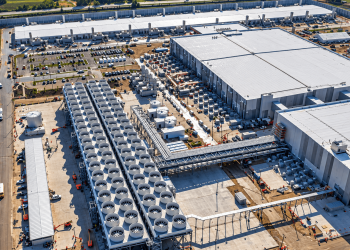
They are constructing enormous data centers, securing electricity, purchasing advanced chips and signing long-term infrastructure agreements.
The four largest cloud buyers are expected to spend roughly half a trillion dollars on AI infrastructure this year alone.
That spending requires resources.
Construction companies need labor and materials. Semiconductor manufacturers need capacity. Utilities need to build additional power generation and transmission infrastructure.
And technology companies increasingly need debt markets to supplement their own cash flows.
Alphabet, for example, recently moved toward issuing bonds in Australian dollars after raising $25 billion through US-dollar bonds earlier in 2026.
The Bond Market Is Feeling the Pressure
This matters because the Treasury market doesn’t operate in isolation.
Investors allocate capital across government bonds, corporate debt and other assets.
If technology companies issue large amounts of debt at the same time that governments are running large deficits, investors have more securities competing for their money.
That can push required yields higher.
Reuters recently reported that AI companies and governments are contributing to a surge in real bond yields, with US 30-year real yields approaching their highest level in nearly two decades.
This is an important distinction.
Higher yields aren’t necessarily being caused by expectations of higher inflation alone.
They can also reflect a growing demand for capital.
AI Spending Can Also Push Up Inflation
There is another channel.
AI investment is creating demand faster than some parts of the economy can expand supply.
Data-center construction requires land, electricity, cooling equipment, transformers, construction workers and specialized hardware.
Semiconductors are also under enormous demand pressure.
Those bottlenecks can increase costs.
There is already evidence that AI-related demand is contributing to higher prices for some technology goods and services. Analysts have estimated that AI-related inflation could add around 0.4 percentage points to US inflation in 2026.
That creates a difficult situation for the Federal Reserve.
If AI eventually raises productivity and expands supply, it could become disinflationary.
But during the investment boom itself, it can be inflationary.
The Fed Has Less Control Over Long-Term Yields
This is perhaps the most important part of the story.
The Federal Reserve has enormous influence over short-term interest rates.
It has much less control over 10-year and 30-year Treasury yields.
Those longer-term yields reflect expectations about inflation, economic growth, government borrowing, investor demand and the term premium.
That explains why Treasury yields can remain high even when traders become less convinced that the Fed will raise rates.
On Aug. 17, markets had reduced the probability of a September Fed hike to around 30%, from more than 50% a week earlier. Treasury yields nevertheless remained relatively high.
That divergence is telling investors that something beyond Fed policy is influencing the bond market.
Government Borrowing Makes the Problem Bigger
AI isn’t operating in a vacuum.
The US government is also issuing enormous amounts of debt.
The federal budget deficit reached about $1.8 trillion during the first 10 months of fiscal 2026, while total US national debt is approaching $40 trillion.
The Treasury is therefore competing with corporations for investors’ capital.
And the competition becomes more intense when companies such as Alphabet, Amazon, Meta and other technology firms need to raise money for AI infrastructure.
The result can be a higher equilibrium cost of capital.
Oracle and Alphabet Show the New Reality
Oracle is one of the clearest examples.
The company spent roughly $55.7 billion in fiscal 2026, while simultaneously expanding its borrowing to support its cloud and AI ambitions.
Alphabet is also entering debt markets while dramatically increasing its AI infrastructure investment. Its decision to explore an Australian-dollar bond sale illustrates how technology companies are broadening their financing sources.
These companies have enormous revenues and valuable businesses.
But the scale of their investment means even the largest technology companies are becoming important participants in global credit markets.
The AI Boom Could Change the Normal Market Relationship
For years, investors often thought about technology as a force that would eventually reduce costs.
Software became cheaper.
Automation increased productivity.
Computing became more efficient.
AI could eventually do the same.
But the transition period may look very different.
Right now, companies are spending aggressively before the full productivity benefits arrive.
That means the economy may experience:
Higher investment → stronger capital demand → higher borrowing → higher yields → tighter financial conditions.
If the AI boom continues at its current pace, this mechanism could become increasingly important.
Higher Yields Create a Problem for AI Companies Too
There is an obvious irony here.
AI spending can contribute to higher interest rates, while higher interest rates make AI infrastructure more expensive to finance.
That creates a feedback loop.
If companies rely heavily on debt, a higher cost of capital reduces the expected return on their investments.
Projects that looked attractive when financing costs were low may become less compelling when long-term yields rise.
This matters particularly for companies with large future infrastructure commitments.
It Could Also Pressure Stock Valuations
Higher Treasury yields affect equities because government bonds are the benchmark against which many risky investments are valued.
When the risk-free rate rises, investors generally demand higher returns from stocks.
That tends to put pressure on high-growth companies whose valuations depend heavily on profits far in the future.
AI stocks therefore face a double test:
- They must deliver rapid earnings growth.
- They must do so while the cost of capital remains elevated.
A company can beat earnings expectations and still see its valuation suffer if Treasury yields rise sharply.
But Higher Yields Aren’t Automatically Bad
There is a counterargument.
If AI investment is genuinely increasing productivity and economic growth, higher real yields may partly reflect a healthier economy.
Strong investment demand is not necessarily a sign of financial distress.
The real danger comes if the infrastructure buildout becomes excessive.
If companies construct too much capacity, borrow too much money and fail to generate sufficient returns, higher yields could expose the weakness.
That is when the AI boom becomes a financial problem rather than simply an investment boom.
What Investors Should Watch
Treasury yields: Particularly the 10-year and 30-year maturities.
Corporate bond issuance: More AI-related borrowing would increase competition for capital.
AI capital expenditure: Continued upward revisions would signal stronger demand for financing.
Data-center construction: Power and infrastructure bottlenecks could increase costs.
Inflation: Persistent AI-related price pressures could limit the Fed’s ability to ease.
Free cash flow: This will determine how much AI spending companies can fund internally.
AI utilization: The crucial question is whether enormous infrastructure investments translate into actual revenue.
The Bigger Picture
The AI boom is no longer just a technology story.
It is becoming an economic and financial system story.
AI is affecting electricity demand, construction, semiconductor prices, corporate borrowing, inflation, equity valuations and now the Treasury market.
Recent market conditions demonstrate why investors cannot simply assume that weaker inflation or softer economic data will automatically produce lower long-term yields.
The Fed may control the overnight rate, but it does not control the amount of capital that governments and corporations want to consume.
And right now, that demand is enormous.
The biggest question is no longer whether AI will transform the economy. It is whether the economy can finance the transformation without pushing borrowing costs high enough to undermine the investment boom itself.