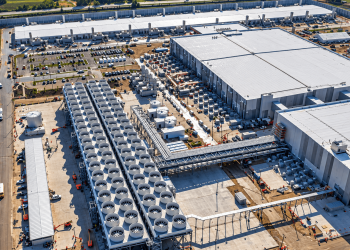
The biggest risk in the AI boom may not be how much Big Tech is spending today. It may be how much it has already committed to spend tomorrow.
That distinction is becoming increasingly important as Meta and Oracle, among the most aggressive companies in the artificial-intelligence infrastructure race, accumulate enormous future obligations tied to data centers, computing capacity, equipment and long-term contracts.
Recent analysis shows that the five major US technology companies—Microsoft, Meta, Oracle, Amazon and Alphabet—have committed roughly $1.09 trillion in future payments under leases that have not yet begun, much of it connected to AI data-center expansion.
The headline AI spending numbers therefore don’t tell the whole story.
The Hidden Cost of AI Infrastructure
AI requires a fundamentally different type of infrastructure investment from much of traditional software.
Companies need enormous data centers, specialized chips, electricity, cooling systems and networking equipment.
Those assets are expensive to build, but companies don’t always have to purchase them outright.
Instead, they can sign long-term leases, capacity agreements and purchase commitments.
The accounting treatment can make these obligations less visible on the balance sheet.
That doesn’t make them economically irrelevant.
The payments still have to be made.
Meta’s Commitments Are Becoming Significant
Meta has traditionally been in a relatively comfortable financial position compared with heavily leveraged technology companies.
Its advertising business generates substantial cash, giving CEO Mark Zuckerberg considerable room to spend aggressively on AI.
But that doesn’t mean the company’s AI expansion is risk-free.
Meta has committed hundreds of billions of dollars in future infrastructure-related obligations, with recent reporting putting its uncommenced lease commitments at roughly $279 billion.
The scale matters because these commitments extend well into the future.
Meta is effectively making a bet that demand for AI computing and the products built on top of it will remain strong enough to justify today’s infrastructure decisions.
If that assumption proves wrong, the company could find itself paying for capacity it doesn’t need.
Oracle Is the More Obvious Pressure Point
Oracle stands out for a different reason.
Unlike Meta, Oracle is financing a huge portion of its AI infrastructure expansion while carrying a substantially heavier debt burden.
Oracle spent about $55.66 billion in fiscal 2026, exceeding its previous $50 billion target, while investors have become increasingly concerned about the company’s rising debt load.
The company has also indicated that it plans to raise substantial additional capital.
That creates a much tighter relationship between AI demand and financial risk.
If Oracle’s cloud and AI business grows rapidly, the spending can generate attractive returns.
If growth disappoints, however, debt service and infrastructure commitments remain.
That asymmetry is what makes Oracle particularly sensitive to any slowdown in AI spending.
The AI Boom Is Becoming a Financing Story
This is the key shift investors should recognize.
The AI boom initially looked primarily like a technology story.
Nvidia sells GPUs.
Cloud providers build data centers.
AI companies develop models.
Consumers and businesses adopt AI applications.
Now it is increasingly becoming a capital-markets story.
Companies are borrowing more.
Infrastructure is being financed through increasingly complicated structures.
Long-term contracts are creating future payment obligations.
And investors are trying to determine how much of the AI buildout is supported by actual demand versus expectations of future demand.
Reuters recently reported that the five largest AI data-center spenders are accumulating enormous future lease obligations, while Big Tech’s broader infrastructure commitments are expanding rapidly.
Why Off-Balance-Sheet Obligations Matter
The phrase “off-balance-sheet” can sound more alarming than it actually is.
Not every future commitment represents debt.
A lease is not automatically equivalent to a bond.
A purchase agreement doesn’t necessarily mean a company has borrowed money.
But these obligations still matter because they reduce future financial flexibility.
Consider a company that commits to billions of dollars of data-center capacity.
If AI demand rises faster than expected, that commitment becomes an asset.
If demand falls short, it becomes a burden.
The accounting classification doesn’t change the underlying economic exposure.
The Bigger Question Is AI Monetization
This is where the argument against the spending boom becomes stronger.
The problem isn’t that Big Tech is investing heavily in AI.
The problem is whether future AI revenue will grow quickly enough to earn an acceptable return on all that infrastructure.
The companies making these investments are among the world’s most profitable businesses.
That gives them much more room for error than startups had during the dot-com bubble.
But even enormous cash flows can be overwhelmed if capital spending continues rising faster than operating profits.
Oracle is already demonstrating that tension.
Its cloud demand is strong, but the company has simultaneously faced investor concerns about negative free cash flow and the scale of its borrowing requirements.
Meta Has More Financial Cushion
Meta’s position is considerably different.
Its core advertising operation remains highly profitable, giving it a much larger internal funding base.
That reduces the immediate danger from its AI spending.
But Meta’s advantage can also encourage more aggressive investment.
If management believes AI is strategically existential, the company can justify spending enormous amounts even before the financial returns are obvious.
That makes the real risk less about solvency and more about capital allocation.
Meta could remain financially healthy while still generating disappointing returns on AI infrastructure.
Oracle Has Less Room for Error
Oracle’s situation deserves more scrutiny because its AI strategy is closely tied to external financing.
The company has accumulated a huge cloud backlog, but investors are questioning how much capital is required to convert that backlog into actual cash flow.
Oracle has also faced a sharp deterioration in investor sentiment as concerns over debt and AI spending have intensified.
That creates a potentially dangerous feedback loop.
More AI demand requires more infrastructure.
More infrastructure requires more capital.
More borrowing increases financial risk.
Higher financial risk increases the cost of capital.
That can make future infrastructure even more expensive.
This Doesn’t Mean the AI Boom Is a Bubble
Calling the entire AI investment cycle a bubble would be too simplistic.
AI demand is real.
Cloud providers are seeing strong demand for computing capacity.
Businesses are investing heavily in AI applications.
And the technology is already generating measurable productivity gains in some areas.
The more difficult question is valuation.
A real technological revolution can still produce bad investments if companies overpay for infrastructure or build too much capacity too quickly.
That distinction is often missed in AI-bubble debates.
The technology can succeed while some infrastructure investments fail to generate adequate returns.
Investors Need to Look Beyond Capex
Traditional analysis often focuses on capital expenditure.
That’s no longer enough.
Investors need to examine:
- Lease commitments
- Purchase obligations
- Debt issuance
- Cloud-capacity contracts
- Free cash flow
- Data-center utilization
- AI revenue growth
- Customer concentration
- Financing costs
These numbers reveal how much future spending has already been locked in.
Recent reporting indicates that Big Tech’s broader AI-related obligations are substantially larger than headline capital-expenditure figures suggest.
What Happens if AI Demand Slows?
This is the scenario worth stress-testing.
Suppose AI adoption continues but grows at half the rate companies currently expect.
The infrastructure still exists.
The leases still have to be paid.
The equipment has already been purchased.
Debt still needs servicing.
Companies may then face excess capacity and weaker returns.
The winners would likely be companies with the strongest balance sheets and the most flexible infrastructure.
The weaker players could be forced to cut spending or raise additional capital at unfavorable terms.
The Bottom Line
Meta and Oracle are not facing the same level of financial risk.
Meta has a much stronger cash-generating engine and greater flexibility. Oracle is more exposed because its enormous AI infrastructure expansion is occurring alongside heavier borrowing and weaker free cash flow.
But both companies illustrate the same broader problem.
The AI investment race is creating obligations that extend far beyond the capital expenditure figures investors see in quarterly headlines.
The real question isn’t whether Big Tech can afford to spend billions on AI.
It is whether today’s infrastructure commitments will generate enough future revenue to justify the enormous financial obligations being created.
The AI boom may ultimately be judged less by how many data centers companies build and more by how efficiently those data centers turn capital into cash flow.