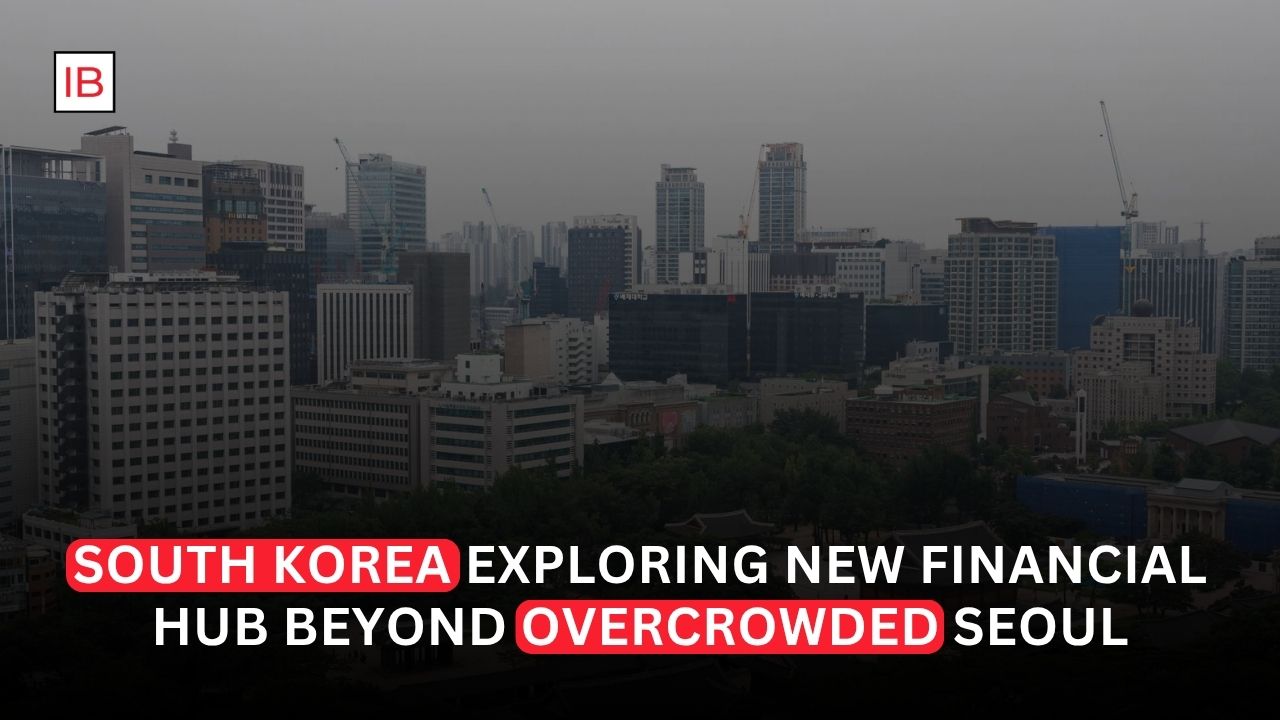
South Korea is considering whether its next major financial center should be built outside Seoul as the government looks for ways to ease congestion in the capital and spread economic activity more evenly across the country.
The idea reflects a broader challenge facing South Korea: the overwhelming concentration of businesses, financial institutions, talent and high-paying jobs in the Seoul metropolitan area has helped create one of Asia’s most powerful economic centers, but it has also contributed to expensive housing, traffic congestion and growing regional inequality.
Seoul remains firmly established as the country’s dominant financial center. Yeouido, in particular, houses major banks, securities firms, the Korea Exchange and other financial institutions. But policymakers are increasingly examining whether some financial activity could be relocated or expanded in another city, potentially creating a second hub capable of attracting international companies and investors.
The debate comes as President Lee Jae Myung’s administration seeks to reduce the economic imbalance between Seoul and other parts of the country. Regional development has become a major policy issue, with the government looking for ways to encourage companies and skilled workers to establish themselves outside the capital.
Creating a new financial district could be part of that strategy.
The proposal faces a fundamental problem, however: financial centers are difficult to manufacture through government policy alone. New York, London, Hong Kong and Singapore became global financial hubs because they accumulated deep pools of capital, specialized talent, international businesses, legal infrastructure and extensive networks over decades.
South Korea already has those advantages concentrated heavily in Seoul. Moving them elsewhere would require companies and employees to have a compelling reason to relocate.
Busan is one of the most obvious candidates. The southeastern port city has long been promoted as an international financial center and has an established role in shipping, logistics and maritime industries. Its geographic position and connection to global trade could provide a foundation for developing specialized financial services focused on commodities, shipping, insurance and international investment.
Busan also has experience with government-backed efforts to establish a financial district. The city has developed infrastructure intended to attract financial companies and has hosted institutions connected to Korea’s financial and capital markets.
The challenge is that attracting a few government agencies or financial companies does not automatically create a globally competitive financial ecosystem.
Financial firms depend heavily on proximity to clients, competitors, regulators and highly skilled employees. Traders, investment bankers, asset managers and lawyers benefit from being physically close to one another because deals, information and talent move quickly through these networks.
That concentration is one reason Seoul has remained dominant despite years of regional development efforts.
Housing costs could nevertheless create an opening for another city. Seoul’s property market has become a major political concern, with the government recently introducing measures aimed at increasing housing supply and supporting younger buyers. President Lee has warned that rising property prices could create broader economic problems if they remain unchecked.
The government’s housing strategy highlights the wider consequences of Seoul’s concentration. When high-paying jobs are clustered in one metropolitan area, demand for housing rises sharply, pushing prices higher and making it harder for younger workers to establish themselves.
Creating another major economic center could theoretically reduce some of that pressure by giving businesses access to alternative locations.
But financial firms are unlikely to move simply because office space and housing are cheaper. They need access to talent, clients and global transportation networks. Any new financial hub would therefore need to offer something distinctive rather than simply replicate Yeouido on a smaller scale.
This is where Busan’s maritime economy could become important. The city is already a major global port, and its financial strategy could focus on areas where it has a natural competitive advantage rather than attempting to become a general-purpose rival to Seoul.
A specialized financial hub could develop around shipping finance, marine insurance, commodities trading, logistics finance, carbon markets and infrastructure investment. These industries could benefit directly from Busan’s existing commercial ecosystem.
Other Korean cities could also have potential roles in the government’s broader decentralization strategy. Incheon has developed Songdo as an international business district and benefits from its proximity to Incheon International Airport. The city could potentially attract companies that prioritize international connectivity and access to foreign markets.
South Korea’s technology sector provides another possible path. Rather than building a traditional financial district, policymakers could encourage financial-technology companies, digital-asset businesses, artificial-intelligence firms and data-driven financial services to establish themselves outside Seoul.
That approach may be more realistic because newer industries are less tied to existing financial networks. A technology-focused financial hub could potentially develop around universities, research centers and specialized infrastructure rather than requiring established banks to relocate their headquarters.
Artificial intelligence is particularly relevant. Financial institutions are increasingly using AI for trading, risk management, fraud detection, customer service and investment research. Cities that combine technology talent with financial infrastructure could compete for some of this emerging business.
Still, the government must avoid confusing construction with economic development. Building skyscrapers, convention centers and financial districts does not guarantee that international investors will arrive.
South Korea has attempted large-scale regional development projects before, with mixed results. Some ambitious business districts have struggled to attract enough companies after the initial construction boom faded.
The same risk exists for a new financial hub. If policymakers subsidize offices and infrastructure without creating genuine commercial demand, the result could be expensive real estate with relatively little financial activity.
The strongest argument for decentralization is therefore not simply to move existing institutions from Seoul. It is to create new financial activity outside the capital.
That could involve tax incentives, regulatory support, investment funds, university partnerships and specialized financial licenses. The government could also encourage public financial institutions and state-backed investors to establish regional operations, creating an initial base of financial professionals.
International connectivity will be another critical factor. A successful financial center needs fast access to global markets, and international airport connections matter for executives and investors. Busan and Incheon both have advantages in this area, although neither currently matches Seoul’s concentration of corporate headquarters and financial services.
The political stakes are also significant. South Korea’s regional imbalance is not simply an economic issue. Population decline in smaller cities and provinces is becoming increasingly serious, while younger workers continue to migrate toward the capital in search of better jobs and opportunities.
A credible second financial center could help reverse some of that trend by creating high-value employment outside Seoul.
But success would likely take years rather than months. Financial ecosystems develop through networks, reputation and accumulated expertise. Government policy can accelerate that process, but it cannot manufacture credibility overnight.
South Korea’s exploration of a new financial hub therefore represents a potentially important shift in regional economic policy, but the hardest part will be execution. The country does not need another collection of office towers. It needs a city with a specific financial specialization strong enough to attract businesses, workers and international capital.
Seoul will remain South Korea’s dominant financial center for the foreseeable future. The realistic goal is not to replace it, but to build a complementary hub that can capture new areas of growth while reducing some of the economic pressure created by excessive concentration in the capital.
If policymakers can connect regional strengths with emerging industries such as AI, digital finance, shipping and international investment, a second financial center could become economically meaningful. If the strategy relies mainly on construction and government incentives, it risks becoming another expensive decentralization experiment with limited impact.