Fresh protests in Libya are exposing a problem that has become increasingly difficult for the country’s political leadership to contain: despite possessing some of Africa’s largest oil reserves, the government is struggling to provide reliable electricity and other basic services to its population.
The demonstrations reflect growing public frustration with prolonged power outages, deteriorating living conditions, rising prices and weak public services. Electricity has become one of the most visible symbols of Libya’s broader governance crisis, with households facing repeated blackouts even as the country continues to produce and export significant amounts of crude oil.
The latest unrest comes after months of worsening pressure on Libya’s electricity network. Daily blackouts have affected both western and eastern parts of the country, with power rationing in some areas extending for more than 14 hours during periods of extreme heat.
For ordinary Libyans, the contradiction is difficult to ignore. The country has Africa’s largest proven oil reserves, yet its electricity system remains vulnerable to fuel shortages, damaged infrastructure, technical failures and political interference. The problem is not simply a lack of natural resources. It is a consequence of years of institutional fragmentation, underinvestment and political conflict.
Libya remains divided between rival political authorities, with the internationally recognized Government of National Unity based in Tripoli controlling much of the west and a rival administration based in the east. That division has made it difficult to create a unified national strategy for infrastructure, public spending and energy policy.
The electricity crisis is therefore about much more than power generation.
The General Electricity Company of Libya, or GECOL, has repeatedly warned that damage to electricity infrastructure and insecurity are threatening the stability of the national grid. Earlier this month, a substation south of Zawiya was targeted and completely burned, cutting electricity to large areas and forcing the facility out of service. GECOL warned that continued attacks could produce even wider disruptions, potentially affecting the national grid.
Those attacks add another layer to an already fragile system.
Libya’s electricity infrastructure has suffered from years of conflict and insufficient maintenance. Power plants require reliable supplies of natural gas and other fuels, while transmission networks and substations need continuous investment. When one part of the system fails, the effects can spread quickly because there is limited spare capacity.
Protesters have increasingly connected electricity shortages with broader economic grievances.
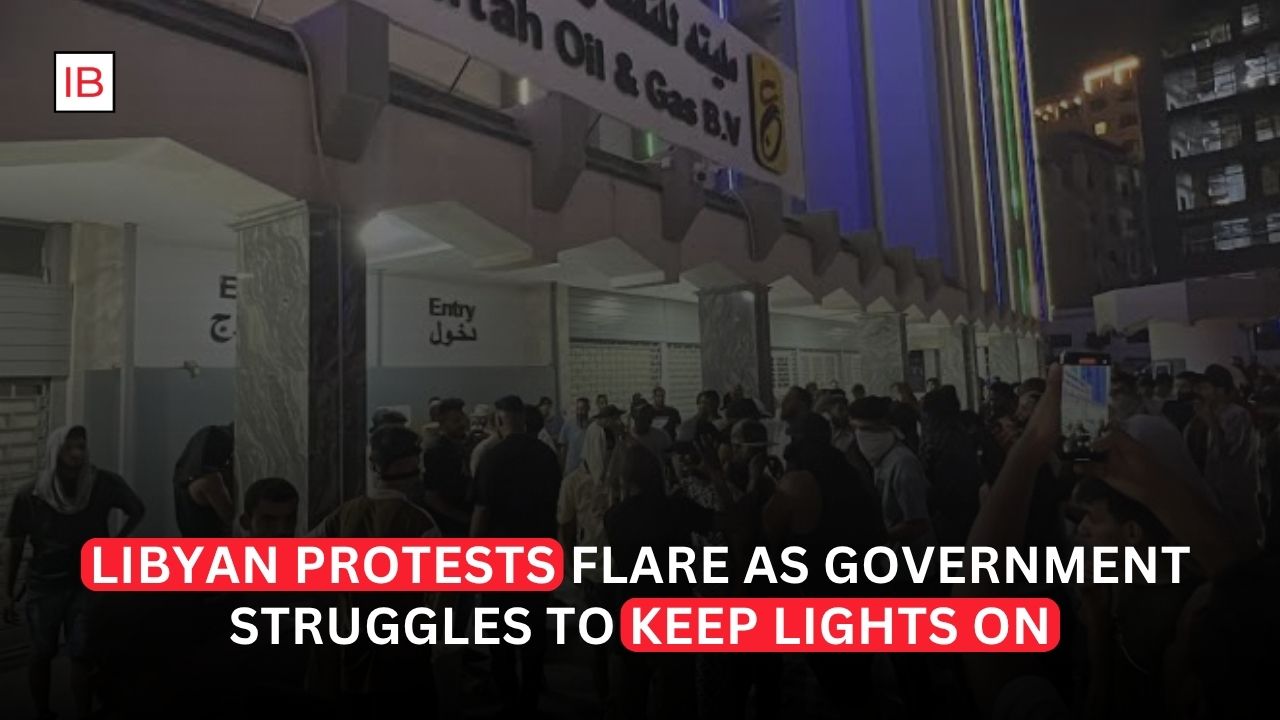
Earlier demonstrations in Tripoli focused not only on blackouts but also on water shortages, inflation, rising prices, weak healthcare services and shortages of cash. Protesters have also demanded accountability from officials responsible for the country’s public services.
The pressure has occasionally reached critical energy infrastructure itself.
In July, protesters shut down the Mellitah oil and gas complex west of Tripoli, disrupting gas supplies to electricity-generation plants. The Government of National Unity responded by ordering security forces to protect the facility and restore gas flows, warning that interference with oil, gas and electricity infrastructure threatened national energy security.
The incident demonstrated the dangerous connection between Libya’s political instability and its electricity crisis.
Natural gas from oil and gas facilities is essential for generating power. If protesters or armed groups interrupt gas supplies, electricity production can fall rapidly. But using security forces to reopen facilities can create further political tensions, particularly in a country where armed groups remain powerful.
The government’s central challenge is therefore difficult to solve through short-term measures.
Libya needs more reliable generation capacity, stronger transmission networks and better maintenance. It also needs stable supplies of gas and fuel and a political system capable of protecting critical infrastructure from interference.
All of those requirements depend on governance.
The contradiction between Libya’s oil wealth and its electricity shortages is especially damaging to public confidence. Oil revenues give the government significant financial resources, but citizens increasingly question why those revenues have not translated into dependable services.
That frustration could become more politically dangerous if blackouts continue.
Electricity demand rises sharply during hot weather because households rely heavily on air conditioning. A heat wave can therefore turn an existing supply deficit into a major public crisis within days.
The government has previously tried to address the electricity problem through new generation projects and infrastructure investment. There was some improvement between 2023 and 2025, but recent disruptions demonstrate how fragile those gains remain.
Security problems are making the situation even worse.
The attack on the Zawiya substation was not an isolated example of damage to critical infrastructure. Telecommunications facilities in western Libya have also been targeted, while the Zawiya oil complex has faced repeated attacks.
Such incidents increase the cost of maintaining infrastructure and make international contractors more reluctant to send engineers and technical specialists into the country.
That problem is already visible in the power sector. GE Vernova has cited security concerns and militia clashes near the Zawiya power station as reasons its engineers were temporarily evacuated, contributing to delays in bringing the plant back online.
The resulting cycle is difficult to break.
Weak infrastructure creates public anger. Public anger produces protests. Protests and insecurity disrupt energy facilities. Disruptions reduce electricity generation and oil and gas output. Lower production or damaged facilities reduce the government’s ability to invest in infrastructure, creating further frustration.
Oil production itself remains central to Libya’s economic survival.
The National Oil Corp. is seeking as much as $40 billion of investment to develop the country’s oil and gas resources and increase production toward 2 million barrels a day by 2030. But political fragmentation, security problems and funding constraints remain major obstacles.
The irony is that Libya wants to increase oil production at exactly the time when citizens are demanding better use of existing oil wealth.
The government will need to convince the public that additional production can generate tangible improvements in living standards rather than simply increasing state revenues without addressing structural problems.
That will require more transparency over public spending and stronger institutions.
Another issue is fuel and electricity subsidies. Libya has historically spent heavily to keep energy prices low for consumers. While subsidies can protect households, they can also encourage excessive consumption, create opportunities for smuggling and place a substantial burden on public finances.
The government has increasingly recognized that reform is necessary, but subsidy reform is politically dangerous when citizens already feel that basic services are inadequate.
Removing subsidies before improving electricity reliability and household incomes could trigger even greater public anger.
For investors, the protests represent a warning about Libya’s political and operational risks. The country’s oil reserves make it highly attractive, but production can be disrupted quickly when political disputes or security incidents affect infrastructure.
International oil companies therefore have to consider not only geological potential but also the reliability of the institutions protecting their investments.
For the government, however, the electricity crisis represents a more immediate political threat.
Citizens can tolerate political uncertainty for only so long when basic services continue deteriorating. Power cuts affect nearly every aspect of daily life, from water pumping and communications to businesses, hospitals and households.
That makes electricity one of the few issues capable of bringing together people across Libya’s political divisions.
The protests are consequently about more than electricity.
They reflect growing dissatisfaction with a political system that has struggled to convert Libya’s enormous natural-resource wealth into stable public services. The longer blackouts continue, the harder it becomes for authorities to argue that the existing system is delivering acceptable results.
Libya’s immediate challenge is to stabilize the grid and prevent further attacks on critical infrastructure. But the longer-term solution requires something more difficult: political stability, accountable institutions and sustained investment.
Without those changes, new power plants alone will not solve the problem.
Libya has the resources to produce far more reliable electricity. What it lacks is the institutional stability needed to turn those resources into dependable services.
That is why the latest protests matter. They show that Libya’s energy crisis is no longer simply an infrastructure problem. It is becoming a test of whether the country’s divided political system can deliver the basic services that citizens increasingly demand.