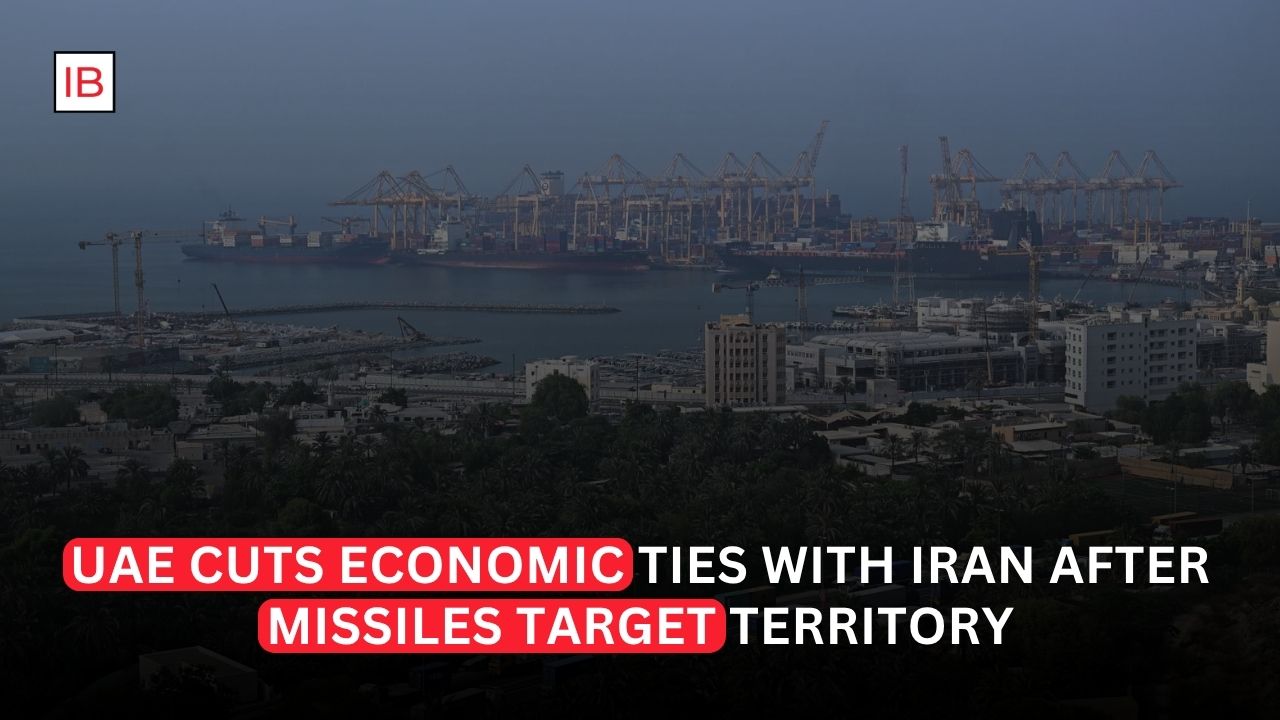
The United Arab Emirates has suspended trade, commercial exchanges and financial transactions with Iran after accusing Tehran of launching ballistic missiles toward its territory, marking a sharp deterioration in relations between two neighboring countries that had recently been trying to rebuild economic and diplomatic links.
The decision announced by the UAE represents one of the clearest signs yet that the latest escalation in the Middle East is threatening to reverse a cautious rapprochement between Abu Dhabi and Tehran. The UAE said the suspension would remain in place until further notice, citing regional developments that it said were undermining peace and security.
The immediate trigger was a missile incident reported Tuesday. The UAE Defense Ministry said its air-defense systems detected two ballistic missiles launched from Iran. One missile landed outside UAE territorial waters, while another fell inside them. The UAE said the missiles were targeting maritime traffic.
Iran has denied launching the missiles, calling the UAE’s accusation baseless and arguing that such claims undermine efforts to improve relations between the two countries. The competing accounts make the incident particularly sensitive because both sides have an interest in preventing the confrontation from developing into a wider direct conflict.
The suspension of economic ties could nevertheless have significant consequences. The UAE has long been an important commercial gateway for Iranian businesses, with Dubai serving as a major regional center for trade, finance, logistics and re-export activity. Disrupting those connections could affect companies on both sides of the Gulf.
For Iran, the UAE is particularly important because of its geographic proximity and role as a financial and commercial hub. Iranian traders and companies have historically used the UAE to access international markets, source goods and conduct transactions that can be more difficult to complete directly through Iran.
For the UAE, Iran represents a significant neighboring market, even though political relations have often been complicated. Trade and business links have survived periods of tension because commercial interests have provided incentives for both countries to maintain channels of communication.
The latest decision puts those relationships under immediate pressure.
It also demonstrates how quickly the broader regional conflict is spilling into economic activity. The UAE had been attempting to avoid being drawn deeper into the confrontation between Iran, the United States and Israel. Abu Dhabi has repeatedly emphasized the importance of protecting its territory and maintaining economic stability while strengthening its security relationships.
The missile incident makes that strategy increasingly difficult.
The timing is especially significant because efforts to reduce tensions between the UAE and Iran had produced some signs of normalization in recent months. Diplomatic and economic channels had been reactivated, some trade had resumed and Iranian flights to the UAE had begun returning. The latest escalation threatens to reverse those developments.
The economic consequences could extend beyond bilateral trade.
The UAE is one of the world’s most important logistics and financial centers, while Dubai is a major hub for shipping, aviation and international commerce. Any prolonged deterioration in relations with Iran could complicate regional transportation networks and increase the risks faced by businesses operating around the Gulf.
The Strait of Hormuz makes the situation even more serious.
The waterway is one of the world’s most important energy routes, carrying a substantial share of global oil and gas shipments. Traffic has already fallen sharply amid the broader conflict and uncertainty over how the strait will be managed.
Iran has maintained restrictions on traffic through the waterway, while the United States has demanded freedom of navigation. President Donald Trump has insisted that the strait is operating, although shipping activity remains well below normal levels.
The UAE’s decision to suspend financial and commercial dealings with Iran therefore comes as global energy markets are already facing heightened geopolitical risk.
Oil prices have risen as traders assess the possibility of prolonged disruption. Brent crude recently moved above $91 a barrel, reflecting concerns that the lack of diplomatic progress could keep supplies constrained.
The UAE is itself a major oil producer, meaning disruptions around the Strait of Hormuz create a complicated economic situation. Abu Dhabi wants to continue exporting energy while avoiding attacks on its infrastructure, vessels and territory.
ADNOC, the UAE’s state-controlled oil company, has already faced difficulties moving crude through the region. Recent attacks involving vessels connected to the company have highlighted the growing risks facing Gulf energy exporters.
That makes the UAE’s economic response partly a security measure. Suspending commercial links with Iran could increase pressure on Tehran while signaling that Abu Dhabi will not tolerate attacks on its territory or maritime interests.
But the move also carries risks.
A complete suspension of trade and financial activity could hurt UAE businesses that depend on Iranian customers, suppliers or shipping networks. Companies operating through Dubai could face higher compliance costs and greater uncertainty as banks and trading firms reassess transactions involving Iranian counterparties.
Financial institutions are likely to be particularly cautious. Even before the latest announcement, sanctions and geopolitical restrictions made Iran-related transactions complicated. A formal UAE suspension could lead banks to apply even tighter controls to payments, accounts and trade financing.
For Iranian businesses, the consequences could be even more severe because the UAE has historically provided access to goods, services and financial channels that are difficult to obtain directly.
The deterioration also threatens a broader regional strategy. Gulf Arab states have increasingly sought to maintain pragmatic relationships with Iran despite political disagreements, partly because they want to reduce the risk of becoming battlefields in conflicts involving Tehran and Western powers.
The UAE had pursued that approach while simultaneously strengthening its military relationships with the United States and Israel.
That balancing act has now become harder.
Iran has repeatedly accused Gulf states of supporting US and Israeli military operations, while Gulf governments argue that they have legitimate security interests and should not be treated as targets because of their relationships with Washington.
The latest missile incident demonstrates the danger of that disagreement.
If attacks continue, the economic freeze could become more permanent and could encourage other Gulf states to strengthen defensive measures or reconsider their economic exposure to Iran.
For global investors, the biggest concern is whether the UAE-Iran confrontation becomes another front in the wider regional conflict. A prolonged dispute could increase shipping costs, insurance premiums and energy prices while disrupting commercial activity across the Gulf.
The immediate economic suspension may therefore be more significant than its bilateral trade impact suggests. It represents a breakdown in one of the mechanisms that had helped keep relations between Iran and the UAE relatively stable despite broader geopolitical disagreements.
The UAE is clearly attempting to send a message that economic cooperation cannot continue normally while its territory or maritime interests are being threatened.
Iran, meanwhile, has denied responsibility and rejected the UAE’s accusations.
The next stage will depend heavily on whether the missile incident remains isolated or becomes part of a broader pattern of attacks. If diplomacy resumes, commercial links could eventually be restored. If hostilities intensify, the economic separation could deepen and spread across financial, transportation and energy networks.
For now, the decision marks a major setback for UAE-Iran relations and another warning that the Middle East’s geopolitical crisis is increasingly becoming an economic crisis as well.