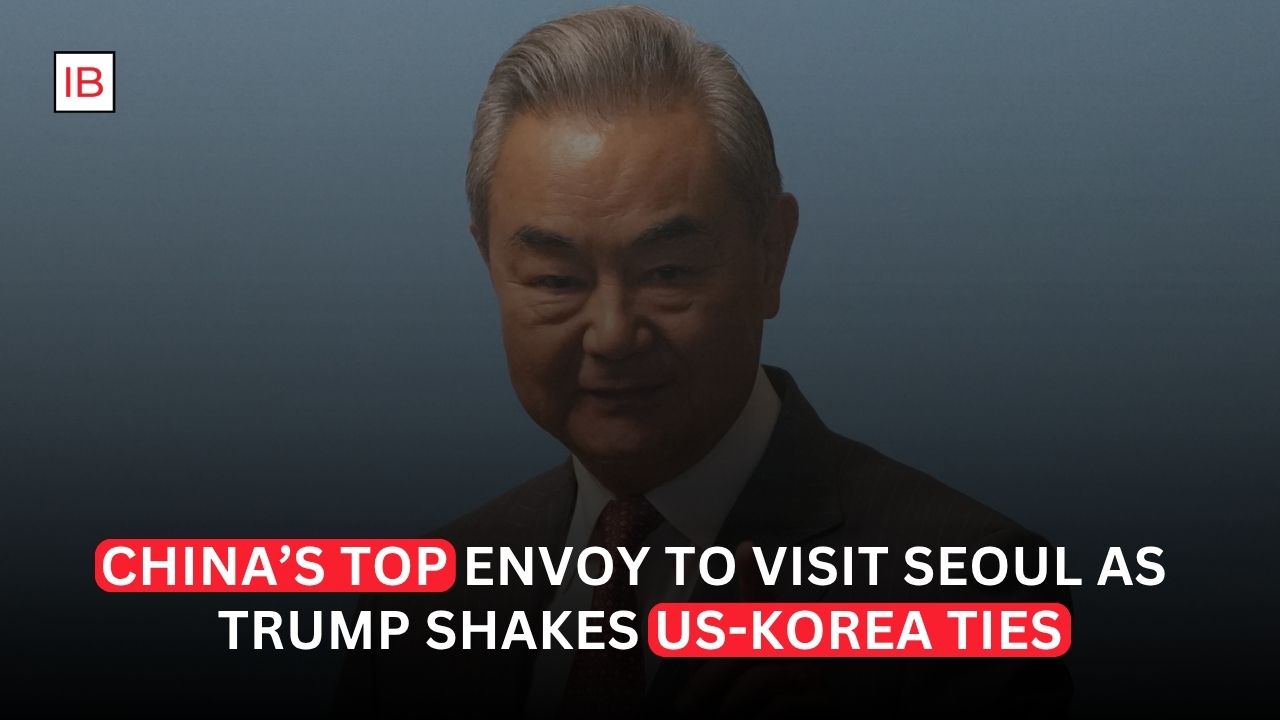
China’s Foreign Minister Wang Yi is preparing to visit South Korea as uncertainty grows around Seoul’s relationship with the United States under President Donald Trump. The timing of the visit is significant, coming just after Trump ordered a reduction in joint military exercises with South Korea and signaled a renewed interest in engaging North Korean leader Kim Jong Un.
Wang is scheduled to visit Seoul from August 19 to 20, his first official trip to South Korea in five years. He is expected to meet President Lee Jae Myung at the presidential office, as well as South Korean National Security Adviser Wi Sung-lac and Foreign Minister Cho Hyun. The discussions are expected to cover bilateral relations, the Korean Peninsula and wider regional and international issues.
The visit gives Beijing an opportunity to strengthen relations with Seoul at a moment when the traditional U.S.-South Korea alliance is facing new uncertainty. Trump’s decision to scale back military exercises with South Korea has unsettled officials and analysts in the region, particularly because the drills are an important part of maintaining military readiness against North Korea.
Trump announced the change shortly before the annual Ulchi Freedom Shield exercises were due to begin. He described the drills as unnecessarily hostile toward North Korea and pointed to his relationship with Kim Jong Un. Trump has since said that Kim responded to his efforts to reopen communication, suggesting that Washington may be preparing for another attempt at direct diplomacy with Pyongyang.
For Seoul, the situation presents a difficult strategic calculation. South Korea relies heavily on the United States for security against North Korea, including the American military presence and extended nuclear deterrence. At the same time, China is South Korea’s largest trading partner and an important economic relationship that Seoul cannot easily ignore.
The weakening of confidence in Washington could therefore encourage South Korea to place greater emphasis on maintaining stable relations with Beijing. President Lee has already pursued a policy aimed at improving ties with China while preserving the U.S.-South Korea alliance. Wang’s visit could provide an opportunity to accelerate that diplomatic balancing act.
China has strong reasons to engage Seoul. Beijing wants stability on the Korean Peninsula and does not want South Korea to become more deeply integrated into a U.S.-led security structure aimed at containing China. Improved relations with Seoul could help Beijing maintain economic and diplomatic influence in Northeast Asia while limiting the possibility of greater military cooperation between South Korea, the United States and Japan.
However, it would be misleading to interpret Wang’s visit as evidence that Seoul is preparing to move away from Washington. South Korea’s security dependence on the United States remains substantial, while North Korea’s expanding nuclear capabilities and increasingly close relationship with Russia create strong incentives for Seoul to preserve its alliance with Washington.
Trump’s recent decisions have nevertheless complicated that calculation. His administration has repeatedly questioned the cost of maintaining U.S. forces overseas and has pushed allies to assume greater responsibility for their own defense. Washington and Seoul already have a cost-sharing agreement covering 2026 through 2030, but Trump has continued to argue that South Korea should contribute more.
Trade is another source of friction. Trump has used tariffs and investment demands as major tools in negotiations with South Korea. Seoul agreed to significant investment commitments in the United States in exchange for tariff relief, but disagreements over the structure and timing of those investments have continued to create tension.
The economic relationship with China therefore remains important for South Korea. Beijing and Seoul have extensive trade and supply-chain links, particularly in electronics, manufacturing and advanced technology. Any major deterioration in China-South Korea relations could create additional costs for businesses already navigating U.S.-China competition and global supply-chain uncertainty.
Wang’s visit is also likely to include discussion of preparations for the upcoming APEC summit in Shenzhen. Chinese officials have indicated that the trip will help review progress in bilateral relations and prepare for high-level interactions later in the year.
The Korean Peninsula will be another central issue. China maintains significant influence over North Korea, although Pyongyang has strengthened its relationship with Russia in recent years. North Korea’s military cooperation with Moscow and its expanding weapons capabilities have made the security environment more complicated for all three major regional powers.
For South Korea, renewed U.S.-North Korea diplomacy could offer an opportunity to reduce tensions, but it also carries risks. Trump’s first-term engagement with Kim Jong Un produced historic meetings but failed to achieve a lasting agreement on denuclearization. North Korea subsequently continued expanding its nuclear and missile capabilities.
Trump’s latest decision to reduce military exercises could therefore be interpreted in two very different ways. Supporters could argue that reducing provocative drills creates space for diplomacy with Pyongyang. Critics argue that it could weaken deterrence and undermine confidence in the U.S. commitment to South Korea, particularly when North Korea remains heavily armed and closely aligned with Russia.
China stands to benefit strategically if uncertainty about the U.S. commitment grows. Beijing does not need South Korea to abandon its American alliance to gain an advantage. Even a more cautious Seoul that seeks greater strategic autonomy and stronger economic ties with China could make it harder for Washington to build a unified regional strategy.
That makes Wang’s visit more than a routine diplomatic exchange. It arrives at a moment when the balance of power in Northeast Asia is being reassessed. Washington is pushing allies to take greater responsibility, China is seeking stronger regional influence, North Korea is strengthening its military partnerships, and South Korea is attempting to protect its security while avoiding unnecessary economic confrontation.
The immediate outcome of Wang’s meetings may be limited, but the broader message is important. Seoul has little interest in choosing between Washington and Beijing outright. Instead, it is likely to seek room to work with both.
Trump’s changing approach to the Korean Peninsula could make that balancing act increasingly difficult. As the U.S.-South Korea alliance faces new questions, China is moving quickly to deepen its own diplomatic engagement with Seoul.