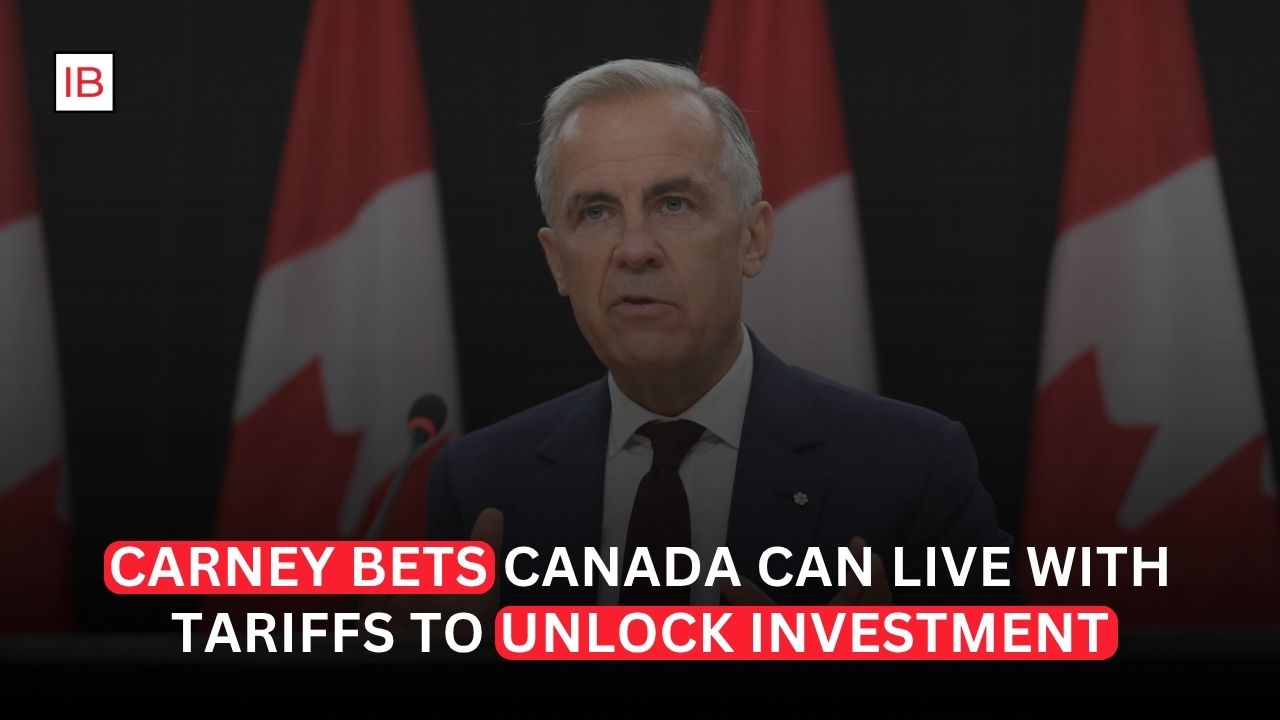
Canadian Prime Minister Mark Carney is taking a calculated risk: instead of waiting indefinitely for a return to normal trade relations with the United States, Canada should learn to operate under higher tariffs while using the pressure to attract investment, diversify trade and build a more independent economy.
The strategy comes at a critical moment for Canada. Relations with the US remain tense, with Washington threatening additional tariffs on Canadian goods while negotiations continue. The latest proposed measures include a potential 50% tariff on about $20 billion of Canadian exports, although the US and Canada have been moving toward an agreement that could reduce some of the existing trade barriers.
Carney’s challenge is to convince businesses and investors that Canada can remain an attractive place to build factories, develop energy projects and expand infrastructure even when access to its largest trading partner becomes more expensive.
Canada Is Trying to Break Its Dependence on the US
For decades, Canada’s economic model has been heavily connected to the United States.
The two countries share an enormous trading relationship, integrated manufacturing networks, energy infrastructure and supply chains.
That relationship created major advantages.
Canadian companies gained access to the world’s largest consumer economy, while US companies benefited from Canadian resources, energy and manufacturing capacity.
But the current trade conflict has exposed a weakness in that model.
When Washington changes tariff policy, Canadian businesses can suddenly face higher costs and uncertainty.
That has pushed Carney’s government toward a broader economic strategy: reduce Canada’s vulnerability by attracting investment and developing alternative markets.
The idea is not necessarily to abandon the US.
Instead, Canada wants to make sure that its economic future is not entirely dependent on decisions made in Washington.
Carney’s Investment Bet
Carney is betting that Canada can turn trade uncertainty into an incentive for investment.
The argument is relatively straightforward.
If Canada can provide abundant energy, critical minerals, skilled workers, infrastructure and access to multiple international markets, companies may still be willing to invest even if tariffs make exports to the US more expensive.
That requires Canada to become more competitive.
It also requires Ottawa to move quickly on projects that have historically faced long regulatory and approval processes.
Carney has already emphasized attracting enormous amounts of private capital into Canadian infrastructure and strategic industries. Earlier this year, his government announced a Canada Investment Summit aimed at bringing investors and business leaders together around a potential $1 trillion investment opportunity.
The objective is clear: replace uncertainty about the US with confidence in Canada’s own economic potential.
Tariffs Could Become an Investment Test
The biggest weakness in this strategy is that tariffs still impose real economic costs.
Companies do not simply ignore higher duties.
If a Canadian manufacturer depends on American customers, a tariff can make its products less competitive.
Businesses may respond by reducing production, delaying investment or moving parts of their operations.
That means Carney cannot simply argue that Canada can “live with” tariffs.
The government has to show that the long-term benefits of investment and diversification can outweigh the short-term costs.
This is a difficult calculation.
A company considering a billion-dollar factory needs to know where its products will be sold.
If the US market becomes significantly more expensive to access, investors may demand a higher return before committing capital.
Energy Could Be Canada’s Biggest Advantage
One area where Canada has a powerful structural advantage is energy.
The country possesses enormous oil, natural-gas and hydroelectric resources.
It also has significant potential for renewable power.
That combination could become increasingly valuable as companies search for reliable and affordable electricity.
Carney’s government recently backed nearly C$70 billion of hydroelectricity, wind and transmission projects in Atlantic Canada, with up to C$10 billion in federal financial support. The initiative is intended to create a more integrated electricity system and strengthen Canada’s energy position.
Cheap and reliable electricity can attract data centers, manufacturing plants, chemical facilities and other energy-intensive industries.
That makes energy policy a potential foundation for Canada’s investment strategy.
Critical Minerals Could Attract More Capital
Canada also has resources that are becoming strategically important.
Critical minerals are essential for batteries, electronics, defense equipment and advanced manufacturing.
As governments around the world try to reduce dependence on China for strategic supply chains, Canada’s resource base could become more valuable.
The opportunity is not simply to export raw materials.
The bigger prize would be developing processing, manufacturing and downstream industries inside Canada.
That would create more jobs and capture more economic value.
But achieving that goal requires investment.
Mining projects can take years to develop, and processing facilities require enormous amounts of capital.
Canada therefore needs investors to believe that its regulatory system is predictable enough to justify long-term commitments.
The US Still Matters Enormously
There is, however, a major blind spot in any strategy built around diversification.
Canada cannot quickly replace the US.
The American market is enormous, geographically close and deeply integrated with Canadian supply chains.
Even if Canada expands trade with Europe, Asia and the Middle East, those markets cannot instantly replicate the scale and efficiency of the US relationship.
This is particularly true for industries such as automobiles, energy and advanced manufacturing.
That means Carney’s strategy is better understood as risk reduction rather than economic separation.
Canada wants more options, not necessarily a complete break with Washington.
A New Pipeline Strategy Could Help
Energy infrastructure is one area where Canada’s relationship with the US remains especially important.
President Donald Trump has recently suggested reviving the Keystone XL pipeline, a project that was canceled during the Biden administration. The proposal has reopened debate about whether Canada should expand its pipeline capacity toward the US while also developing alternative export routes.
For Canada, this creates a complicated choice.
More pipelines to the US could provide additional export capacity.
But dependence on a single market remains a strategic risk.
Carney has therefore emphasized the need to diversify Canada’s trade relationships.
The ideal outcome would be infrastructure that allows Canadian resources to reach multiple markets.
Investors Need More Than Government Promises
The success of Carney’s strategy will ultimately depend on private investors.
Governments can announce projects and offer incentives, but companies decide where to put their money.
Investors will examine:
- Tax policy
- Energy costs
- Labor availability
- Regulatory approvals
- Infrastructure
- Currency risks
- Access to export markets
- Political stability
- Expected returns
If Canada wants to compete successfully with the US, Europe and Asia for capital, it needs to perform well across all of these categories.
Regulatory Speed Could Become a Competitive Weapon
One of Canada’s longstanding economic problems is the time required to approve major projects.
A mining project, pipeline, power facility or manufacturing plant can face multiple levels of government and extensive regulatory reviews.
That can delay investment.
Carney’s government has increasingly argued for faster approvals and a more coordinated national approach to major infrastructure projects.
This could be one of the most important parts of the strategy.
A country with abundant resources does not automatically benefit from them.
It must be able to develop them.
Canada Wants to Become More Self-Reliant
The trade dispute has also changed the political conversation inside Canada.
For years, economic integration with the US was largely seen as an unquestioned advantage.
Now Canadian policymakers are increasingly discussing economic resilience and sovereignty.
That includes strengthening domestic supply chains, developing new export markets and building infrastructure that connects different parts of the country.
The objective is not economic isolation.
It is economic flexibility.
Canada wants to be able to withstand a sudden change in US trade policy without suffering a major economic shock.
The Risk of Paying Too Much for Independence
There is another side to this strategy.
Diversification is expensive.
Building new ports, railways, pipelines, power lines and processing facilities requires enormous capital.
If governments subsidize too many projects, taxpayers could ultimately carry part of the cost.
There is also a risk that political pressure leads to investment in projects that are strategically attractive but economically weak.
Canada therefore needs discipline.
Not every project deserves government support simply because it reduces dependence on the US.
The test should be whether the project can eventually become commercially viable.
Canada-China Relations Add Another Dimension
Canada has also been working to improve relations with China.
Earlier this year, Canada and China reached agreements that reduced tariffs on Canadian canola and allowed more Chinese electric vehicles into the Canadian market.
This shows the complexity of Carney’s diversification strategy.
Canada wants access to alternative markets, but closer economic ties with China can create tensions with Washington.
That means diversification cannot be treated simply as replacing American trade with Chinese trade.
Canada needs a broad network of relationships across Europe, Asia and other regions.
The Trade Deal Could Buy Canada Time
The latest US-Canada negotiations could provide temporary breathing room.
The two governments have been working toward an agreement that would reduce some tariffs, including lower duties on Canadian-built vehicles and cuts to US tariffs on Canadian steel and aluminum.
A deal would be valuable because it could restore some certainty for businesses.
But it would not eliminate the underlying problem.
Canada would still need to prepare for future trade disputes.
The lesson from the past two years is that the rules of North American trade can change quickly.
The Real Goal Is Investment, Not Tariff Victory
Carney’s strategy ultimately depends on shifting the conversation away from tariffs.
Tariffs are the immediate problem.
Investment is the long-term solution.
If Canada can attract large amounts of capital into energy, minerals, technology, manufacturing and infrastructure, the economy could become more productive and diversified.
That would make Canada less vulnerable to future trade shocks.
It could also create higher-paying jobs and strengthen government revenues.
But investment does not arrive simply because politicians announce ambitious targets.
Canada must make itself more competitive.
What Investors Should Watch
Several indicators will determine whether Carney’s strategy is working.
Foreign direct investment
A sustained increase would indicate that companies see Canada as an attractive destination despite trade uncertainty.
Infrastructure approvals
Faster approvals would make major projects easier to finance.
Energy development
New electricity and pipeline capacity could strengthen Canada’s industrial advantage.
Critical-mineral projects
Success in this area could position Canada as an important supplier for global manufacturing.
Export diversification
More trade with Europe and Asia would reduce Canada’s dependence on the US.
Manufacturing investment
New factories would show whether Canada can convert resources into higher-value production.
Conclusion
Mark Carney is making a difficult bet.
Rather than waiting for the US-Canada relationship to return to the relatively predictable trade environment of the past, he is trying to use the current crisis as a reason to rebuild Canada’s economy around investment, infrastructure, energy and diversified trade.
The approach has logic, but it also carries significant risks.
Canada cannot simply absorb unlimited tariffs without consequences.
The US remains by far its most important economic partner, and many Canadian industries depend on seamless access to American customers.
At the same time, the trade conflict has demonstrated why relying too heavily on a single market can leave Canada vulnerable.
The solution is not to abandon the US.
It is to make Canada strong enough that the country has alternatives.
That means developing critical minerals, expanding energy infrastructure, improving electricity capacity, speeding up project approvals, attracting foreign capital and opening new export markets.
The potential payoff is substantial.
A more diversified Canada could become an important supplier of energy, minerals, technology and advanced industrial products to multiple global markets.
But the government must avoid confusing investment announcements with actual economic transformation.
Factories must be built.
Projects must become profitable.
Workers must be trained.
Infrastructure must be completed.
And investors must earn competitive returns.
The latest trade negotiations may give Canada some breathing room, particularly if tariffs are reduced. But they do not remove the need for a longer-term strategy.
Carney’s biggest challenge is therefore not simply negotiating with Donald Trump.
It is convincing investors that Canada can become more productive, more competitive and more diversified even when tariffs make its traditional economic model less attractive.
If he succeeds, today’s trade conflict could ultimately push Canada toward a stronger and more resilient economy.
If he fails, tariffs could instead become another burden on a country that remains heavily dependent on its southern neighbor.