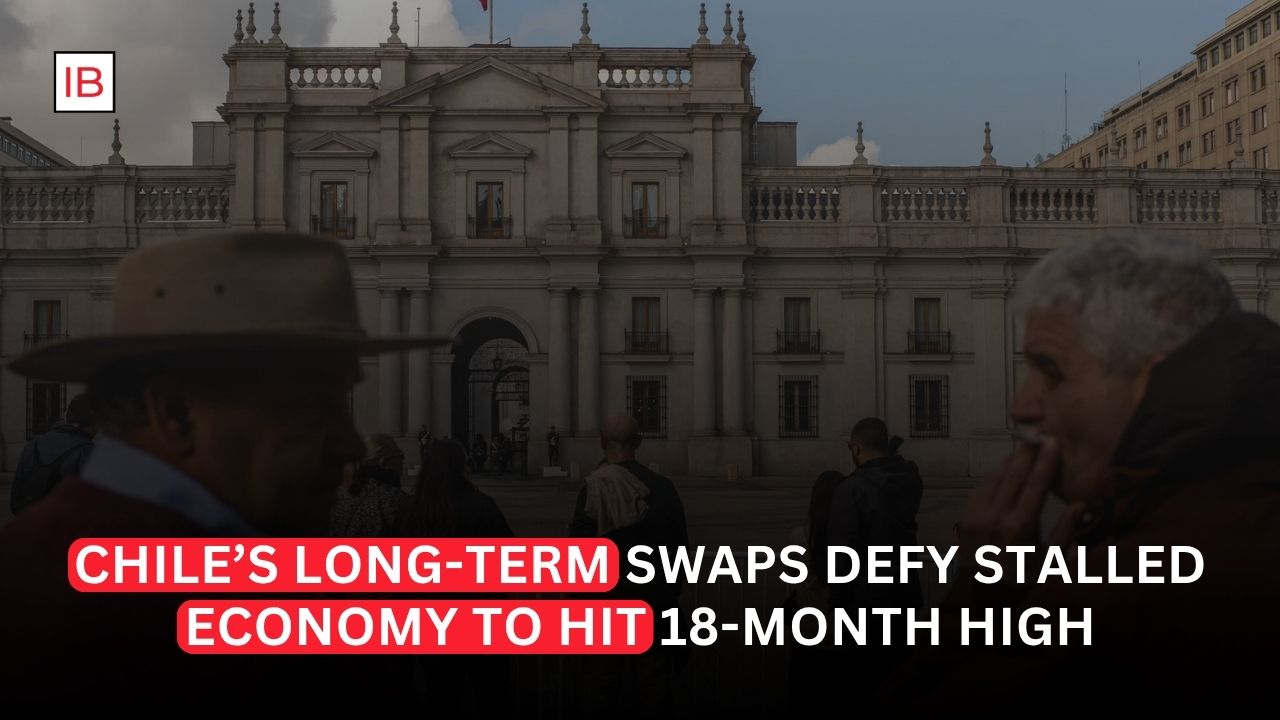
Chile’s long-term interest-rate swaps have climbed to their highest level in about 18 months, an unusual move given the country’s sluggish economic backdrop. The rise highlights how financial markets can anticipate changes in inflation, monetary policy and government borrowing costs even when economic growth remains under pressure.
The move is particularly notable because Chile has traditionally been viewed as one of Latin America’s more credible and predictable economies. Investors closely watch its interest-rate market because expectations for the central bank can shift quickly when inflation, currency movements or global bond yields change.
Recent data from the Banco Central de Chile show that the country’s derivatives market remains active, with substantial trading and outstanding positions in peso-denominated swaps.
Long-Term Swaps Move Higher
Interest-rate swaps allow investors to exchange fixed and floating interest payments. They are widely used by banks, companies and investors to hedge borrowing costs or express views about where interest rates are heading.
When long-term swap rates rise, it can indicate that investors expect borrowing costs to remain higher for longer.
Chile’s long-term swap market has now moved to levels not seen for roughly a year and a half.
That is striking because the country’s economy has not been experiencing a powerful growth boom.
Instead, investors are dealing with a combination of weak economic activity, changing inflation expectations and uncertainty about the future path of monetary policy.
Why the Move Matters
The most important point is that long-term swaps are not simply a reflection of today’s economic conditions.
They represent expectations about the future.
A weak economy might normally encourage investors to expect lower interest rates.
But if markets simultaneously believe inflation will remain sticky, global bond yields will remain elevated or fiscal risks will increase, long-term rates can rise even while growth remains disappointing.
That appears to be the tension currently facing Chile’s financial markets.
Chile’s Economy Remains a Concern
Chile’s economy has struggled to generate consistently strong growth in recent years.
The country remains heavily exposed to commodity prices, particularly copper, which is one of its most important exports.
Copper demand is closely linked to global industrial activity and China’s economy.
That creates a difficult environment when external demand is uncertain.
At the same time, domestic investment and consumption have not necessarily provided enough momentum to generate a sustained acceleration in economic activity.
The result is an economy that can look relatively stable from a macroeconomic perspective while still producing limited growth.
Inflation Remains Central to the Outlook
Inflation is one of the key variables behind long-term interest rates.
If investors believe inflation will remain above the central bank’s comfort zone, they may demand higher yields on longer-term instruments.
That pushes swap rates higher.
The opposite is also true.
If inflation expectations become firmly anchored and price pressures weaken, markets can begin pricing lower interest rates.
Chile’s monetary policy therefore remains central to the swap market.
The Central Bank’s Role
The Banco Central de Chile operates an active monetary-policy framework and closely monitors financial-market conditions.
Its market operations include instruments designed to implement monetary policy and manage liquidity. The central bank also publishes information on financial-market transactions and derivatives activity.
For investors, the central bank’s future decisions are critical.
Any indication that policymakers may keep rates higher for longer can push longer-dated swaps higher.
Conversely, a clearer path toward monetary easing could eventually put downward pressure on long-term rates.
Global Bond Yields Are Also Important
Chile does not operate in isolation.
Global interest rates strongly influence emerging markets.
If US Treasury yields remain elevated, investors may demand higher returns from Chilean assets to compensate for currency and country risks.
This can put upward pressure on local bond yields and swap rates even when Chile’s domestic economy is weak.
That is one reason the recent move should not be interpreted solely as a bet on Chile’s domestic economic outlook.
Global fixed-income markets remain a major driver.
The Chilean Peso Matters Too
The currency is another important factor.
A weaker Chilean peso can increase the local cost of imported goods and potentially add to inflationary pressure.
That can complicate the central bank’s policy decisions.
Chile’s official data show the peso and related derivatives remain an important part of the country’s financial-market infrastructure. The central bank’s derivatives system tracks significant USD/CLP activity and outstanding positions involving both foreign and domestic participants.
Currency volatility can therefore feed directly into interest-rate expectations.
Long-Term Rates Can Diverge From Short-Term Rates
One of the most interesting aspects of the current market is the difference between short- and long-term expectations.
Central banks directly influence short-term interest rates.
But long-term rates depend on a much wider range of factors.
They reflect expectations for:
- Future inflation
- Economic growth
- Government borrowing
- Global bond yields
- Currency risk
- Monetary policy
- Investor demand
- Long-term fiscal credibility
That means long-term swap rates can rise even when traders expect short-term policy rates to eventually decline.
Fiscal Policy Is Becoming More Important
Government finances are another factor investors need to consider.
If markets expect higher government borrowing in coming years, investors may demand greater compensation for holding long-term debt.
That can raise longer-term yields.
Chile has historically benefited from a reputation for relatively strong institutions and fiscal management.
Maintaining that credibility matters because it helps limit the risk premium demanded by investors.
The country’s debt market remains closely connected to government and central-bank financing conditions.
The Market Is Looking Beyond the Current Slowdown
The rise in long-term swaps suggests that traders are looking beyond the immediate economic slowdown.
There are several possible interpretations.
One is that investors expect economic growth to eventually recover, increasing demand and potentially creating upward pressure on inflation.
Another is that global interest rates will remain structurally higher than they were during the ultra-low-rate period of the previous decade.
A third possibility is that investors are demanding a larger risk premium because of uncertainty around Chile’s future economic and fiscal policies.
The actual outcome could involve all three factors.
Copper Remains a Major Variable
Chile’s dependence on copper means commodity markets remain crucial.
Higher copper prices can improve export revenues, strengthen government finances and support the currency.
That can improve the broader economic outlook.
But if copper prices weaken, the opposite can happen.
A weaker commodity environment can reduce investment and export income while putting pressure on the currency.
For long-term interest rates, that creates a complicated relationship.
Strong copper prices could support growth but potentially increase inflation expectations, while weak copper prices could hurt growth but reduce inflationary pressure.
Foreign Investors Remain Important
International investors play a major role in Chile’s financial markets.
Their decisions are influenced by relative yields across emerging markets.
If Chilean long-term rates rise while inflation expectations remain relatively contained, local assets can become more attractive.
But higher rates do not automatically mean stronger capital inflows.
Investors also consider currency risk.
A high local interest rate can be less attractive if the currency is expected to depreciate significantly.
Derivatives Data Show Active Market Participation
The Banco Central de Chile’s derivatives reporting system provides a useful picture of market activity.
As of Aug. 19, the system showed substantial outstanding positions in CLP interest-rate swaps, including significant positions involving non-residents and domestic non-bank participants.
That matters because swap-market movements are not being driven by a tiny group of investors.
They reflect a broader market in which banks, companies and institutional investors manage interest-rate exposure.
What Higher Swap Rates Mean for Companies
Higher long-term rates can increase financing costs for businesses.
Companies planning to issue debt may face more expensive borrowing conditions.
That can discourage investment, particularly for projects whose profitability depends on cheap financing.
For highly leveraged companies, the effect can be even more significant.
A prolonged period of elevated long-term rates can therefore weigh on economic growth.
This creates a potential feedback loop.
Weak growth can normally encourage monetary easing, but if long-term rates remain elevated because of inflation or global conditions, the economy may not receive as much financial relief as expected.
Housing Could Feel the Impact
Higher long-term interest rates can also affect the housing market.
Mortgage rates tend to be influenced by broader fixed-income conditions.
If borrowing costs remain high, households may delay home purchases.
Developers can also postpone new projects because financing becomes more expensive.
That can weigh on construction activity and employment.
Chile’s economy therefore has several channels through which long-term interest rates can influence domestic demand.
Investors Are Watching the Next Policy Signals
The next major driver will likely be communication from Chile’s central bank.
Markets will pay attention to:
Inflation Data
Any unexpected acceleration in inflation could push long-term rates higher.
Economic Activity
Weak growth could increase expectations for monetary easing.
Currency Movements
A significant peso decline could complicate the inflation outlook.
Global Yields
Movements in US and other developed-market bond yields could influence Chilean rates.
Fiscal Policy
Government spending and debt projections could affect the long-term risk premium.
Why the 18-Month High Is Significant
The fact that long-term swaps have reached an 18-month high does not necessarily mean Chile is facing a financial crisis.
That would be an excessive interpretation.
Instead, it indicates that investors are demanding a different interest-rate structure than they did during the previous period.
Markets are reassessing the long-term balance between inflation, growth, monetary policy and global borrowing costs.
The important question is whether this increase proves temporary or becomes a more persistent feature of Chile’s financial system.
A Persistent Rise Would Be More Concerning
If long-term swaps continue climbing, the implications become more significant.
Businesses would face higher financing costs.
Government debt servicing could become more expensive.
Mortgage conditions could remain restrictive.
Investment could weaken further.
And monetary policy would become more difficult to calibrate.
The central bank could lower short-term rates while long-term borrowing costs remained elevated.
That would reduce the effectiveness of monetary easing.
A Reversal Could Come Quickly
On the other hand, markets can reverse rapidly.
If inflation falls faster than expected, global bond yields decline and Chile’s economic growth remains weak, long-term swap rates could retreat.
That would provide some relief to borrowers.
The current move therefore should not be viewed as a one-way trend.
It represents the market’s present assessment of future conditions.
The Bigger Emerging-Market Story
Chile’s experience also reflects a broader challenge for emerging economies.
Central banks can control short-term policy rates, but they cannot completely control long-term borrowing costs.
Global capital markets determine much of the long end of the curve.
This has become increasingly important in a world where government debt levels are high and investors are demanding greater compensation for holding long-duration assets.
Chile’s relatively strong institutions may help it manage that pressure better than some emerging-market peers.
But it is not immune to global financial conditions.
Conclusion
Chile’s long-term swaps reaching an 18-month high despite a stalled economy highlights an important disconnect between current economic activity and expectations for future interest rates.
The move does not necessarily mean investors expect an immediate economic recovery.
Instead, it suggests markets are weighing several competing forces: inflation risks, global bond yields, currency movements, fiscal policy and the future path of Chilean monetary policy.
The country’s derivatives market remains active, with the Banco Central de Chile reporting substantial activity in peso swaps and foreign-exchange derivatives.
For businesses and households, the most important issue is whether higher long-term rates remain temporary or become entrenched.
If they persist, borrowing costs could remain restrictive and make it harder for the economy to accelerate.
If inflation eases and global yields decline, the recent rise in swaps could reverse.
For investors, therefore, the Chilean market is becoming a test of whether weak domestic growth will eventually dominate the interest-rate outlook—or whether inflation, global borrowing costs and risk premiums will keep long-term rates elevated.
The next phase will depend heavily on economic data and signals from the central bank.