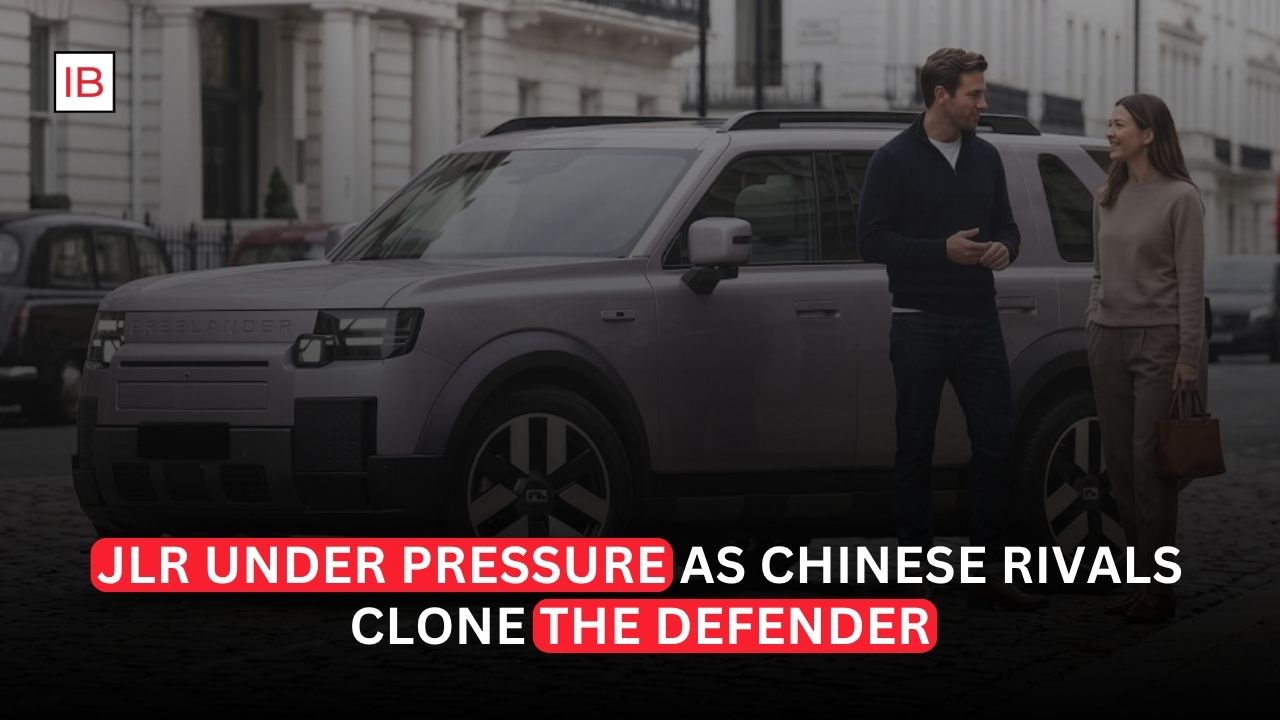
Land Rover has long been associated with British motoring, rugged luxury and a distinctive design that has become recognizable around the world. But Britain’s roads are increasingly becoming a stage for Chinese-made SUVs that borrow heavily from the visual language of the Defender, raising questions about how much of the brand’s advantage comes from engineering and how much comes from heritage.
The trend is particularly striking because Chinese automakers are no longer competing only on price. They are producing vehicles with sophisticated technology, premium interiors and styling that can closely resemble established Western models.
Chinese SUVs Enter the UK
Chinese carmakers have rapidly expanded their presence in Britain. Models from brands such as BYD and Jaecoo are appearing in increasing numbers, offering buyers a combination of large SUV proportions, modern technology and competitive pricing.
One of the clearest examples is BYD’s Ti 7, a seven-seat SUV whose boxy appearance strongly recalls the Defender. The vehicle is priced at £47,995 in the UK, while a seven-seat Defender 110 starts at more than £68,000 before options.
That price difference creates an uncomfortable comparison for established manufacturers.
The Defender’s Design Advantage
The Defender’s appeal has never been based entirely on transportation.
Its squared-off body, upright stance and rugged details communicate adventure and durability. Those design cues have become valuable brand assets.
Chinese manufacturers appear to understand that appeal.
By producing SUVs with similar proportions and visual characteristics, they can offer customers some of the same aesthetic appeal without charging the traditional premium associated with Land Rover.
Price Is the Biggest Challenge
The most obvious competitive advantage for Chinese manufacturers is price.
The BYD Ti 7 costs more than £20,000 less than a comparable seven-seat Defender. Yet it offers a substantial list of equipment, including a large touchscreen, panoramic roof, heated and ventilated seats and an advanced plug-in hybrid powertrain.
For consumers who care more about features and appearance than heritage, the calculation is straightforward.
The cheaper vehicle can look remarkably similar while offering many modern conveniences.
Technology Is Changing the Competition
Chinese automakers have invested heavily in electric vehicles, batteries, software and connected-car technology.
That gives them an advantage in areas where traditional automakers have sometimes moved more slowly.
The competitive threat is therefore not simply about copying exterior design.
It is about combining attractive styling with technology and lower manufacturing costs.
Land Rover Still Has Brand Power
The Defender retains significant advantages.
It has decades of heritage, a globally recognized name and a reputation for off-road capability.
Land Rover’s current Defender has also become one of Jaguar Land Rover’s strongest-selling models. The vehicle accounts for roughly one-third of JLR’s annual sales, making it strategically important to the company.
That level of demand demonstrates that consumers are still willing to pay for the original.
But Heritage Has Limits
The problem for Land Rover is that younger consumers may value technology more than history.
A buyer who wants a large, distinctive SUV may not care whether the badge has existed for 75 years.
If a cheaper competitor offers similar styling, good performance and more equipment, heritage alone may not justify the price difference.
That creates a long-term challenge for premium European brands.
China’s Automotive Rise
The Defender lookalike phenomenon is part of a much larger transformation in the global car industry.
Chinese manufacturers have moved from being low-cost suppliers to increasingly serious competitors in international markets.
Their expansion has been particularly strong in electric and hybrid vehicles.
They are now targeting segments traditionally dominated by European, Japanese and American manufacturers.
BYD’s Growing Ambition
BYD illustrates this transformation.
The company has become one of the world’s largest electric-vehicle manufacturers and is increasingly expanding beyond its domestic market.
Its Ti 7 demonstrates how Chinese automakers are moving into larger, premium-looking SUVs rather than competing only with inexpensive city cars.
The goal is to capture customers who might previously have considered established European brands.
The Jaecoo Effect
Jaecoo has already demonstrated how quickly Chinese SUV brands can become visible in Britain.
Its vehicles have been described as “Temu Range Rovers” because of their styling similarities to established luxury SUVs.
The growing popularity of such vehicles suggests that British consumers are not automatically rejecting Chinese brands because of their origins.
Design Imitation Creates Controversy
The similarities inevitably raise questions about design imitation.
Automotive design is heavily protected in some circumstances through intellectual-property laws, but broad styling concepts are difficult to control.
A manufacturer cannot easily claim ownership of every boxy SUV shape, upright windshield or squared-off wheel arch.
That leaves established brands vulnerable when competitors reproduce the overall visual formula.
The Defender Is More Than a Shape
Land Rover’s defense is that a vehicle’s identity is not determined by appearance alone.
The Defender has specific engineering characteristics, off-road systems and driving capabilities.
Its buyers are paying for the complete product rather than simply its exterior design.
But that argument becomes weaker if most customers use their SUVs primarily for commuting and family transportation.
Most SUV Buyers Rarely Go Off-Road
The modern SUV market illustrates the problem.
Many large SUVs spend most of their lives on paved roads.
Their owners may value comfort, appearance, technology and status more than extreme off-road capability.
That makes it easier for competitors to challenge established brands with products that deliver the lifestyle image without replicating every technical capability.
JLR Faces Its Own Financial Pressure
The competitive challenge comes at a difficult moment for Jaguar Land Rover.
The company has been dealing with tariffs, weak demand in some markets and pressure to reduce costs.
Its new chief executive, PB Balaji, is pushing a cost-cutting strategy as the company attempts to strengthen its financial position.
That limits how aggressively JLR can respond with expensive new product programs.
Defender’s Electric Future Is Delayed
JLR has also delayed plans for a fully redesigned electric Defender.
The next-generation full-size Defender had been expected toward the end of the decade, but the program has been pushed back into the 2030s as the company reassesses costs and technology.
That delay could create another opening for Chinese competitors.
Chinese Brands Are Moving Faster
Chinese automakers have developed electric and plug-in hybrid technology rapidly.
The BYD Ti 7, for example, combines a 1.5-liter turbocharged engine with a large battery and electric motors to produce 402 horsepower. It can accelerate from zero to 62 mph in 4.8 seconds and offers a substantial electric-only range.
Such specifications make the competitive gap harder to dismiss.
The Battle Is About Value
The central question for Land Rover is whether consumers will continue paying a large premium for the original.
If buyers increasingly compare vehicles based on features, performance, technology and price, Chinese manufacturers could capture more market share.
Land Rover would then need to justify its premium through engineering, reliability, design, brand status and customer experience.
Britain Is Becoming a Test Market
The UK is particularly important because Land Rover is deeply associated with British identity.
Seeing Chinese SUVs compete directly on British roads therefore has symbolic importance.
It demonstrates that China’s automotive rise is no longer a distant phenomenon affecting only Asian markets.
It is happening in the home market of some of Europe’s most famous car brands.
The Bigger Threat to European Carmakers
The challenge extends beyond Land Rover.
BMW, Mercedes-Benz, Volkswagen and other European manufacturers are facing Chinese competition across multiple vehicle categories.
Chinese companies can combine lower production costs with rapid product development and strong battery technology.
European manufacturers must therefore compete on more than brand recognition.
Tariffs May Slow the Shift
Governments can attempt to protect domestic manufacturers through tariffs and trade restrictions.
Those policies can make Chinese vehicles more expensive and reduce their immediate price advantage.
But protection can also give domestic companies less incentive to improve.
The underlying technological and cost advantages do not disappear simply because trade barriers increase.
Consumers Ultimately Decide
The most important factor will be consumer behavior.
If buyers continue to prioritize heritage and established brands, Land Rover can maintain its premium.
If buyers increasingly prioritize value, technology and styling, Chinese automakers could continue taking market share.
The growing visibility of Defender-like SUVs suggests the second trend deserves serious attention.
Conclusion
The arrival of Chinese SUVs that resemble the Land Rover Defender represents more than a dispute over styling.
It is a sign of how quickly China’s automotive industry has advanced.
For decades, European automakers benefited from technological expertise, premium branding and design heritage. Those advantages remain valuable, but they are no longer sufficient by themselves.
Chinese manufacturers are increasingly capable of producing sophisticated SUVs with attractive designs, strong hybrid and electric powertrains and significantly lower prices. BYD’s Ti 7, for example, offers seven seats and 402 horsepower from £47,995, while a comparable Defender costs substantially more.
Land Rover still possesses something competitors cannot easily reproduce: decades of brand history and a genuine reputation for off-road capability. The Defender also remains one of JLR’s most successful products, accounting for a large share of the company’s sales.
But the market is changing.
Consumers increasingly expect advanced software, electrification, comfort and extensive equipment. Chinese manufacturers are competing aggressively on exactly those factors.
JLR’s decision to delay the next full-size electric Defender makes the challenge more complicated. While the company remains committed to the model, Chinese competitors are already bringing new technology and aggressively priced SUVs into markets where European brands once dominated.
The Defender’s future therefore depends on whether Land Rover can make its premium feel justified.
The question is no longer simply whether Chinese companies can imitate the Defender’s appearance.
It is whether they can offer enough of the same emotional appeal, technology and everyday usefulness at a much lower price.
If they can, the pressure on Europe’s premium carmakers will extend far beyond one famous British SUV.