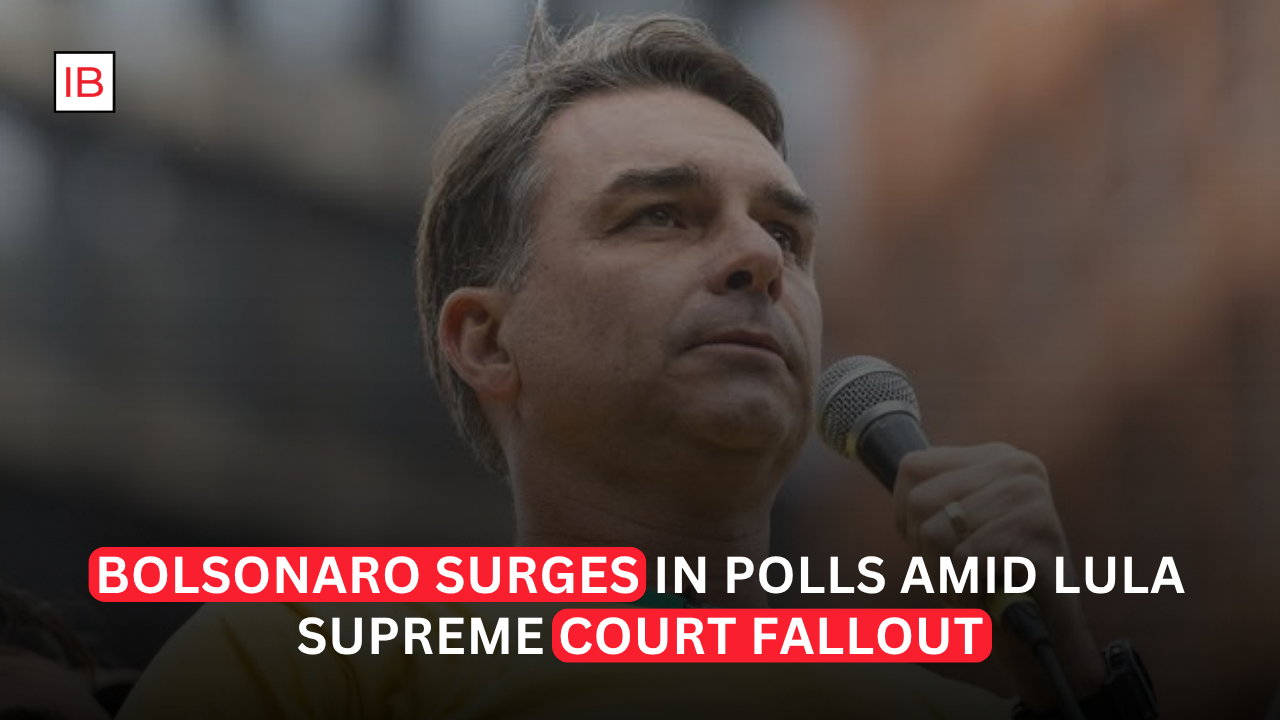
Brazil’s 2026 presidential election is entering a decisive phase with Flávio Bolsonaro rapidly closing the gap on President Luiz Inácio Lula da Silva, turning what once appeared to be a relatively comfortable contest for the leftist leader into a highly competitive race less than a month before the first round of voting.
The latest AtlasIntel/Bloomberg polling has Flávio Bolsonaro, the eldest son of former President Jair Bolsonaro, statistically tied with Lula in a simulated runoff. Other recent surveys have gone even further, showing Flávio holding narrow numerical advantages in some second-round scenarios. The shift has strengthened the Brazilian right and increased pressure on Lula’s campaign as voters prepare to go to the polls on October 4.
The numbers remain fluid, however. A Datafolha survey released earlier in September showed Lula leading Flávio 38% to 33% in the first round, while the president held a 46% to 44% advantage in a simulated runoff. Because that two-point difference falls within the poll’s margin of error, the result was already considered a technical tie.
More recent surveys suggest the gap has narrowed further. Palver’s September poll put Lula and Flávio at 40% and 39% respectively in one first-round scenario, while a second-round simulation gave Flávio 46% against Lula’s 44%. Meio/Ideia showed the pair tied at 46% each in a runoff, while BTG/Nexus found Flávio ahead 46% to 45%. Quaest also reported a 41%-41% tie in a second-round matchup.
The increasingly tight numbers are arriving alongside a political crisis inside Brazil’s Supreme Federal Court, or STF, that has become an unexpected problem for Lula’s campaign.
The court has been divided by disputes involving Justice Alexandre de Moraes and Justice André Mendonça, who was appointed by Bolsonaro during his presidency. Mendonça recently suspended Brazil’s federal police chief after allegations were circulated against him, while a separate dispute involving leaked material and an investigation linked to former Banco Master owner Daniel Vorcaro has intensified tensions among the justices.
The conflict has created an opening for Bolsonaro’s political camp. Flávio and his allies are portraying the turmoil as evidence that Brazil’s judicial system has become too politically involved and are attempting to link Lula to the institutions under pressure. The strategy gives the opposition an issue that extends beyond the traditional left-right economic divide and allows Bolsonaro’s supporters to appeal to voters concerned about institutional balance.
For Lula, the danger is that the Supreme Court controversy could distract from his economic and social agenda. The president is seeking another term after returning to office in 2023 and has promoted government spending, social programs and measures designed to protect consumers from rising costs.
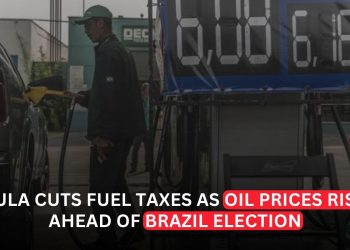
Energy prices have become particularly important. Global oil prices have surged above $100 a barrel amid the continuing US-Iran conflict and disruptions around the Strait of Hormuz. Lula’s government has responded with temporary fuel-tax cuts and diesel subsidies designed to reduce pressure on consumers and transportation companies ahead of the election.
Those measures may provide short-term relief, but they also demonstrate how economic policy is increasingly intertwined with the campaign. Brazil is a major oil producer, yet it remains dependent on fuel imports, making international energy shocks politically sensitive. High diesel prices can quickly raise transportation and food costs, creating a direct electoral problem for an incumbent government.
Flávio Bolsonaro, meanwhile, is benefiting from the consolidation of Brazil’s right-wing electorate around his candidacy. His rise has given the Bolsonaro family a realistic path back to the presidency despite Jair Bolsonaro himself being unable to run. The former president remains a powerful figure among conservative voters, and his son has increasingly positioned himself as the vehicle for continuing that political movement.
But Flávio still faces major obstacles. Polling shows that the election remains highly volatile, and several other candidates could influence the distribution of votes. Augusto Cury has gained ground in some surveys, while Ronaldo Caiado, Renan Santos and Romeu Zema remain in contention for smaller shares of the electorate. A fragmented first round could therefore produce a very different runoff matchup if either Lula or Flávio loses support in the final weeks.
Another major uncertainty is voter rejection. Both leading candidates face significant resistance from portions of the electorate. That creates an unusual dynamic in which neither Lula nor Flávio needs to dominate the first round to remain competitive; instead, the decisive battle may be over which candidate can attract voters who strongly oppose the other.
The Supreme Court crisis could therefore have consequences beyond the judiciary. With the election approaching, every institutional dispute risks becoming campaign material, while every new poll can influence perceptions of momentum.
For Lula, the immediate challenge is to prevent the election from becoming a referendum on political institutions and instead refocus voters on the economy, jobs and social policy. For Flávio Bolsonaro, the opportunity is to turn dissatisfaction with the government and distrust of the judiciary into a broader anti-Lula coalition.
Brazil’s election is still weeks away, and polling margins remain within statistical error in many scenarios. But the direction of the race has changed significantly. What increasingly looks like a two-sided contest means Lula can no longer rely on an early advantage, while Flávio Bolsonaro has transformed the Bolsonaro name from a legacy of the previous presidency into a credible route back to power.