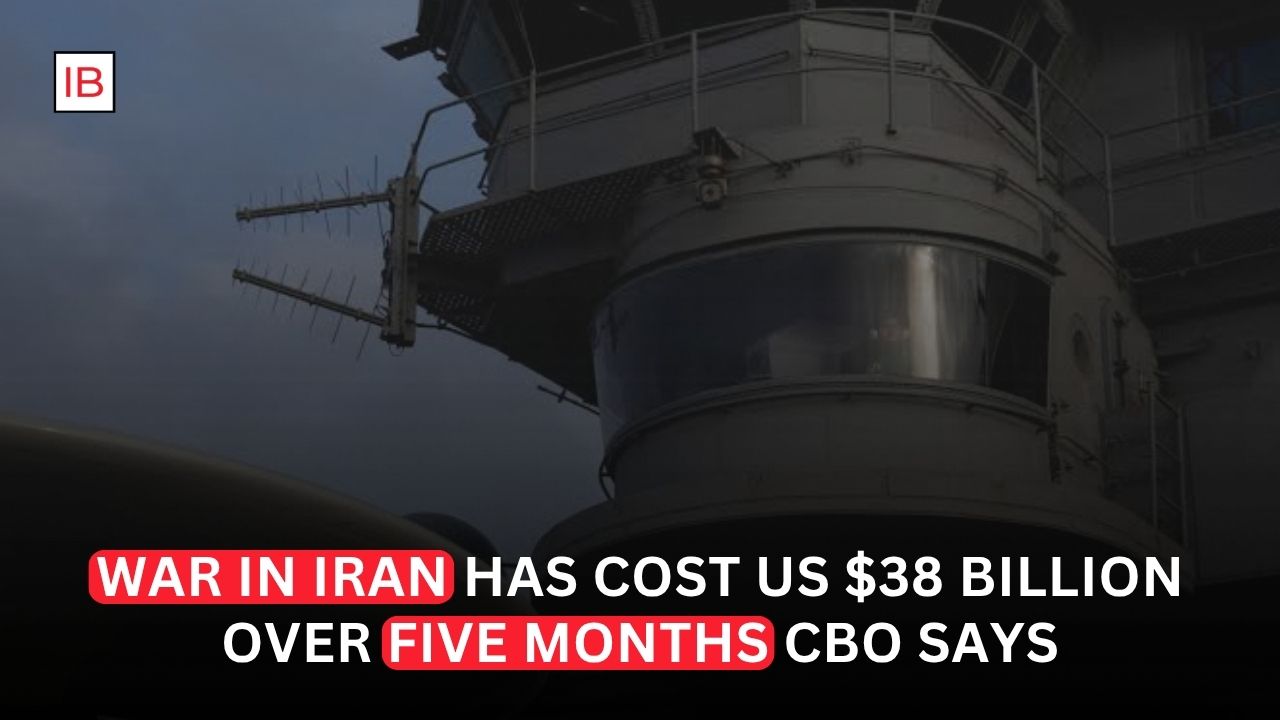
The United States has spent about $38 billion on its war with Iran through Aug. 1, according to a new Congressional Budget Office assessment, adding a significant financial burden to an already strained federal budget while warning that the conflict could continue costing billions of dollars every month.
The CBO’s estimate covers direct military costs accumulated since the conflict began on Feb. 28. The nonpartisan agency said the war could require another $2 billion to $3 billion a month if fighting continues at a relatively low intensity, with the monthly cost potentially rising further if the conflict escalates.
The latest figure is broadly consistent with the Pentagon’s earlier public estimate. Defense Secretary Pete Hegseth told lawmakers in July that the war had already cost approximately $37.5 billion. A separate Defense Department inspector general report put the cost at about $33.4 billion between Feb. 28 and June 30, highlighting how quickly expenses have accumulated as the conflict has continued.
A major portion of the spending is being driven by weapons and ammunition. The Pentagon inspector general estimated that more than $22 billion had been spent on munitions through June 30 alone. The report warned that the pace of weapons consumption had created “strategic inventory shortfalls” and exposed bottlenecks in the US defense industrial base.
That depletion could become one of the war’s most important long-term costs. Replacing sophisticated interceptors and precision weapons is not simply a matter of allocating additional money. Production capacity is limited, supply chains for specialized components can take years to expand, and manufacturers must often balance replenishment for the US military with existing contracts for allies.
The CBO assessment indicates that some of the most advanced missile inventories could take years to restore. Reuters reported that replenishing certain long-range precision weapons and interceptors could take as long as five years, potentially affecting US military readiness for other contingencies, including a future conflict involving China and Taiwan.
The financial consequences are extending beyond the Pentagon. The war has disrupted energy markets, particularly because fighting has affected shipping through the Strait of Hormuz, one of the world’s most important routes for oil and natural gas. Higher energy prices have added pressure to consumers and businesses while complicating the Federal Reserve’s efforts to manage inflation.
The CBO estimates that the conflict could increase US inflation by about 0.5 percentage point during the first three months of 2027. That effect would add to price pressures at a time when inflation is already proving difficult to bring fully under control.
Oil prices illustrate the economic impact. Brent crude climbed above $100 a barrel in September as the conflict disrupted regional energy infrastructure and shipping. Prices had been around $72 a barrel before the war began in late February, meaning the energy shock has become a significant additional cost for households and businesses.
The conflict is therefore creating a difficult policy trade-off for President Donald Trump. Continuing military operations carries an increasingly visible fiscal cost, while attempting to end the war could require diplomatic concessions or leave unresolved security concerns that triggered the conflict in the first place.
Trump has recently signaled greater openness to discussions over ending the war, although Iranian officials have rejected what they describe as mixed signals from Washington and continue to insist that certain conditions must be met before negotiations can begin. The future of the Strait of Hormuz remains central to those calculations because restoring stable commercial shipping would help ease pressure on global energy markets.
The CBO’s estimate also arrives as Washington confronts a broader fiscal challenge. US federal debt has already surpassed $40 trillion, while rising interest costs are consuming an increasing share of government revenue. Adding several billion dollars a month in military expenses would make it harder for lawmakers to stabilize the deficit without higher taxes, spending reductions or additional borrowing.
The war’s costs are also becoming politically significant. Representative Brendan Boyle, who requested the CBO analysis, has criticized the conflict’s financial and human consequences as lawmakers approach the 2026 midterm elections. The debate could intensify if monthly military expenses remain near the CBO’s projected range and voters continue to face higher energy prices.
For defense contractors, the conflict is likely to generate substantial demand as Washington attempts to rebuild depleted inventories. But for taxpayers, the picture is more complicated: the $38 billion figure does not capture every long-term consequence of the war, including future healthcare costs for service members, reconstruction, additional borrowing expenses or the economic effects of prolonged energy disruption.
The CBO assessment therefore provides only a snapshot of the conflict’s financial burden. If fighting continues, the cost could quickly move well beyond the current $38 billion estimate. With weapons inventories under pressure, inflation risks rising and energy markets unsettled, the economic price of the Iran war is becoming almost as important to Washington’s calculations as its military objectives.