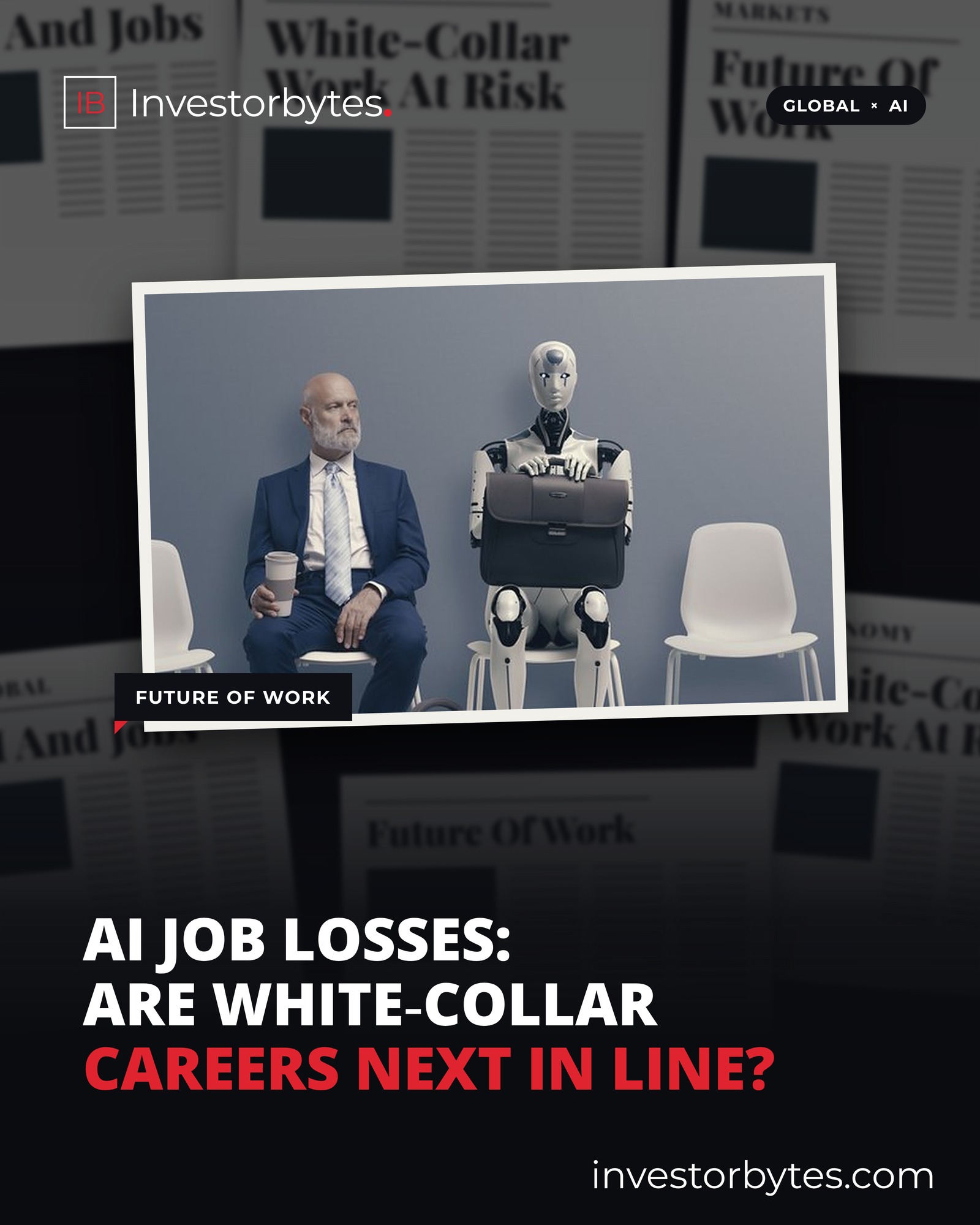
Fears of AI job losses have moved from science fiction into boardrooms and earnings calls. As a new generation of AI agents learns to plan, decide and carry out tasks with little human supervision, companies from Silicon Valley to Wall Street are reconsidering how many people they need and what those people should do. Some observers compare the moment to the Industrial Revolution, with one crucial difference: this time the disruption is aimed squarely at office workers.
The forecasts behind AI job losses
The headline estimates are large, though they vary. Goldman Sachs calculated in 2023 that around 300 million jobs worldwide could be exposed to AI, and a later analysis by the bank suggested that 6 to 7 percent of the US workforce could be displaced if the technology were widely adopted. McKinsey has estimated that 30 percent of hours currently worked across the US economy could be automated by 2030. Boston Consulting Group puts the potential elimination of US jobs at 10 to 15 percent over a horizon of five years or more, and describes remaking the workforce as a competitive imperative rather than an option.
Exposure is not the same as elimination, and many of these figures describe tasks rather than whole jobs. Still, the direction of travel is clear enough for corporate leaders to act on it.
Big Tech and Wall Street are already moving
Several high-profile companies have explicitly tied headcount decisions to AI. Fintech group Block, led by Jack Dorsey, said in February that it would shrink its workforce from roughly 10,000 to around 6,000, citing AI tools and a move to smaller, flatter teams. Meta planned in April to cut about 8,000 roles, roughly 10 percent of staff, with chief people officer Janelle Gale saying the reductions would offset other investments. Microsoft made more than 15,000 job cuts last year even as it committed $80bn to AI, and Amazon chief executive Andy Jassy has said he expects the company’s corporate workforce to shrink as AI delivers efficiency gains.
Finance is heading in the same direction. Citigroup has launched Arc, a platform for building and scaling AI agents across the bank. Anthropic released agents for financial services in May that can assemble pitchbooks, audit statements and draft credit memos. At JPMorgan, chief analytics officer Derek Waldron has described a future in which processes are powered by AI agents.
From generative AI to agentic AI
The shift matters because agents go further than chatbots. Generative AI produces content on request, while agentic systems can take a goal, break it into steps and execute them. They can be digital, such as coding assistants, or physical, such as robots, drones and self-driving cars. Consumer tools like OpenClaw, launched in November 2025, already manage email, calendars and flight check-ins. McKinsey suggests that a team of two to five people could eventually oversee 50 to 100 specialised agents running entire processes end to end, and its analysis indicates AI may be able to complete four days of work without supervision by 2027.
Entry-level workers face the sharpest risk
The most immediate pressure from AI job losses appears to fall on graduates. Anthropic chief executive Dario Amodei has warned that AI could wipe out half of entry-level white-collar jobs and push unemployment up by 10 to 20 percent within one to five years. A 2025 McKinsey survey found that 51 percent of organisations said generative AI was reducing their need for entry-level staff. Pencheng Shi of the Rochester Institute of Technology reports that large technology firms are increasingly hiring people with 10 to 15 years of experience or doctorates, leaving holders of bachelor’s and master’s degrees struggling to get a foothold.
That creates a pipeline problem. If junior roles disappear, firms may find it harder to develop the experienced professionals they will need later. Microsoft research ranking occupations by their applicability to generative AI placed writers, journalists, historians, customer service representatives, sales staff, data scientists, mathematicians and personal financial advisers among the most exposed.
The risks are also unevenly distributed. A 2024 McKinsey analysis found that the lowest-paid workers in Europe were three to five times more likely than higher earners to need to change occupation, and in the US the gap was 10 to 14 times. Without large-scale reskilling, McKinsey warns of a more polarised labour market, and it estimates Europe may need up to 12 million occupational transitions, roughly double the pre-pandemic rate.
New roles, new skills and the policy debate
Not everyone sees a straight line from automation to unemployment. Microsoft research economist Sida Peng argues that people will spend less time on repetitive execution and more time directing work and managing outcomes. The company’s Work Trend Index found that 58 percent of workers were producing work they could not have done a year earlier, rising to 80 percent among its so-called Frontier Professionals. McKinsey’s research on the agentic organisation points to emerging roles such as agent orchestrators, hybrid managers and AI coaches, while other studies highlight trainers, explainers and sustainers, and a growing premium on empathy, communication and leadership.
There are less visible costs too. Researchers Erik Hermann, Stefano Puntoni and Carey Morewedge argue that generative AI can undermine workers’ sense of competence, autonomy and connection, and call for human-centred workplaces. Shi worries about skill erosion, likening it to the way satellite navigation dulled people’s sense of direction. A study in The Lancet found that experienced doctors performed worse at unaided colonoscopy diagnosis after a three-month period of using AI support. Hallucinations and algorithmic bias also remain unresolved.
On the policy side, ideas range widely. Amodei has floated a token tax on AI revenues, Elon Musk has suggested a universal high income building on the concept of universal basic income, and Shi argues that wealth distribution and social safety nets must adapt. Each proposal raises hard questions about funding and incentives. A fuller account of the debate is available in World Finance’s feature on the AI jobs debate.
Conclusion
AI job losses are no longer hypothetical, but their eventual scale remains uncertain. The technology could raise productivity and help tackle problems from climate change to cancer, yet the transition threatens to fall hardest on entry-level and lower-wage workers. Whether the outcome resembles a job apocalypse or a painful but manageable reshuffle will depend less on the algorithms than on choices made by companies, educators and governments over the next few years.