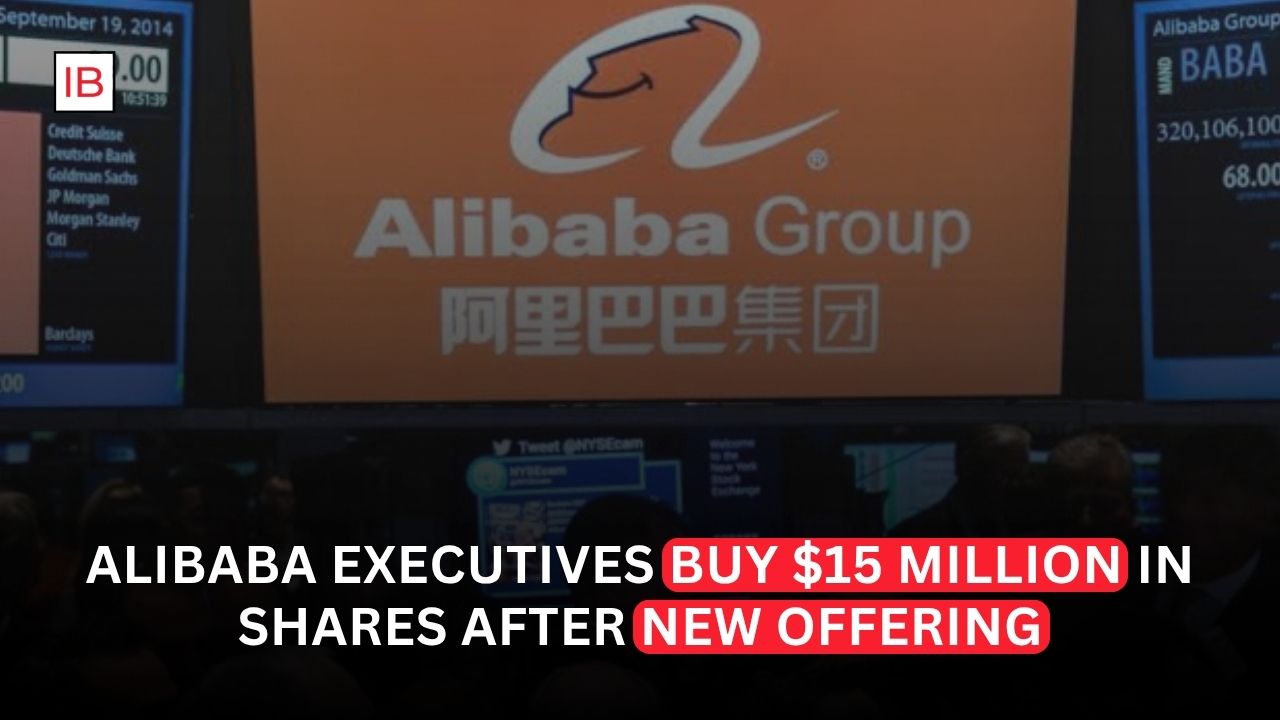
Alibaba Group’s top executives have made a significant personal investment in the company shortly after the Chinese technology giant announced a $10.2 billion share offering to fund artificial-intelligence expansion. Chairman Joe Tsai and Chief Executive Officer Eddie Wu together purchased about HK$120 million ($15.3 million) worth of Alibaba shares, sending a clear signal that the company’s leadership believes its aggressive AI strategy can generate long-term value.
The purchases came at a sensitive moment for Alibaba. The company has just launched one of the largest equity offerings in Hong Kong’s history, while its stock has fallen sharply as investors question the scale of its AI spending and the dilution created by issuing new shares.
That combination makes the executives’ purchases more than a routine insider transaction. They represent a public vote of confidence at a time when investors are debating whether Alibaba can turn enormous AI investment into sustainable profits.
Executives Put Their Own Money Behind Alibaba
Joe Tsai, Alibaba’s chairman, purchased approximately 720,000 shares for around HK$80 million, while CEO Eddie Wu bought about 350,000 shares for roughly HK$40 million, according to Hong Kong stock-market filings.
The purchases were made separately from Alibaba’s new share-placement program.
That distinction matters.
The company is raising capital from outside investors to finance its AI ambitions, while its two highest-profile executives are simultaneously committing their own money to Alibaba’s publicly traded shares.
For investors, that can be interpreted as management saying that the current market valuation does not fully reflect Alibaba’s future potential.
But it is not proof that the AI strategy will succeed.
Insider purchases can signal confidence, but executives can also be wrong about the future value of their businesses.
The Timing Is Particularly Significant
Alibaba announced the pricing of its new share placement at HK$112.70 per share.
The company is issuing 710 million new ordinary shares, with the transaction expected to raise approximately HK$80 billion, or about $10.2 billion. Alibaba says all of the net proceeds will be used to strengthen its full-stack AI capabilities and expand AI infrastructure.
The new shares represent roughly 3.7% of Alibaba’s existing outstanding shares.
That means existing shareholders face dilution.
At the same time, Alibaba’s shares dropped sharply after the offering was announced. Reuters reported that the stock fell about 8% in Hong Kong trading, reflecting concerns about dilution and the enormous cost of the company’s AI expansion.
The executives therefore bought into a falling market rather than waiting for sentiment to improve.
Alibaba Is Betting Heavily on AI
The share offering is ultimately about one thing: artificial intelligence.
Alibaba wants to become a major global AI player, competing not only with Chinese technology companies but also with giants such as Microsoft, Amazon, Alphabet and Meta.
The company plans to use the new capital for chips, computing infrastructure, data centers and AI models.
Alibaba’s Qwen family of models has become a major part of its technology strategy, while Alibaba Cloud provides the computing infrastructure needed to train and operate increasingly sophisticated AI systems.
The company has said that its AI investments are already producing increasing demand.
The challenge is that AI infrastructure requires enormous upfront spending.
Profit Has Already Taken a Hit
Alibaba’s latest financial results demonstrate the cost of this strategy.
The company’s quarterly net profit dropped by roughly 75% year over year, while capital expenditures increased significantly as Alibaba accelerated its AI investment.
That creates a difficult situation for shareholders.
Alibaba is asking investors to accept lower near-term profitability in exchange for the possibility of much larger future returns from AI and cloud computing.
The market is clearly not prepared to accept that argument without evidence.
The share-price reaction shows that investors are questioning whether the expected returns justify the amount of capital being committed.
The Offering Was Heavily Oversubscribed
There is an important counterpoint.
Despite concerns about dilution, demand for Alibaba’s new shares was extremely strong.
The order book reportedly attracted around $28 billion in demand, almost three times the targeted $10.2 billion offering.
That indicates that institutional investors remain interested in Alibaba’s AI strategy.
The company also attracted interest from sovereign wealth funds and long-only investors, according to reports on the placement.
So the market reaction is not simply a rejection of Alibaba.
Instead, investors appear divided.
Some see AI as the next major growth engine for Alibaba.
Others believe the company is spending too aggressively and putting shareholder returns at risk.
Dilution Is the Main Immediate Concern
The biggest issue for existing shareholders is dilution.
When a company issues new shares, the ownership percentage represented by each existing share decreases.
That does not automatically destroy value.
If the money raised generates returns greater than the cost of the new capital, existing shareholders can ultimately benefit.
But if the company invests the money poorly, shareholders suffer both from dilution and from weak returns.
This is why the success of Alibaba’s offering will ultimately depend on return on investment, not the size of the fundraising itself.
Raising $10 billion is easy to measure.
Turning that $10 billion into substantially more economic value is much harder.
Why Management’s Purchases Matter
Tsai and Wu’s purchases are significant because they are directly exposed to the same shareholder economics.
If Alibaba’s stock performs well, their personal investments gain value.
If the AI strategy disappoints, they lose money.
That alignment can reassure investors.
It also gives management a stronger incentive to demonstrate that the capital being raised is being deployed effectively.
However, investors should avoid treating insider purchases as an automatic bullish signal.
The executives know the company better than outside investors, but they also have a strong personal and professional interest in Alibaba succeeding.
Alibaba Is Making a Strategic Shift
Alibaba was traditionally viewed primarily as an e-commerce company.
That is changing.
The company increasingly presents itself as an AI and cloud-computing business with a major commerce operation, rather than simply an online retailer.
The shift reflects changes in China’s technology market.
Traditional e-commerce has become increasingly competitive, while AI and cloud computing offer potentially much larger long-term growth opportunities.
Alibaba therefore believes that failing to invest aggressively in AI could be more dangerous than spending heavily today.
AI Competition Is Becoming Extremely Expensive
Alibaba is not operating in isolation.
China has a growing group of AI companies competing for developers, customers and computing resources.
At the same time, American technology companies are spending enormous amounts on data centers and AI infrastructure.
That creates an arms race.
Companies need powerful chips, huge data centers and increasingly expensive computing capacity.
Alibaba cannot simply build an AI model and expect to win.
It needs infrastructure capable of supporting millions of users and enterprise customers.
That is why the company’s capital requirements are increasing so rapidly.
The Qwen Model Is Central to the Strategy
Alibaba’s Qwen AI family has become one of the most important pieces of its AI strategy.
The company has developed a range of models designed for different applications and has increasingly emphasized open-source development.
The objective is to build an ecosystem around Qwen while simultaneously generating demand for Alibaba Cloud’s computing services.
If that strategy works, Alibaba could benefit from two connected businesses.
First, AI models could attract users and developers.
Second, those users could generate demand for cloud infrastructure.
That would create a potentially powerful feedback loop.
Cloud Computing Could Be the Real Prize
The AI story may ultimately be less about chatbots and more about cloud computing.
Training and operating AI systems requires massive amounts of computing power.
Cloud providers that supply that infrastructure can capture recurring revenue from AI companies and businesses.
Alibaba Cloud is already one of China’s major cloud providers.
If AI adoption accelerates, demand for cloud computing could rise significantly.
That gives Alibaba an opportunity to transform its current AI spending into a long-term infrastructure business.
But AI Revenue Must Catch Up With AI Spending
This is where investors remain skeptical.
Spending billions on AI does not guarantee profitability.
A company can build enormous computing capacity and still fail to generate adequate returns.
The AI market could also become increasingly competitive, forcing companies to reduce prices.
If AI services become commoditized, the cost of infrastructure may remain high while revenue per user declines.
That would make it difficult for Alibaba to achieve the returns investors are expecting.
The Market Has Already Sent a Warning
Alibaba’s share-price reaction should not be ignored.
Reuters reported that the stock dropped about 8% following the announcement of the share placement.
The decline suggests that investors initially viewed the fundraising as a cost rather than an immediate benefit.
That is understandable.
Shareholders are being diluted today for an uncertain future payoff.
Alibaba therefore has to demonstrate that its AI strategy can produce measurable financial results.
A Successful AI Strategy Could Change Alibaba’s Valuation
If Alibaba can show that AI is accelerating cloud growth, improving margins and creating new sources of recurring revenue, investor sentiment could change quickly.
The company would no longer be valued primarily on its mature e-commerce operations.
Instead, investors could begin assigning greater value to its AI and cloud businesses.
That could materially change how the market views Alibaba.
But that revaluation requires evidence.
Management cannot rely indefinitely on promises about future AI growth.
The Risk of Overinvestment
There is also a scenario in which Alibaba spends too much.
The global AI boom has encouraged technology companies to make enormous infrastructure commitments.
If demand grows more slowly than expected, companies could end up with excess computing capacity.
That would lower returns on capital.
Alibaba would then have to absorb large depreciation and operating costs while generating less revenue than anticipated.
For investors, this is arguably the biggest long-term risk.
Michael Burry’s Criticism Highlights the Debate
Investor Michael Burry has criticized Alibaba’s decision to raise capital through the new share sale.
His concerns focus partly on dilution and the company’s increasing capital requirements.
His criticism reflects a broader investor debate.
The question is not whether Alibaba can build impressive AI technology.
It is whether the economic returns from that technology will justify the enormous amount of capital required.
That is a much harder question.
What Investors Should Watch Next
Several indicators will determine whether Alibaba’s strategy succeeds.
AI Revenue Growth
Investors need to see whether AI-related demand is translating into meaningful revenue.
Alibaba Cloud Growth
Cloud performance will be critical because it can provide recurring revenue from AI infrastructure.
Capital Expenditure
Spending must eventually stabilize.
If capital expenditure continues rising indefinitely, investors may question whether the business can generate attractive returns.
Free Cash Flow
Alibaba needs to demonstrate that AI investment can eventually translate into stronger cash generation.
Qwen Adoption
The scale of Qwen’s commercial adoption will help determine whether Alibaba can establish a meaningful AI ecosystem.
Return on Invested Capital
Ultimately, this may be the most important metric.
The company needs to demonstrate that every dollar invested in AI can produce attractive long-term returns.
The Executives’ Message Is Clear
By purchasing $15.3 million of Alibaba shares, Joe Tsai and Eddie Wu have made their position clear.
They believe the market is underestimating Alibaba’s future potential.
Their purchases come at a critical moment when the company is asking investors to provide billions of dollars to accelerate its AI ambitions.
The decision therefore carries symbolic weight.
Management is not merely asking shareholders to believe in Alibaba’s AI strategy.
Its senior executives are putting their own money behind it.
Conclusion
Alibaba is entering a new phase of its corporate history.
The company is moving aggressively from its traditional identity as an e-commerce giant toward becoming a major AI and cloud-computing competitor.
The $10.2 billion share offering gives Alibaba substantial new capital to pursue that transformation, but it also creates dilution and raises questions about whether the investment will generate adequate returns.
The decision by chairman Joe Tsai and CEO Eddie Wu to personally purchase about $15.3 million of Alibaba shares provides a strong vote of confidence.
But investors should not confuse confidence with certainty.
Alibaba’s future will depend on whether its enormous AI investments translate into profitable growth.
The company has already demonstrated that it can attract massive investor demand—the new offering was reportedly nearly three times oversubscribed.
Now comes the harder part.
Alibaba has to prove that the billions it is putting into chips, data centers, cloud infrastructure and AI models can generate returns that exceed the cost of the capital being invested.
If it succeeds, the current dilution could eventually look like a necessary investment in Alibaba’s next era.
If it fails, shareholders may conclude that the company spent too much chasing an AI future that never delivered the expected financial returns.
For now, Tsai and Wu are betting with their own money that Alibaba gets the equation right.