Artificial Intelligence May Be Affecting Paychecks Before Employment
Artificial intelligence has fueled widespread fears that automation could eliminate millions of jobs. But according to new research associated with Apollo Global Management, the technology may be affecting workers in a different way — by putting pressure on wages rather than immediately causing widespread job losses.
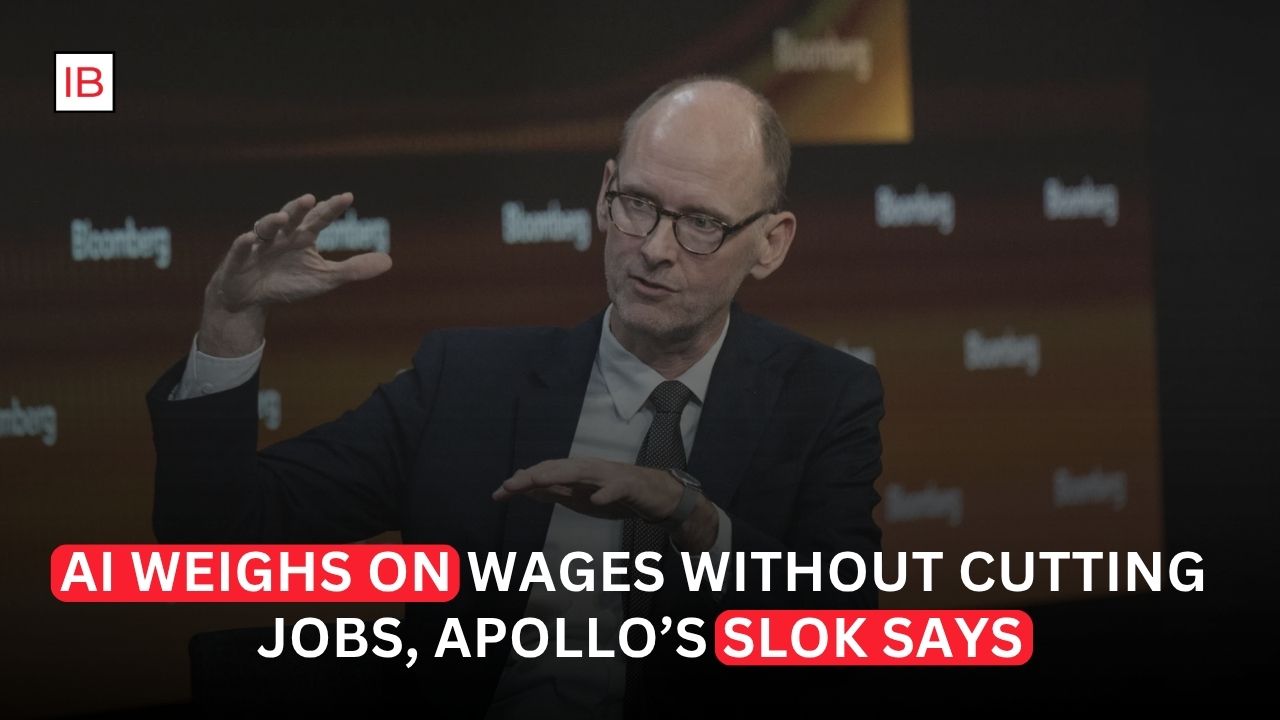
Apollo Chief Economist Torsten Slok and researcher Sania Edlich found that workers in occupations with greater exposure to AI have experienced significantly weaker wage growth since 2023. At the same time, the research found no clear evidence that AI has yet produced a measurable decline in employment across those occupations.
The findings suggest that the first major effect of AI on the labor market may not be mass unemployment. Instead, companies could be using AI-driven productivity gains to reduce the need to offer higher salaries.
For millions of workers, that could mean keeping their jobs while earning less than they might have in a world without rapid AI adoption.
AI-Exposed Workers See Slower Wage Growth
The Apollo research compared wage and employment trends across hundreds of occupations, focusing particularly on jobs with a high level of exposure to artificial intelligence.
The analysis found that workers in highly AI-exposed occupations experienced real wage growth that was 6.7 percentage points lower than workers in less-exposed jobs after 2023, when generative AI began spreading rapidly across workplaces.
The affected occupations include areas where AI tools can already perform or assist with significant parts of the work, such as:
- Computer programming
- Customer service
- Financial analysis
- Administrative work
- Other knowledge-based occupations
Apollo estimated that around 5.8 million US workers, representing approximately 3.7% of the labor force, are currently employed in occupations with high AI exposure under its measurement approach. The research estimated that weaker wage growth could amount to roughly $28 billion in lost annual income growth for affected workers.
The number could increase if AI becomes more deeply integrated across a wider range of industries.
Companies May Be Keeping Workers but Paying Them Less
The findings present a different version of the AI disruption story.
The traditional fear surrounding automation is straightforward: machines replace workers, companies reduce their payrolls and unemployment rises.
That pattern has not yet clearly appeared in the data examined by Apollo.
Instead, AI may be changing the balance of power between employers and employees.
If a worker can use AI to complete tasks more quickly, companies may need fewer additional employees to expand production. At the same time, existing workers may become easier to replace because AI can assist less experienced employees with some tasks.
As a result, companies may have less reason to compete aggressively for workers by offering higher salaries.
Apollo’s research suggests that businesses could be capturing some of AI’s productivity benefits through wage compression rather than direct workforce reductions.
In other words, the technology may allow companies to control labor costs without necessarily announcing major AI-related layoffs.
There Is Still Little Evidence of an AI Job Apocalypse
Despite warnings from technology leaders and economists about automation, Slok has argued that there is currently little evidence that AI has caused widespread job losses.
The Apollo analysis found no statistically detectable AI-driven effect on overall employment in the occupations studied, even as wage growth weakened.
This distinction is important.
A worker may remain employed but still experience a negative economic effect if:
- Salary increases slow down
- Starting salaries decline
- Promotions become less valuable
- Companies hire fewer additional workers
- Workers lose bargaining power
- AI allows businesses to demand more output without proportional increases in pay
The absence of major layoffs therefore does not necessarily mean that AI is having no impact on workers.
The pressure may simply be appearing in a less visible part of the labor market.
Lower-Income Workers Could Face Greater Pressure
The impact of AI on wages may also be uneven.
Apollo’s findings suggest that workers lower on the income scale experienced a greater slowdown in wage growth than higher-paid employees.
This could create concerns about inequality.
Workers in highly paid positions may have greater bargaining power, specialized expertise or management responsibilities that are more difficult to automate.
Lower-paid employees performing more standardized tasks may have less ability to negotiate when AI tools increase the amount of work that each employee can complete.
That does not mean every lower-paid job will disappear.
In fact, Apollo’s research suggests many of those jobs may remain.
The greater risk, at least for now, could be that workers continue performing their roles but receive a smaller share of the economic gains generated by AI.
AI Productivity Gains May Not Be Reaching Workers
Artificial intelligence is frequently promoted as a technology that will dramatically improve productivity.
Businesses are spending hundreds of billions of dollars on data centers, chips, software and AI infrastructure because they expect the technology to help reduce costs and increase output.
But an important question remains: Who receives the financial benefits when AI makes workers more productive?
Ideally, productivity growth can lead to higher wages, increased profits and economic expansion.
However, the Apollo findings raise the possibility that AI’s early gains are being captured primarily by companies and investors rather than being shared equally with employees.
Slok has previously expressed concerns that the expected productivity benefits from AI have not yet appeared broadly across the economy. He has argued that measurable benefits remain concentrated in parts of the technology sector rather than being clearly visible across most large companies.
The wage research adds another dimension to that debate.
Even where AI may be improving efficiency, workers may not automatically receive a larger share of the benefits.
AI Could Change Hiring Before It Eliminates Jobs
One reason employment levels may remain stable is that companies do not need to fire existing workers to benefit from AI.
Instead, they can change their hiring strategies.
A business that previously needed to hire ten new employees to support growth may discover that AI allows its existing workforce to handle part of that additional work.
The company can then reduce future hiring without carrying out mass layoffs.
This process can be difficult to identify in traditional employment data.
A company may report stable headcount while still employing fewer people than it would have without AI.
Over time, slower hiring could have a major impact, particularly on younger workers entering the labor market.
Entry-level jobs are often built around routine tasks that can be partially automated or accelerated by generative AI.
If companies need fewer junior employees, the long-term consequences could become more visible even without a sudden wave of layoffs.
AI Could Eventually Affect Employment More Directly
The current data does not prove that AI will never eliminate large numbers of jobs.
It only suggests that a major employment effect has not yet been clearly detected.
AI adoption remains relatively new, and companies are still experimenting with how to integrate generative AI into their operations.
Apollo itself warned that the number of workers affected could grow as adoption expands beyond the occupations currently classified as highly exposed.
The impact could develop in stages.
The first stage may involve AI helping workers become more productive.
The second could involve slower hiring and reduced wage growth.
Eventually, companies may redesign entire business processes around AI, potentially reducing the number of employees required.
That means the current absence of widespread job losses should not necessarily be interpreted as proof that future disruption will not occur.
The Jevons Paradox Could Also Complicate Predictions
Slok has previously pointed to another possible outcome.
Under the economic concept known as the Jevons Paradox, making a product or service cheaper and more efficient can sometimes increase total demand rather than reduce it.
Applied to AI, greater automation could make certain professional services cheaper. But lower costs could also encourage more businesses and consumers to use those services.
That could potentially create new work rather than simply eliminating existing jobs.
For example, AI might allow lawyers, accountants or customer-service teams to serve more clients at a lower cost. Increased demand could then create additional opportunities for human workers even if each individual task requires less labor.
This is one reason predicting AI’s long-term impact on employment remains difficult.
The technology could eliminate certain tasks while simultaneously expanding the overall market for the services connected to those tasks.
Workers May Need New Ways to Protect Their Bargaining Power
If AI’s immediate impact is primarily on wages rather than employment, policymakers and workers may need to rethink how they respond.
The debate around AI has largely focused on protecting jobs.
But workers could face financial pressure even when they remain employed.
Potential areas of concern include:
- Wage transparency
- Worker training
- Access to AI skills
- Productivity-sharing arrangements
- Stronger career development programs
- Protection for entry-level opportunities
- Policies that encourage companies to invest in human workers alongside AI
The challenge will be ensuring that productivity gains do not become concentrated entirely among shareholders and technology companies.
AI has the potential to increase economic output.
The more difficult question is how that additional value will be distributed.
Investors Are Also Watching the AI Productivity Story
The labor market debate is connected to a broader question about the economics of artificial intelligence.
Companies and investors are spending enormous amounts on AI infrastructure, but Slok has repeatedly questioned whether enough profits are being generated across the broader AI industry to justify the scale of investment.
He has argued that some of the strongest profits are currently appearing in infrastructure-related parts of the AI ecosystem, while companies developing AI models and applications face greater challenges in generating sustainable returns.
That creates a complicated picture.
AI may already be helping companies reduce labor-cost growth in some occupations.
At the same time, the broader business case for massive AI investment remains uncertain.
Companies may therefore face pressure to demonstrate that their spending is producing real financial benefits.
Labor costs could become one of the areas where executives look for returns.
Looking Ahead
Apollo Chief Economist Torsten Slok’s research challenges the popular image of an immediate AI-driven employment collapse.
For now, the evidence suggests that artificial intelligence may be having a more subtle effect on the labor market.
Workers in highly AI-exposed occupations are experiencing significantly weaker wage growth, while employment levels have not yet shown a clear AI-driven decline. The gap in wage growth reached 6.7 percentage points, with an estimated 5.8 million workers currently falling into highly exposed occupations under Apollo’s methodology.
This could mean the first major labor-market consequence of AI is not unemployment.
It could be slower wage growth, weaker bargaining power and reduced demand for additional workers.
That distinction matters.
Losing a job is an obvious economic shock. Receiving smaller pay increases year after year can be less visible, but the long-term financial consequences may still be significant.
As AI adoption expands, economists will be watching closely to determine whether today’s wage pressure eventually develops into reduced hiring and job losses — or whether increased productivity ultimately creates entirely new forms of employment.
For now, Slok’s message is more complicated than the popular prediction of an AI job apocalypse.
AI may not be taking workers’ jobs yet. But for millions of employees, it may already be changing what those jobs are worth.