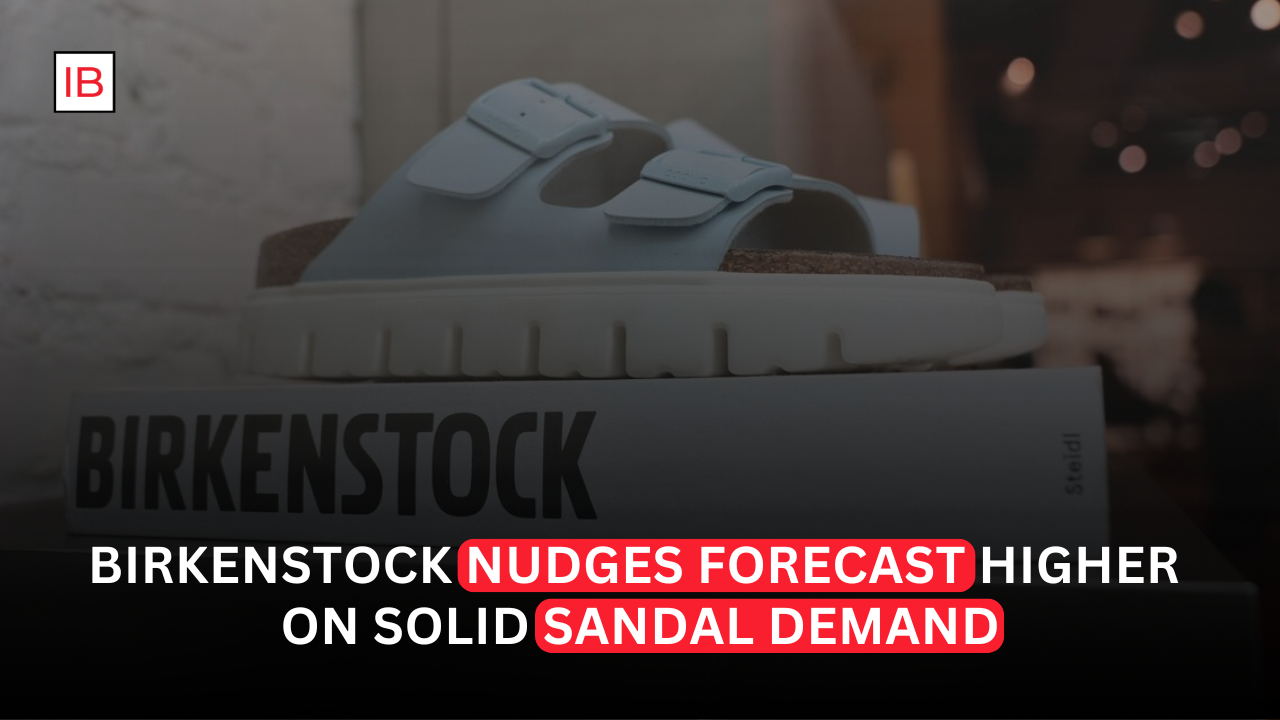
Birkenstock is raising its full-year sales outlook as demand for its premium sandals, clogs and closed-toe footwear remains resilient, offering another sign that affluent consumers are continuing to spend on established brands despite broader weakness in discretionary retail.
The German footwear company now expects 15% revenue growth for fiscal 2026 on a constant-currency basis, compared with its previous forecast range of 13% to 15%. Its third-quarter revenue increased 13% to €719.5 million, beating analysts’ expectations of €713.4 million.
The headline is positive, but the more interesting story is why Birkenstock is performing well while parts of the broader footwear and apparel market are struggling.
Premium Consumers Are Still Spending
Birkenstock’s results suggest that the consumer slowdown is not affecting every segment equally.
The company benefits from a customer base that is relatively affluent and therefore less sensitive to economic pressure.
That matters because consumers may cut spending on discretionary products while still being willing to pay for brands they perceive as durable, recognizable and worth the premium.
Birkenstock has increasingly positioned itself in that space.
Its products are no longer simply functional sandals.
The brand has become a fashion and lifestyle label while retaining its original comfort-focused identity.
That combination gives the company pricing power that many footwear competitors lack.
Sandals Remain the Core Growth Engine
Strong demand for sandals helped drive the improved outlook.
Birkenstock’s product portfolio also includes clogs and closed-toe shoes, but sandals remain central to the company’s identity and sales momentum.
The important point is that the company has managed to maintain demand without relying primarily on aggressive discounting.
That is valuable in an industry where promotions can quickly damage margins and weaken brand positioning.
A brand that can sell more products at full price has a fundamentally stronger economic model than one that needs constant promotions to generate volume.
Revenue Beat Expectations
Birkenstock reported third-quarter revenue of €719.5 million, up 13% from the same period a year earlier. That exceeded the €713.4 million analyst consensus.
The earnings picture was slightly less impressive.
Adjusted earnings per share came in at €0.74, compared with the €0.76 expected by analysts.
That distinction matters.
The company is clearly growing revenue, but investors should not assume that every additional euro of sales automatically translates into proportional profit growth.
Input costs, retail expansion, marketing spending and currency movements can all influence margins.
Direct-to-Consumer Sales Are Becoming More Important
Birkenstock’s direct-to-consumer business continues to expand.
DTC revenue increased 14% during the quarter and represented almost 39% of total revenue.
That is strategically important.
Selling through its own stores and website gives Birkenstock greater control over:
- Pricing
- Customer data
- Product presentation
- Inventory
- Promotions
- Brand experience
It can also potentially generate higher margins than wholesale distribution, although operating its own stores comes with additional costs.
The growth of DTC therefore gives Birkenstock more control over the economics of its brand.
Asia-Pacific Is the Standout Region
Regional performance also provides an important clue about where future growth could come from.
Birkenstock’s Asia-Pacific sales increased 18% during the quarter, significantly faster than its other major regions. The Americas grew 11%, while EMEA increased 15%.
Management expects APAC to continue growing at roughly twice the pace of its other regions for the full fiscal year.
That makes Asia particularly important to the company’s long-term growth story.
The region contains large populations of increasingly affluent consumers, but it also contains highly competitive fashion and footwear markets.
Birkenstock therefore has considerable opportunity, but maintaining rapid growth will require continued brand investment.
Birkenstock Has Built a Different Kind of Brand
The company’s transformation over the past decade is worth considering.
Birkenstock was historically associated primarily with comfort and practicality.
It has gradually become much more visible in fashion.
Designer collaborations, celebrity exposure and broader adoption have helped change the perception of the brand.
That repositioning allows Birkenstock to occupy an unusual space between traditional footwear and premium fashion.
It can charge more than a mass-market sandal company without necessarily needing to compete directly with the most expensive luxury footwear brands.
That middle ground has proved commercially attractive.
Pricing Power Is the Real Story
The strongest part of Birkenstock’s business model may not be store growth.
It is pricing power.
If customers remain willing to pay full price for the brand, Birkenstock can increase revenue without having to dramatically increase unit volumes.
That is particularly valuable during periods of inflation or higher input costs.
It also protects the brand from the vicious cycle of discounting.
Once consumers become accustomed to waiting for sales, it becomes harder for a company to return to full-price selling.
Birkenstock appears to have avoided that problem relatively well.
But There Is a Risk in Calling the Consumer “Resilient”
The biggest mistake would be to interpret Birkenstock’s results as evidence that consumers broadly are doing well.
They are not necessarily.
Birkenstock is benefiting from a specific consumer segment.
Affluent consumers can behave very differently from lower-income households.
A premium brand can therefore continue growing even while mass-market retailers experience weaker demand.
That means Birkenstock’s performance should not automatically be extrapolated across the entire footwear industry.
The Middle East Remains a Variable
Birkenstock also acknowledged uncertainty connected to the conflict in the Middle East.
However, the impact on its business during the quarter was more limited than initially expected.
That is encouraging, but geopolitical risk remains difficult to forecast.
The company’s exposure to different international markets means regional disruptions can affect tourism, retail traffic, shipping and consumer confidence.
For now, those risks appear manageable.
Store Expansion Supports the Strategy
Birkenstock has also been expanding its direct retail footprint.
Earlier in 2026, the company planned to open roughly 40 additional stores globally as part of its effort to strengthen DTC sales.
That strategy makes sense if new locations generate attractive returns.
But store expansion should not be treated as automatically positive.
Retail locations create significant fixed costs.
The important question is whether each new store produces enough revenue and profit to justify the investment.
If Birkenstock maintains strong sales productivity, the strategy can increase brand visibility and strengthen margins.
If productivity declines, rapid expansion could become a drag.
Brand Strength Gives Birkenstock an Advantage
One reason the company has been able to withstand broader discretionary pressure is its strong brand recognition.
Customers often purchase Birkenstocks for a combination of:
- Comfort
- Durability
- Design
- Brand identity
- Fashion appeal
That reduces the need for the company to compete purely on price.
And price competition is dangerous for footwear companies because there are many cheaper alternatives.
Birkenstock’s objective is therefore to make the consumer compare products based on value rather than simply price.
The Luxury Connection Is Useful — But Limited
Birkenstock is not a traditional luxury company.
That distinction matters.
Luxury brands can often generate very high margins because scarcity and status are central to their business models.
Birkenstock’s appeal is broader.
Its products are relatively accessible compared with high-end luxury footwear.
That creates a larger potential customer base, but it also means the company cannot assume that luxury-style pricing power will continue indefinitely.
Its growth depends on maintaining a delicate balance between premium positioning and mass appeal.
Investors Should Watch Margins
The improved revenue forecast is encouraging.
But the next question should be whether profitability is keeping pace.
Investors should watch:
Gross margin: Is Birkenstock maintaining pricing power?
Adjusted EBITDA margin: Is operating leverage improving?
DTC mix: Does the growing direct business improve profitability?
Store productivity: Are new locations generating attractive returns?
APAC growth: Can the region maintain its current momentum?
Inventory: Is the company avoiding excess stock that could eventually require discounting?
These indicators will provide a better picture of the business than revenue growth alone.
The Stock Reaction Shows Expectations Were Already High
Birkenstock shares jumped about 7% in premarket trading after the results, according to Reuters.
But that reaction should be interpreted carefully.
A stock can rise after strong results even when the underlying business is not dramatically different from what investors expected.
What matters is the gap between expectations and actual performance.
Birkenstock has become a well-known growth story.
That means investors may already have priced in substantial future expansion.
The higher the valuation, the less room there is for operational mistakes.
What Could Go Wrong?
There are several obvious risks.
First, discretionary spending could weaken further.
Second, competitors could increase promotional activity.
Third, higher costs could pressure margins.
Fourth, international expansion could generate lower returns than expected.
Fifth, the brand could become overexposed to fashion trends.
And finally, rapid growth creates execution risk.
A company operating across numerous countries and thousands of retail relationships has considerably more complexity than it did a decade ago.
The Bigger Picture
Birkenstock’s improved forecast illustrates an important shift in consumer markets.
The spending slowdown is not affecting every brand equally.
Consumers appear increasingly selective.
They may be willing to spend on products that offer a combination of quality, comfort, brand recognition and long-term use, while cutting spending elsewhere.
Birkenstock is positioned directly in that intersection.
Its strong third-quarter revenue, rising direct-to-consumer sales and particularly strong Asia-Pacific performance provide evidence that the brand still has substantial growth momentum.
But the company now faces a harder challenge.
The easy part was transforming Birkenstock from a functional sandal manufacturer into a global premium brand.
The harder part is maintaining double-digit growth while getting progressively larger.
That requires new customers, new markets, new products and disciplined pricing — without weakening the brand.
For now, the numbers suggest Birkenstock is managing that balance. The 15% fiscal 2026 growth target is a modest but meaningful upgrade, and strong full-price demand suggests the brand retains pricing power. But investors should focus less on the sandal boom itself and more on whether Birkenstock can convert that demand into durable margins and high returns on its expanding retail footprint.