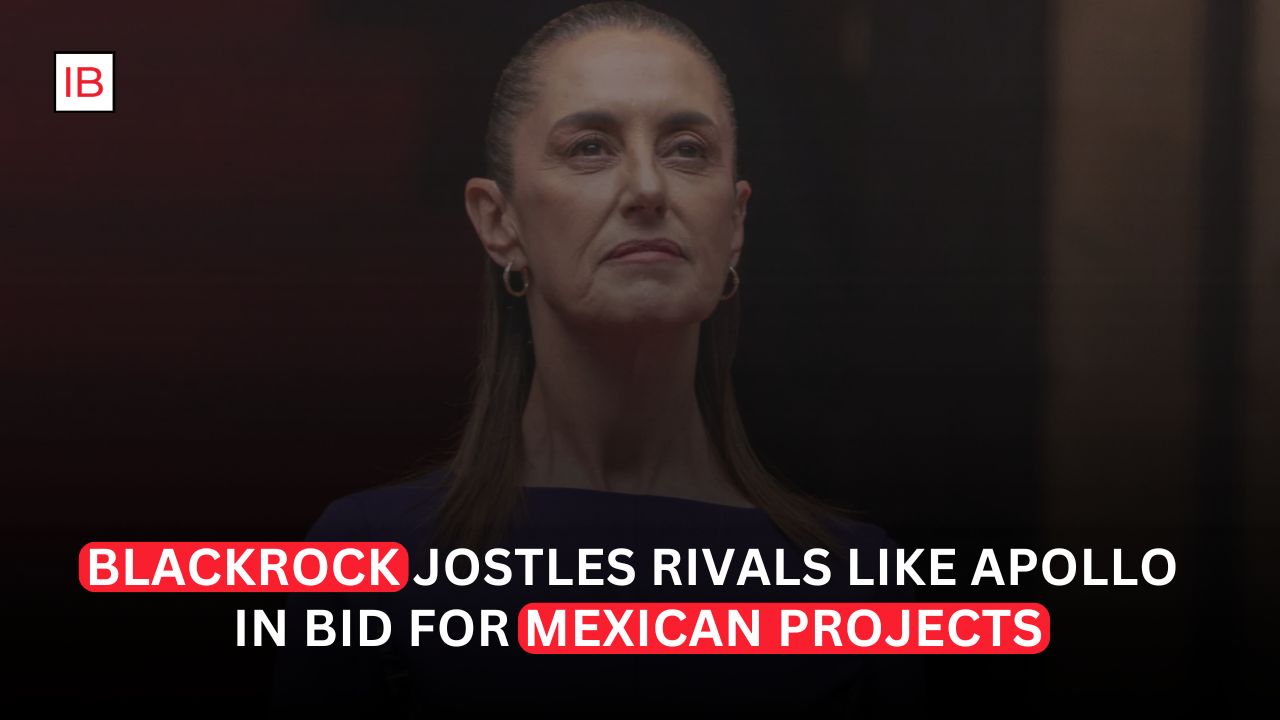
BlackRock is stepping up its pursuit of infrastructure financing opportunities in Mexico, competing directly with rival asset managers including Apollo Global Management as President Claudia Sheinbaum’s government courts private capital to fund an ambitious national infrastructure buildout.
Mexico Actively Courting Wall Street
Top officials from Sheinbaum’s administration have held meetings in recent weeks with major asset managers including BlackRock, KKR & Co., and Macquarie Asset Management, as the government looks to jump-start private investment in infrastructure development across the country. The outreach reflects Mexico’s broader strategy of leaning on private capital to help finance a wave of transportation, energy, and industrial projects laid out under its 2026-2030 Plan México framework, which explicitly opens the door to mixed public-private funding structures rather than relying solely on government spending.
Apollo Sets an Early, Aggressive Marker
Apollo has moved particularly aggressively in staking out its position in the market, unveiling plans to deploy as much as $20 billion in private credit financing for Mexican projects. The firm’s ambitions extend beyond infrastructure alone, with Apollo also expressing interest in providing long-term debt financing to Mexican companies ranging from large corporations to small and medium-sized enterprises that have traditionally struggled to access this kind of capital. Projects tied to power plants, renewable energy generation, and electrical grid modernization have reportedly begun gaining momentum as Apollo works to build out its pipeline in the country, even as the exact scope of individual deals remains in early stages of development.
Apollo’s Mexico push aligns with the firm’s broader, long-term thesis that as much as $100 trillion may be needed globally over the coming decades to finance digital infrastructure and meet rising energy demand, an ambition so large that Apollo has indicated it may need to collaborate with major Wall Street banks to finance a meaningful share of that opportunity.
BlackRock’s Competing Push
BlackRock’s interest in Mexican infrastructure is not a new development, with the asset manager having previously partnered with Mexican construction firm Prodemex on portions of the Maya Train rail project connecting Cancun and Tulum. That history gives BlackRock an established foothold in Mexican infrastructure financing as it now competes for a larger slice of the country’s renewed investment push. The firm’s broader private credit ambitions have also been accelerating globally, following its acquisition of direct lending specialist HPS Investment Partners, which combined with its existing infrastructure business to create a platform managing roughly $220 billion in assets, positioning BlackRock to compete more aggressively against established private credit players like Apollo, Blackstone, and Blue Owl across multiple markets simultaneously.
Why Mexico Has Become a Priority Market
Mexico’s appeal to global asset managers stems from a combination of factors, including its proximity to the United States, ongoing nearshoring trends that have drawn manufacturing investment away from other regions, and a government actively signaling openness to private capital participation in infrastructure that has traditionally been publicly financed. The Sheinbaum administration’s willingness to court multiple competing asset managers simultaneously, rather than settling on a single financing partner, appears designed to maximize both the scale of available capital and the competitive terms Mexico can secure as it works to fund large-scale transportation and energy projects.
A Broader Private Credit Land Grab
The jostling between BlackRock and Apollo in Mexico reflects a wider pattern playing out across the private credit industry, where major managers are increasingly competing head-to-head for opportunities in fast-growing emerging markets rather than confining their rivalry to more mature financing markets in the U.S. and Europe. That competition has intensified even as parts of the broader private credit industry have faced turbulence this year, including redemption pressures tied to concerns over loan quality at several major managers, suggesting that firms view international infrastructure financing as an attractive growth avenue somewhat insulated from those domestic pressures.
What Comes Next
With Mexico’s government continuing to hold discussions with multiple global asset managers and Apollo already having staked out a headline $20 billion commitment, the coming months will likely reveal how directly BlackRock and other competing firms respond with their own formal financing pledges. How quickly these asset managers can translate preliminary discussions into concrete, deployed capital will ultimately determine whether Mexico’s ambitious infrastructure plans receive the private-sector backing the government is hoping to secure.