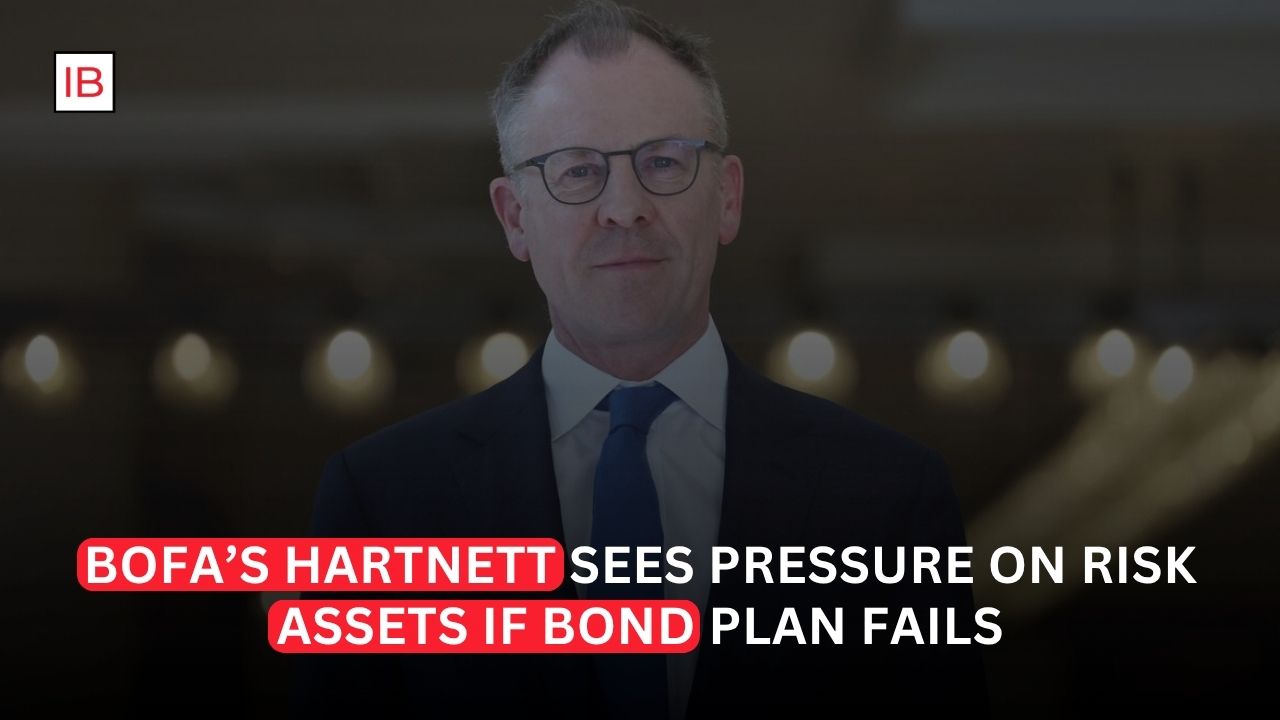
Global investors may be underestimating the importance of the bond market, according to Bank of America strategist Michael Hartnett. His latest warning is centered on a simple but potentially painful scenario: if efforts to stabilize government bond markets fail, the pressure could quickly spread into stocks, credit and other risk assets.
Hartnett has spent much of 2026 warning that investors are becoming too comfortable with elevated valuations while government debt, inflation and long-term bond yields remain significant sources of risk. His broader message has been that markets can continue rising for a while, but the foundation becomes increasingly fragile when investors remain heavily exposed to risk assets while avoiding the underlying problems in fixed income.
The latest concern is particularly important because the bond market has become one of the central fault lines in the global investment landscape.
Why the Bond Market Matters So Much
Government bonds are often treated as one of the safest parts of financial markets.
But that does not mean they are immune to major losses.
When bond yields rise sharply, bond prices fall. Higher yields also increase borrowing costs across the economy, affecting mortgages, corporate loans, government financing and valuations for stocks.
That creates a chain reaction.
Rising bond yields can lead to:
- Higher government borrowing costs
- More expensive corporate financing
- Lower stock-market valuations
- Wider credit spreads
- Pressure on highly leveraged companies
- Weaker consumer borrowing
- Greater volatility across financial markets
This is why Hartnett’s warning extends beyond bonds themselves.
The problem is not simply that bond investors could lose money.
The bigger concern is that a disorderly bond market could force investors to reduce exposure to riskier assets at the same time.
The US Debt Problem Is Becoming Harder to Ignore
One of Hartnett’s central concerns is the trajectory of US government debt.
The US national debt is approaching $40 trillion, while debt-service costs have become an increasingly important part of federal spending. Recent commentary citing Hartnett’s research says he expects the debt burden to continue rising significantly over the coming years.
The problem for bond investors is straightforward.
The US government must continually issue debt to finance deficits and refinance maturing securities.
If investors demand higher yields to absorb that supply, financing costs rise.
Higher financing costs can then contribute to larger deficits, creating a difficult feedback loop.
This is why long-term Treasury yields have become such an important market indicator.
Long-Term Yields Are the Key Pressure Point
Short-term interest rates are heavily influenced by central-bank policy.
Long-term yields are different.
They reflect expectations about inflation, economic growth, government borrowing and the supply and demand for bonds.
That makes the 10-year and 30-year Treasury markets particularly important.
If long-term yields remain elevated despite expectations for easier monetary policy, investors may be signaling that they are increasingly concerned about fiscal sustainability or future inflation.
Hartnett has repeatedly focused on this tension.
His broader argument is that investors should not assume central-bank rate cuts automatically translate into lower long-term borrowing costs.
Why Stocks Could Be Vulnerable
The relationship between bond yields and equities is especially important for expensive markets.
When Treasury yields rise, investors can demand a higher return from stocks.
That can put pressure on valuations.
This is particularly relevant for growth stocks whose valuations depend heavily on expectations of profits many years into the future.
If the discount rate rises, the present value of those future earnings falls.
The impact can be strongest on:
- Technology stocks
- High-growth companies
- AI-related equities
- Speculative assets
- Highly leveraged businesses
- Companies with weak current earnings
This does not necessarily mean stocks must crash whenever bond yields rise.
But it reduces the margin for error.
The AI Boom Adds Another Layer of Risk
Artificial intelligence has become one of the biggest drivers of global investment.
Companies are spending enormous amounts on data centers, computing equipment and related infrastructure.
That spending requires financing.
Much of it is supported by debt and corporate borrowing.
Recent market analysis has highlighted a dramatic increase in AI-related debt issuance, with financing associated with data centers and AI infrastructure reaching unusually high levels.
That creates a potential vulnerability.
If borrowing costs remain high, the economics of AI infrastructure projects become more difficult.
Companies may still believe the long-term opportunity is enormous, but investors could become less willing to finance projects at increasingly expensive rates.
The “Anything But Bonds” Trade
Hartnett has developed a broader investment argument around what he describes as an environment in which investors prefer almost anything to traditional government bonds.
That has supported demand for equities, gold and other assets.
His recent thinking has also emphasized gold as a hedge against concerns surrounding government debt, currency weakness and bond-market stress.
The problem is that crowded trades can become dangerous.
When too many investors hold similar positions, a change in market conditions can produce a rapid reversal.
If bond yields suddenly stabilize or fall, investors who have avoided bonds may rush back in.
If yields continue rising, meanwhile, investors may be forced to reduce risk elsewhere.
Either way, the bond market can become the catalyst for a major portfolio adjustment.
What Happens If the Bond Plan Fails?
The exact meaning of the bond “plan” is crucial.
Markets increasingly expect policymakers to respond if government borrowing costs become disruptive.
That response could involve changes to fiscal policy, monetary policy or measures designed to improve demand for government debt.
But if those efforts fail to convince investors, the consequences could spread.
A failed stabilization effort would tell markets that policymakers have less control over long-term borrowing costs than investors previously assumed.
That could trigger another rise in yields.
And once yields rise sufficiently, the effects could move rapidly into equities and credit markets.
Credit Markets Could Be the Transmission Mechanism
Stocks receive most of the attention during market selloffs.
But credit markets may provide the earliest warning.
Corporate borrowing costs tend to rise when government yields rise.
If investors become nervous about corporate balance sheets, credit spreads can widen.
That makes refinancing more expensive.
Companies with large debt loads may then cut investment, reduce hiring or sell assets.
This can weaken economic activity.
Hartnett has previously highlighted widening credit spreads as a potential warning that the market’s apparent stability is becoming less reliable.
The Fed Cannot Solve Every Problem
One of the biggest assumptions in financial markets is that central banks can intervene whenever asset prices fall sharply.
But monetary policy has limits.
If inflation remains elevated, cutting rates aggressively could reignite price pressures.
If long-term bond yields are rising because investors are concerned about government debt, lower short-term rates may not solve the problem.
That creates a difficult situation for policymakers.
The central bank may be able to influence short-term rates.
It cannot completely control the price at which investors are willing to lend to the government for 10 or 30 years.
Inflation Remains a Major Risk
Inflation is particularly important because it directly affects bond investors.
A government bond promises fixed payments.
If inflation rises unexpectedly, the real value of those payments falls.
Investors therefore demand higher yields to compensate.
That can create another negative cycle.
Higher inflation leads to higher yields.
Higher yields reduce bond prices.
Higher borrowing costs put pressure on businesses and households.
And if investors begin demanding even more compensation for inflation risk, yields can rise further.
This is one reason the market remains sensitive to energy prices and geopolitical developments.
Risk Assets Are Still Supported by Economic Resilience
There is an important counterargument to Hartnett’s warning.
The global economy has not collapsed.
Corporate earnings remain resilient in many sectors.
AI investment continues.
Consumers in several major economies remain relatively strong.
And investors still have reasons to own equities.
That means a bond-market problem does not automatically imply an equity crash.
The key question is whether economic growth remains strong enough to offset the valuation damage caused by higher yields.
If profits rise rapidly, stocks can sometimes tolerate higher interest rates.
If growth weakens at the same time yields rise, the situation becomes much more dangerous.
The Most Dangerous Combination
The worst outcome for risk assets would be a combination of:
Higher inflation + higher bond yields + weaker economic growth.
That environment would leave policymakers with very few attractive choices.
Cutting rates could worsen inflation.
Keeping rates high could weaken growth.
Fiscal stimulus could increase borrowing requirements.
Higher government borrowing could push bond yields even higher.
That is the kind of environment in which correlations between asset classes can become unstable.
Investors May Need to Think Beyond the 60/40 Portfolio
Traditional portfolios often rely on diversification between stocks and bonds.
But that relationship becomes less reliable when inflation and fiscal concerns affect both asset classes simultaneously.
If stocks fall because yields rise, bonds may not necessarily provide protection.
That is why investors are increasingly considering alternatives such as gold, commodities, international equities and other real assets.
Hartnett has repeatedly favored gold and international assets as part of his broader strategy for dealing with the changing macroeconomic environment.
The goal is not necessarily to abandon stocks and bonds.
It is to recognize that both can be exposed to the same macroeconomic shock.
What Investors Should Watch Now
The most important signals are not necessarily daily movements in the S&P 500.
Investors should pay close attention to the bond market.
Key indicators include:
- 10-year Treasury yield
- 30-year Treasury yield
- Treasury auction demand
- Corporate credit spreads
- Inflation expectations
- Oil prices
- US dollar strength
- Federal Reserve policy
- Government borrowing requirements
A sustained rise in long-term yields combined with widening credit spreads would be particularly concerning.
It would suggest that the problem is moving beyond government bonds and into the broader financial system.
A Bond Market Shock Would Not Necessarily Mean a Recession
Another important distinction is between financial-market stress and economic recession.
A bond selloff could initially produce volatility without immediately damaging the real economy.
Banks and corporations may have strong enough balance sheets to absorb higher financing costs.
But prolonged stress would eventually become more problematic.
Companies would face refinancing challenges.
Consumers would pay more to borrow.
Government interest costs would rise.
Investment could slow.
That is when a financial-market problem could become an economic problem.
Conclusion
Michael Hartnett’s warning highlights a risk that investors can easily overlook during a strong equity market: the bond market may ultimately determine how sustainable the current appetite for risk really is.
Stocks can continue rising while investors remain comfortable with economic growth and corporate earnings.
But if long-term bond yields rise sharply and policymakers fail to convince markets that the debt problem is manageable, the consequences could spread rapidly.
Higher yields can pressure equity valuations, increase corporate borrowing costs and weaken credit markets.
The danger becomes greater if inflation remains persistent, because central banks would have less freedom to respond aggressively.
At the same time, the AI investment boom adds another layer of sensitivity because enormous amounts of capital are being committed to data centers and related infrastructure.
Hartnett’s warning should therefore not be interpreted as a prediction that markets are guaranteed to crash.
The more useful interpretation is that the margin for error is becoming smaller.
If bond yields stabilize, inflation cools and corporate earnings remain strong, risk assets may continue performing well.
If the bond market loses confidence in policymakers’ ability to manage government borrowing and inflation, however, the adjustment could spread well beyond Treasuries.
For investors, the lesson is straightforward: stocks may dominate the headlines, but bonds remain one of the most important signals of whether the financial system is becoming more stable or more fragile.