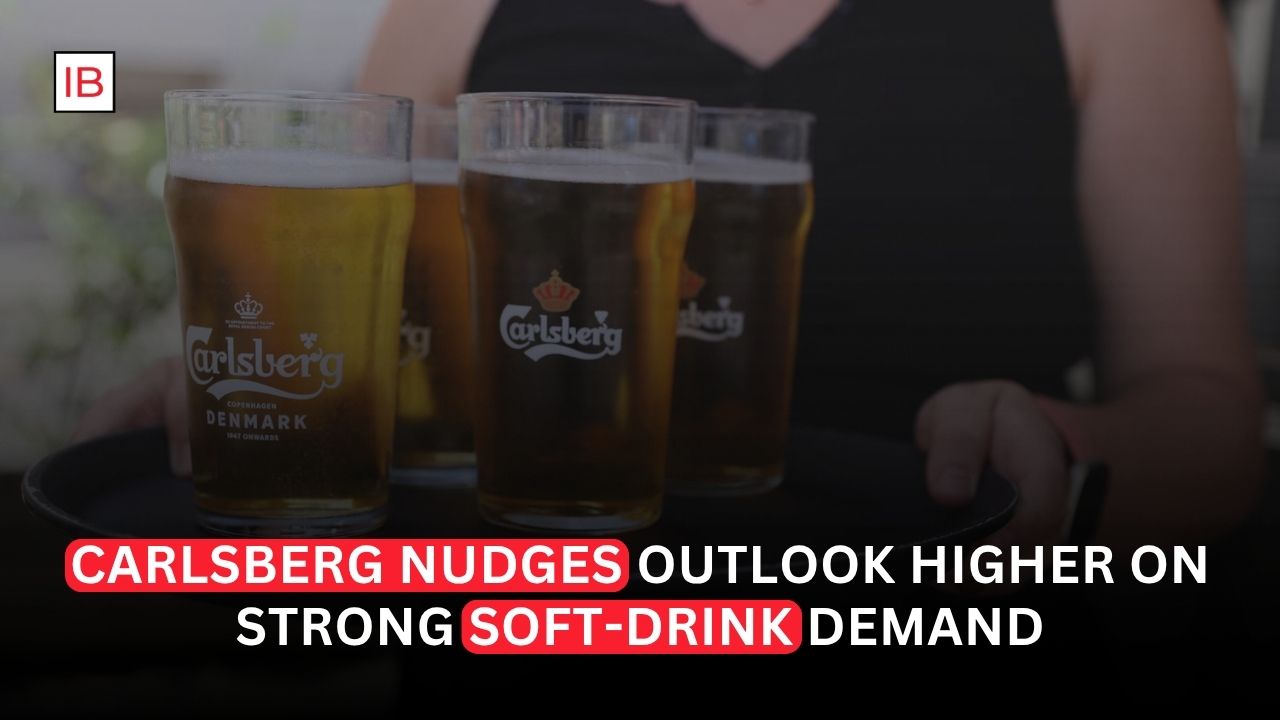
Carlsberg is becoming increasingly confident about its prospects for 2026 as strong demand for soft drinks and premium beverages helps the Danish brewer navigate a difficult environment for traditional beer sales.
The company has slightly raised its outlook for the year, signaling that the diversification strategy built around its acquisition of Britvic is beginning to provide meaningful support. While beer remains the foundation of the business, soft drinks are becoming an increasingly important contributor to growth as consumers change their drinking habits and seek alternatives to alcohol.
Carlsberg’s first-half performance builds on a strong start to the year. In the first quarter, the company reported organic revenue growth of 3.6%, while total volumes increased 2.8% organically. Soft drinks were one of the strongest parts of the portfolio, recording organic growth of 10%. The improvement was broad-based across markets including the UK, Nordic countries, Switzerland and Kazakhstan.
The strength of the soft-drinks business is particularly important because beer demand remains uneven across many developed markets. Consumers are facing higher living costs and continuing economic uncertainty, while health-conscious customers are increasingly moderating their alcohol consumption.
That shift has created an opportunity for Carlsberg. The company has been deliberately expanding beyond beer, using the acquisition of Britvic to build a broader beverage portfolio. The deal added brands and distribution capabilities across soft drinks and gave Carlsberg a much larger presence in categories that are growing faster than traditional mainstream beer.
Soft drinks now represent roughly 30% of Carlsberg’s portfolio, making the company increasingly different from a conventional brewer. Management has argued that combining beer and soft drinks gives the group more opportunities to grow while reducing its dependence on alcohol consumption.
The strategy is particularly useful in markets where consumers are cutting back on beer. A customer who decides not to buy an alcoholic drink may still purchase a soft drink, energy beverage or other non-alcoholic product distributed by the same company.
Carlsberg is also benefiting from growth in alcohol-free and low-alcohol beverages. Its alcohol-free brewing portfolio grew strongly during the first quarter, with organic volume growth of 7%. Western Europe was particularly strong, showing that changing consumer preferences are not limited to soft drinks alone.
The broader trend is important for the global beverage industry. Younger consumers in particular are showing greater interest in moderation, wellness and lower-alcohol options. At the same time, traditional beer remains vulnerable to changing social habits and pressure on household budgets.
Carlsberg’s response has been to build a portfolio capable of benefiting from both trends.
The company’s premium beer brands are another source of resilience. Carlsberg, Tuborg and 1664 Blanc have continued to perform well in several markets, while premium beer volumes increased during the first quarter. The Carlsberg brand itself recorded strong growth, helped by markets including China and India.
That gives the company multiple growth drivers rather than relying on a single category.
However, the improved outlook does not mean Carlsberg has eliminated its challenges. Beer volumes remain weak in some markets, and geopolitical tensions are creating uncertainty around commodity prices, transportation and supply chains.
The company has previously warned that the economic consequences of Middle East tensions could continue affecting costs through the year. Packaging materials, energy and agricultural commodities are all sensitive to global disruptions, while higher consumer prices can make customers more cautious about discretionary purchases.
Carlsberg is also dealing with currency fluctuations. Its international footprint means exchange-rate movements can have a significant effect on reported revenue and operating profit even when underlying business performance remains solid.
The acquisition of Britvic provides another layer of complexity. Integrating a major soft-drinks business requires investment, changes to distribution networks and coordination across multiple markets. But the company has said the combination is already generating benefits, strengthening the case for its decision to diversify.
Carlsberg is also expanding its partnership with PepsiCo. The company announced that it will become PepsiCo’s bottler in Denmark, Finland and the three Baltic states from January 2029, extending a relationship that already covers several European and Central Asian markets.
That agreement could significantly strengthen Carlsberg’s soft-drinks distribution platform over time. Instead of relying only on its own beverage brands, the company can use its distribution infrastructure to sell a much broader portfolio.
This is one of the clearest strategic changes taking place inside Carlsberg. The company is gradually transforming itself from a brewer into a broader beverage distributor and manufacturer.
That transformation could become increasingly valuable if alcohol consumption remains under pressure. Carlsberg can use its existing relationships with retailers, restaurants and distributors to introduce new products without having to build an entirely new commercial network.
For investors, the improved outlook therefore needs to be viewed in the context of this structural shift. The company is not simply expecting stronger beer sales. A significant part of its growth is coming from categories that are less exposed to traditional beer consumption.
The first-quarter figures already showed the effect. Soft drinks grew much faster than beer, while premium and alcohol-free categories also performed well. The result was enough for Carlsberg to maintain its 2026 operating-profit growth guidance of 2% to 6% at that stage.
The latest improvement in the outlook suggests management now sees additional confidence in the second half of the year.
Still, investors should not overlook the risks. Soft-drink markets are highly competitive, with global beverage companies fighting aggressively for shelf space and consumer attention. Higher input costs can also squeeze margins if companies cannot fully pass those costs to customers.
Carlsberg must therefore balance volume growth against pricing. Raising prices too aggressively could undermine demand, while keeping prices too low could weaken profitability.
The company’s future performance will also depend on how successfully it integrates Britvic and captures the expected synergies. The acquisition has substantially changed Carlsberg’s business mix, meaning execution will be just as important as consumer demand.
For now, the evidence suggests diversification is helping. Strong soft-drink demand is providing a buffer against weaker beer consumption, while premium beer and alcohol-free products are creating additional sources of growth.
That does not make Carlsberg immune to economic or consumer pressures. But it does give the company more ways to grow than it had when beer dominated the portfolio.
The biggest strategic question is whether Carlsberg can turn that broader portfolio into consistently stronger profitability. If it can, the Britvic acquisition and expanding PepsiCo partnership could fundamentally change the company’s growth profile.
Carlsberg’s latest outlook therefore reflects more than a temporary improvement in beverage demand. It points to a company increasingly relying on diversification to navigate a changing consumer market, with soft drinks becoming a central part of its future rather than simply a secondary business.